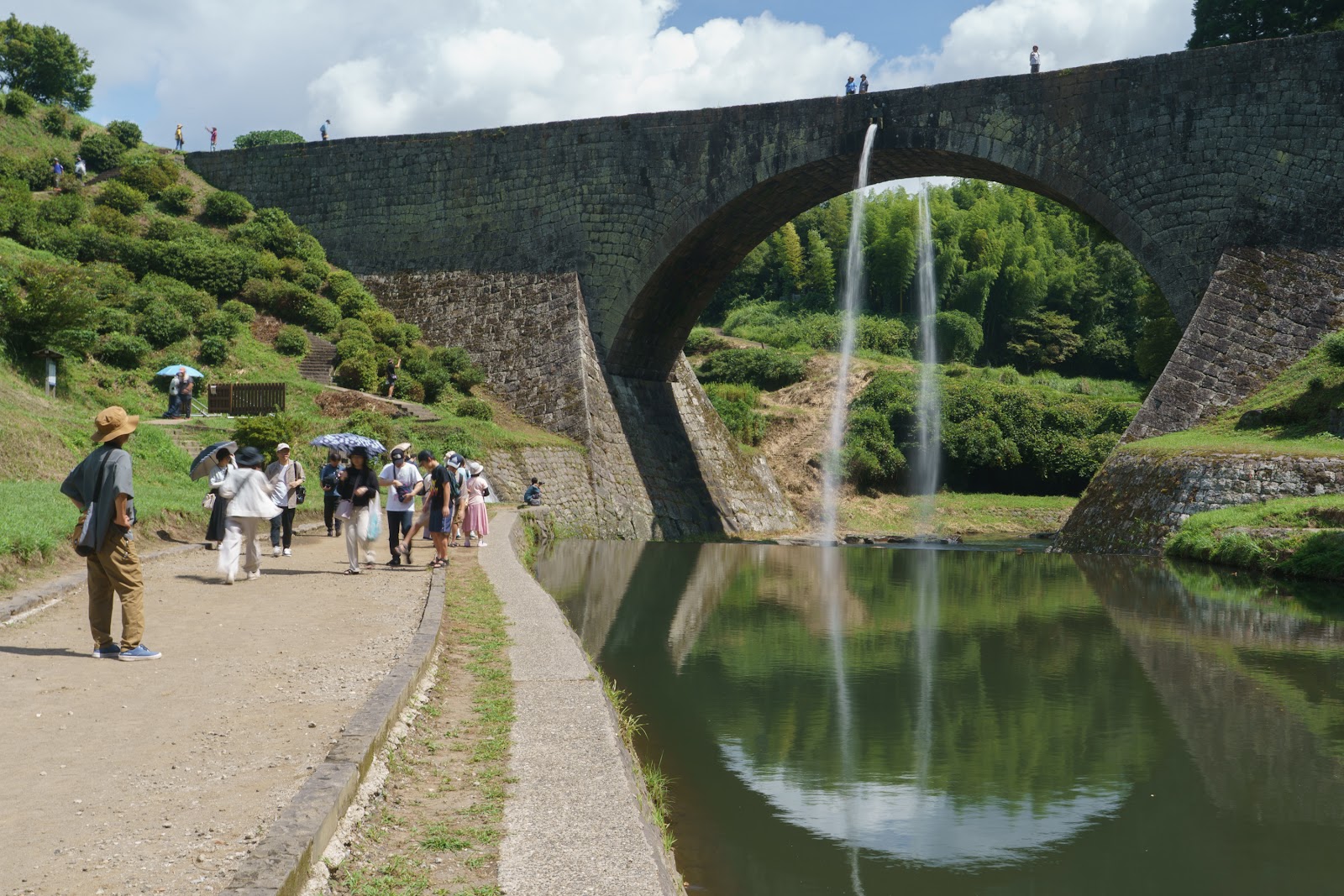
A majestic 1854 stone aqueduct bridge that still irrigates the plateau, famous for its dramatic water discharges.
Tsujun Bridge, or Tsujunkyo, is a masterpiece of Edo-period civil engineering and one of the most impressive stone structures in Kyushu. Completed in 1854 in the town of Yamato, southeast of Kumamoto, it is a large single-arch stone aqueduct built to solve a pressing problem: the fertile Shiraito plateau above the Midori river was chronically short of water, its fields stranded above the surrounding valleys with no way to irrigate them. Under the leadership of a determined local headman, the community constructed this graceful bridge to carry water across the gorge and onto the parched tableland, transforming local agriculture.
The bridge is a beautiful object in its own right, a broad, elegant stone arch spanning the green valley, some seventy-five metres long and rising more than twenty metres above the river. But its genius lies inside: three stone conduits run across the top, using an inverted-siphon principle to carry water up and over the span under pressure, a sophisticated hydraulic solution for its time. More than a century and a half later, the aqueduct still functions, delivering water to the rice fields it was built to serve, a living monument rather than a museum piece, and it has been designated a National Treasure in recognition of its historic and engineering value.
The unmissable spectacle is the 'housui', or scheduled water discharge. On set days, to clear silt from the conduits, the outlets in the middle of the bridge are opened and two great arcing jets of water blast dramatically from the sides of the aqueduct into the gorge below, throwing up spray and rainbows. The sight of these powerful twin fountains against the old stonework is genuinely thrilling and draws crowds, so it is well worth checking the discharge schedule and timing a visit to coincide with it. On other days the bridge is quietly beautiful, best appreciated from the valley path that lets you view the full arch, or from the plateau above.
The surrounding landscape of terraced fields, forest and the Midori river valley is pleasant and rural, with autumn colour among the highlights. A roadside station beside the site offers parking, restrooms, local produce and information, making it an easy stop.
Tsujun Bridge lies in Yamato town, reached by car in about an hour and a quarter from central Kumamoto; public transport is limited, so driving is recommended. The bridge and surrounding area are freely accessible at all times, though the water discharges occur only on scheduled days, so plan accordingly. Allow around 40 minutes to view the bridge from above and below, longer if you come for the discharge. As a testament to community determination and Edo-era ingenuity, and as a rare working antique aqueduct, Tsujunkyo is a memorable and distinctive Kumamoto sight.
A local's tip
Time your visit for one of the scheduled 'housui' water discharges — great arcs of water blast from the aqueduct's central pipes to clear sediment, a spectacular and unique sight.
Best time to visit
Check the scheduled water-discharge days for the dramatic twin jets
Getting there
In Yamato town, southeast of Kumamoto toward the mountains; reached by car in about an hour and a quarter, with a car park and roadside station (michi-no-eki) beside the bridge.
Good to know
- Parking
- Restrooms
- Roadside station
Plan the whole trip offline
Tsujun Bridge (Tsujunkyo) is one of many places in the Real Japan app — with turn-by-turn directions, nearby spots and full offline maps you can use with no signal.