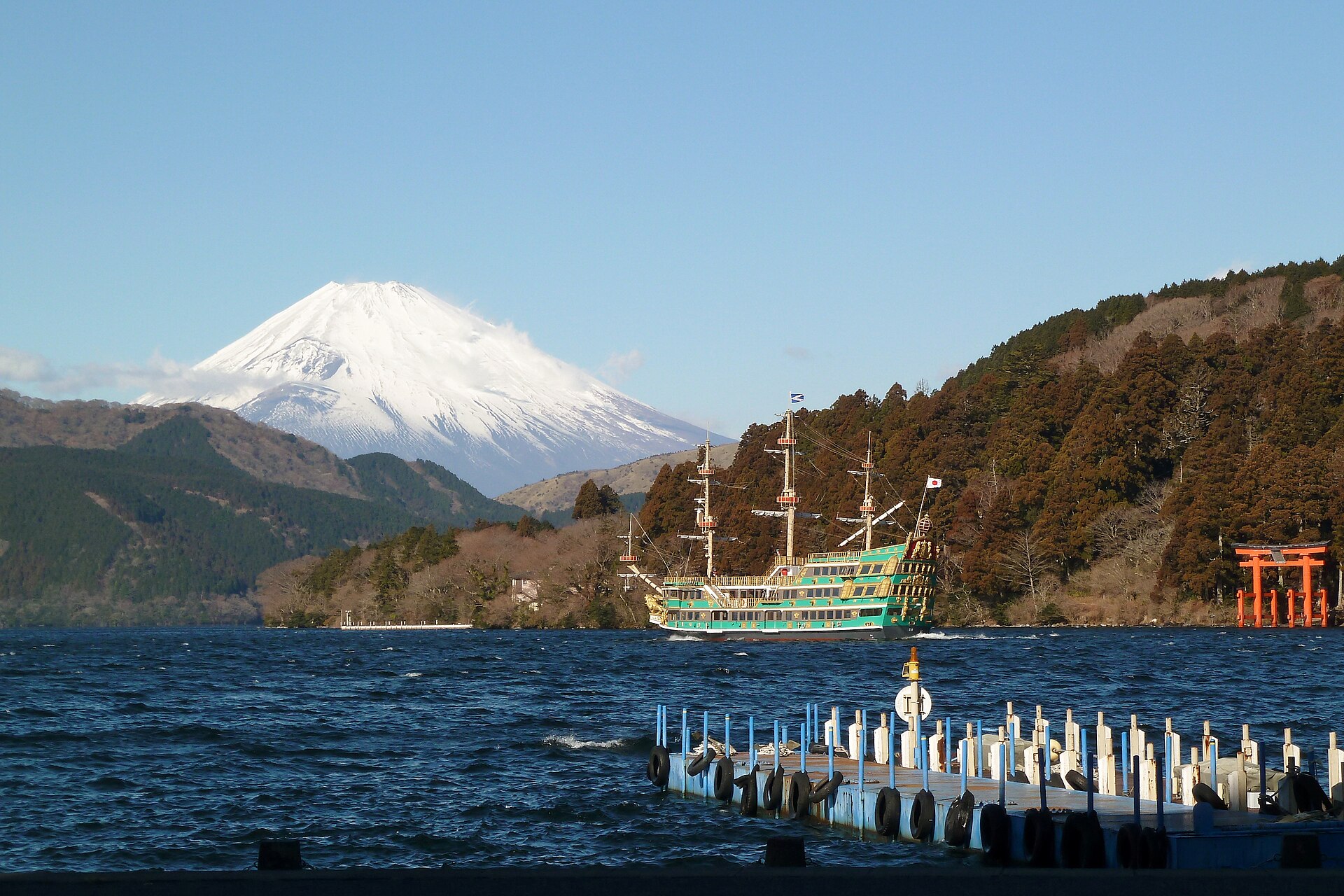
Where Japan Turns the Drama Up to Maximum
An hour from the neon sprawl of Shinjuku, the landscape transforms so completely it feels almost theatrical. Forested ridgelines rise sharply on every side, sulphurous steam drifts across a moonscape of grey rock, and on a clear morning the unmistakable white cone of Mount Fuji floats above Lake Ashi like something painted on silk. This is Hakone, and it has been drawing travellers — first Edo-period lords, then Meiji-era intellectuals, now visitors from every corner of the world — for centuries. What makes it special is not any single attraction but the sheer density of extraordinary experiences packed into one compact mountain circuit. You can soak in a volcanic hot spring at dawn, ride a ropeway over a steaming caldera by mid-morning, cruise a feudal-era lake before lunch, and spend the afternoon wandering one of Asia's finest outdoor sculpture parks. Few destinations in Japan reward a two-day visit quite so generously.
A Landscape Shaped by Fire and History
Hakone sits inside the collapsed caldera of an ancient volcano, and the geology here is very much alive. The Owakudani valley — whose name translates delightfully as Great Boiling Valley — is a constant reminder that you are standing on top of significant geothermal activity. Fumaroles hiss, the ground is stained vivid yellow with sulphur deposits, and vendors sell kuro-tamago, eggs hard-boiled in the mineral-rich hot springs until their shells turn black. Local legend insists each egg adds seven years to your life, which may explain the enthusiastic queues.
Historically, Hakone sat at a critical point on the Tokaido, the great road that linked Edo (modern Tokyo) with Kyoto. The Hakone Checkpoint, established in 1619 by the Tokugawa shogunate, was one of the most strictly controlled barrier stations in the country, used to regulate the movement of people — particularly the wives and weapons of potentially rebellious regional lords. The reconstructed checkpoint on the shores of Lake Ashi is a surprisingly absorbing stop, with mannequins depicting inspections and well-translated displays explaining how the system shaped Edo-period society.
By the Meiji era, wealthy Japanese and foreign residents of Yokohama had discovered Hakone's healing waters, and grand resort hotels began appearing in the cedar forests. That tradition of sophisticated hospitality continues today in the town's exceptional ryokan culture, with establishments like Fujiya Hotel — opened in 1878 and still operating — bridging the gap between historic charm and modern comfort.
What to See and Do: Building Your Hakone Loop
The classic way to experience Hakone is the Hakone Loop, a circuit using five different forms of transport: the Hakone Tozan switchback railway, a cable car, the Hakone Ropeway, a sightseeing boat on Lake Ashi, and a highway bus back to Odawara or Shinjuku. The loop is not just a gimmick — each leg deposits you at a genuinely worthwhile destination.
- Hakone Open-Air Museum (Chokoku no Mori): Easily one of Japan's best museums of any kind, and arguably the most visitor-friendly. Twenty hectares of landscaped hillside hold around 120 outdoor sculptures by Rodin, Giacometti, Henry Moore, and Niki de Saint Phalle alongside works by Japanese masters. A dedicated Picasso Pavilion houses over 300 pieces. Children run between the sculptures; adults linger over views that frame the mountains behind the art. Allow two to three hours and do not skip the foot-bath midway through the grounds.
- Owakudani: The ropeway from Sounzan deposits you at Hakone's most dramatic volcanic landscape. On a clear day the views of Mount Fuji from here are genuinely breathtaking — the mountain appears to levitate above the steam. Note that the area occasionally closes when volcanic activity increases, so check current conditions before you go.
- Lake Ashi (Ashinoko): The boat crossing from Togendai to Hakone-machi or Moto-Hakone takes about thirty minutes and offers the classic postcard image of a red torii gate rising from the water with Fuji behind it. Near the southern shore, a short walk through a cryptomeria cedar avenue leads to a well-preserved section of the original Tokaido stone road — atmospheric even on a misty day.
- Onsen: Hakone has eleven distinct hot-spring areas, each fed by different geological sources and offering slightly different mineral profiles. Yumoto is the most accessible; Gora is quieter and more upmarket; Sengokuhara offers an almost rural feel. Even if you are not staying overnight, many ryokan offer higaeri (day-trip) bathing for a modest fee.
When you are navigating between these spots — catching the right ropeway connection or finding the foot of that cedar avenue — the Real Japan app (free on iOS and Android) earns its keep fast. Its offline maps work perfectly in the mountain areas where connectivity can be patchy, and the nearby-spot suggestions have a way of surfacing the small finds — a particular tofu restaurant in Moto-Hakone, a ceramics gallery tucked behind Gora station — that repay a slight detour.
Staying Overnight: Why You Should Not Rush Back to Tokyo
Day-trippers from Tokyo are common, but Hakone reveals a completely different personality after the tour buses leave. Booking even one night in a ryokan transforms the experience. Waking before dawn to bathe in an outdoor rotenburo when the air is cold and the steam rises into dark cedar branches is one of those travel memories that refuses to fade. A kaiseki dinner — eight to twelve courses of seasonal mountain vegetables, freshwater fish, and exquisitely prepared local ingredients — gives you a genuine sense of how refined Japanese hospitality can be.
Budget options exist too. Guesthouse-style accommodation in Hakone-Yumoto is perfectly comfortable, and several public bathhouses charge just a few hundred yen. The Hakone Free Pass (available from Odakyu stations) covers most transport on the loop plus discounts at many attractions, making an overnight stay very economical once you factor in how much ground you cover.
Best Time to Visit
Hakone is rewarding year-round, but each season brings a distinct character. Autumn (mid-October to late November) is arguably the peak, when the maple and beech forests ignite in scarlet and gold and the air is sharp enough to make outdoor rotenburo bathing feel genuinely restorative. Mount Fuji is also most frequently visible from autumn through early spring, when atmospheric clarity is highest.
Winter brings the clearest Fuji views and the peculiar pleasure of soaking in snow-dusted gardens. Spring delivers cherry blossoms along the Hayakawa river and fresh greenery on the slopes. Summer is the most crowded season but the hydrangeas along the Tozan railway line — best seen from the train in June and early July — are genuinely spectacular and less photographed than the cherry blossoms. Whenever you go, book ryokan well in advance for weekends and public holidays.
Getting There and Getting Around
From Shinjuku, the Odakyu Romance Car runs directly to Hakone-Yumoto in around 85 minutes (reserved seating, no changes required — a genuinely pleasant ride). Alternatively, take a JR Shinkansen or regular express to Odawara Station and transfer to the Hakone Tozan Line. The journey from central Tokyo costs roughly ¥1,000–¥2,500 depending on your pass and train choice.
Once inside Hakone, the loop transport system is well-integrated but timetables matter — the ropeway in particular has gaps between services that can add up if you miss a connection. Download the Real Japan app before you leave; its real-time opening hours and step-by-step directions between Hakone stops have saved many travellers from standing at a closed cable-car station wondering what went wrong. The app is free on both iOS and Android and works offline, which matters more than you might expect once you are up in the mountains.
Hakone is, in the end, one of those rare destinations that exceeds its own considerable reputation. The volcanic drama is real, the art is world-class, the onsen are as good as anything Japan offers, and the views of Fuji — when the mountain deigns to appear — stop conversation entirely. Give it at least one night. You will not regret it.