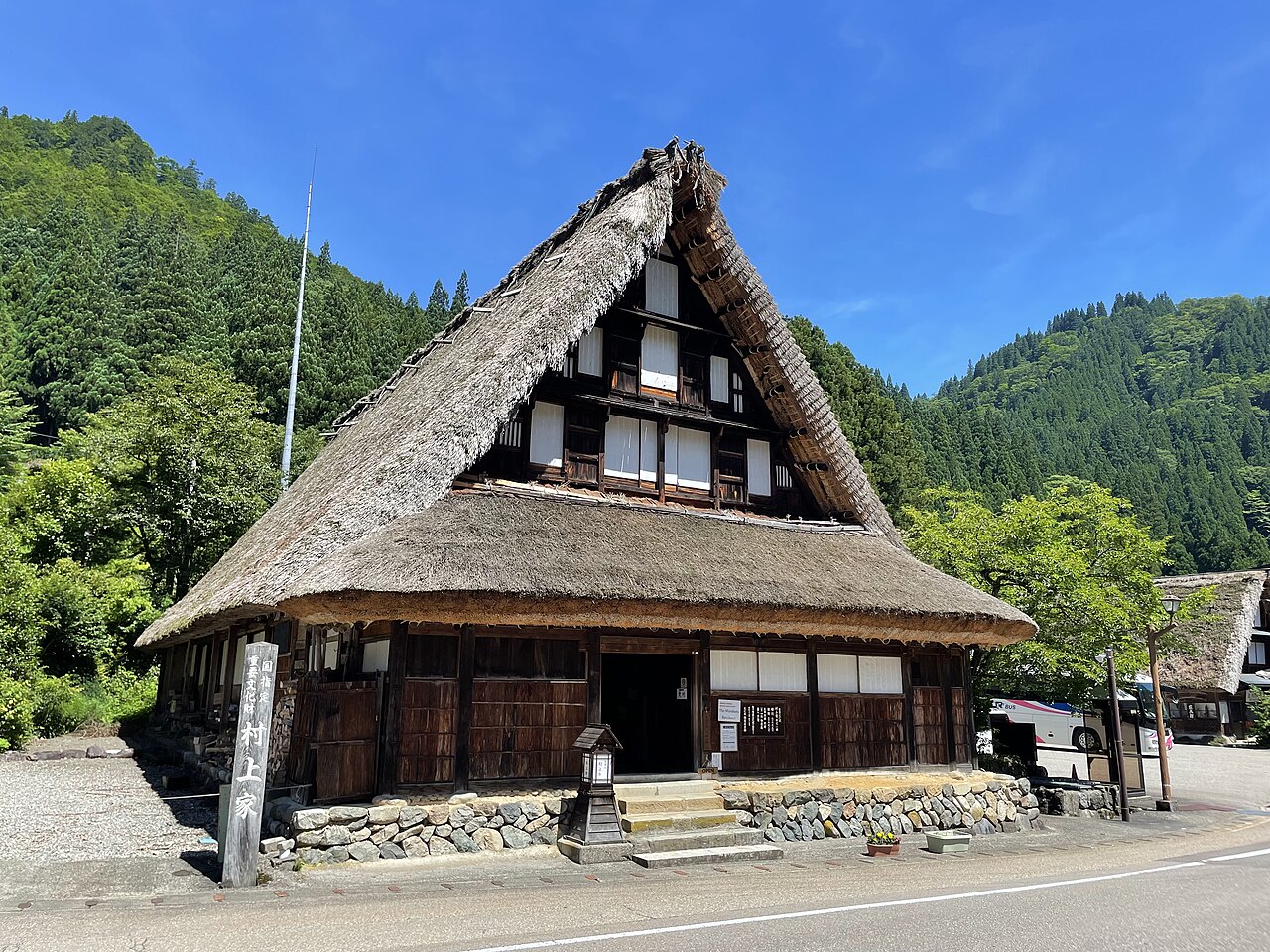
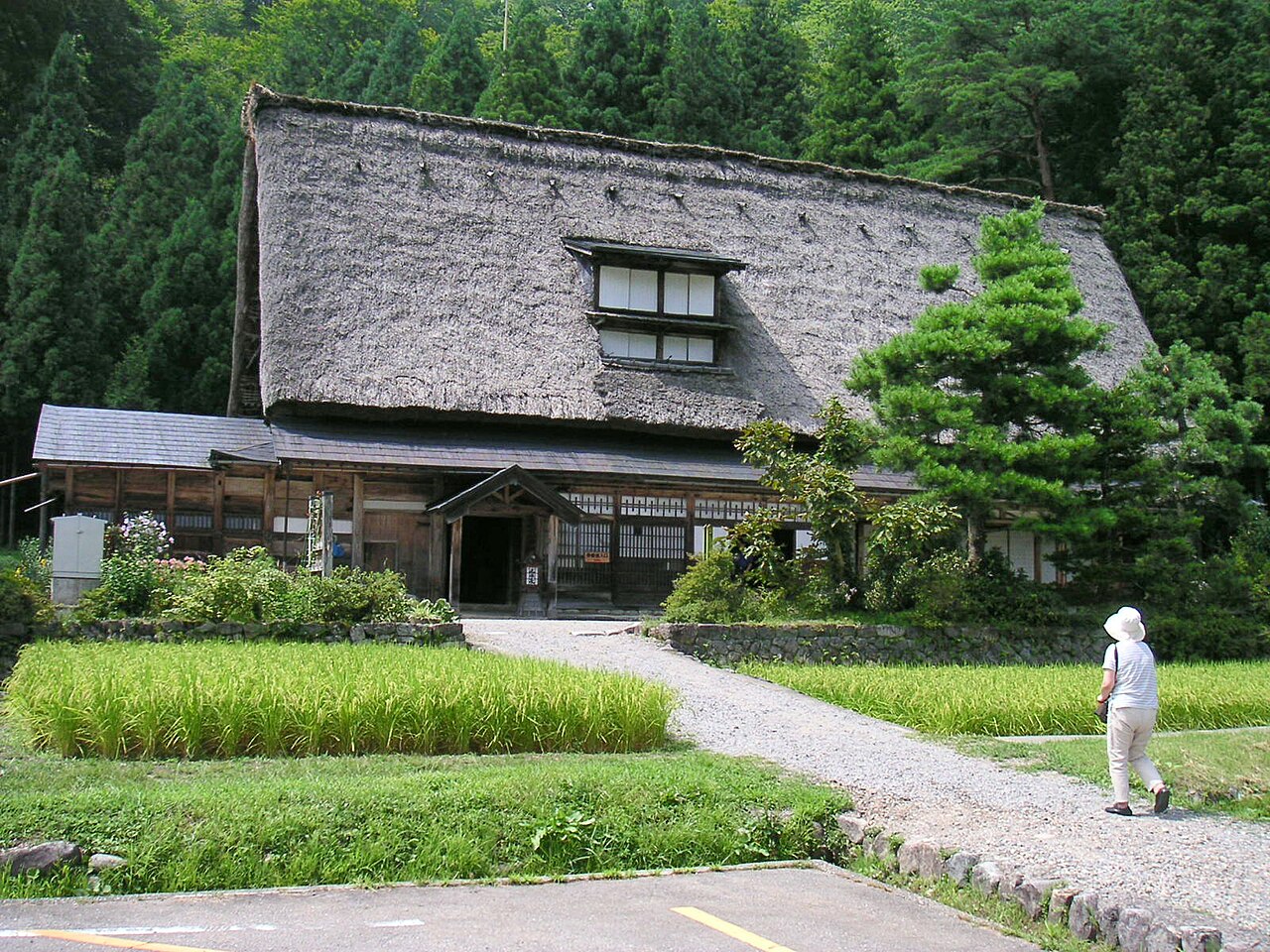
The smallest and most intimate of the UNESCO Gokayama hamlets, nine thatched houses on a bend of the Sho River.
Suganuma is the smallest of the three World Heritage villages in the Shirakawa-go and Gokayama group, and for many visitors the most affecting precisely because of its scale. Just nine gassho-zukuri farmhouses sit on a flat terrace inside a horseshoe bend of the emerald Sho River, hemmed in by steep forested slopes. Where Ainokura spreads across a hilltop and Shirakawa-go bustles with crowds, Suganuma feels like a single family's holding frozen in time.
The village shares the history of the wider Gokayama region: isolation, silkworm cultivation in the lofty roof spaces, and — unusually — the manufacture of gunpowder saltpetre, produced under the floors of these very houses for the Kaga domain during the Edo period. That trade, along with washi papermaking, gave the community the means to build and re-thatch its extraordinary roofs, some of which are re-laid communally in a tradition of mutual help called yui. Suganuma was inscribed on the UNESCO World Heritage List in 1995 for the same reasons as its neighbours: an exceptional, still-living example of a traditional settlement shaped by an unforgiving climate.
Two small museums, the Gokayama Folk Museum and the Saltpetre Museum, occupy former farmhouses and explain the ingenious below-floor saltpetre process and the rhythms of mountain life. Beyond a tunnel from the main car park lies Gokayama Gassho no Sato, a hands-on area where you can try papermaking and other crafts. The village itself is compact enough to walk in twenty minutes, but it repays lingering: the light off the river, the moss on the stone walls, the smell of the irori hearths.
Suganuma is at its most photogenic in deep winter, when snow smooths every roofline and, on select evenings, lanterns and floodlights turn the hamlet into a glowing tableau against the black mountains. Fresh early-summer green and flaming autumn maples are quieter but equally rewarding, and with far fewer visitors than Shirakawa-go you can experience the place unhurried.
Practical logistics are straightforward. A modern car park sits on the highway above, linked to the village by an elevator and a short pedestrian tunnel that spares you the steep grade; restrooms and a little shop are on hand. The World Heritage Bus from Shin-Takaoka Station stops right by Suganuma in about an hour, continuing on to Ainokura and Shirakawa-go, so the three can be strung together in a single day. If you have time for only one Gokayama village and want intimacy over spectacle, Suganuma is the one to choose — a tiny, tender survival of pre-modern Japan cradled by the river and the peaks.
A local's tip
Suganuma is tiny and quiet compared with Ainokura — come at the end of the day and you may have the riverside hamlet almost to yourself.
Best time to visit
Winter snow or fresh green early summer
Getting there
From Shin-Takaoka Station take the World Heritage Bus and alight at Suganuma (about 65 minutes). By car, it is about one minute from the Gokayama IC on the Tokai-Hokuriku Expressway to the riverside car park; a lift and tunnel connect the car park to the village below.
Good to know
- Shops
- Parking
- Restrooms
Plan the whole trip offline
Suganuma Gassho-zukuri Village is one of many places in the Real Japan app — with turn-by-turn directions, nearby spots and full offline maps you can use with no signal.