Japan's largest rock-carved Buddhas, two ancient reliefs reached by a legendary demon-built stone stairway.
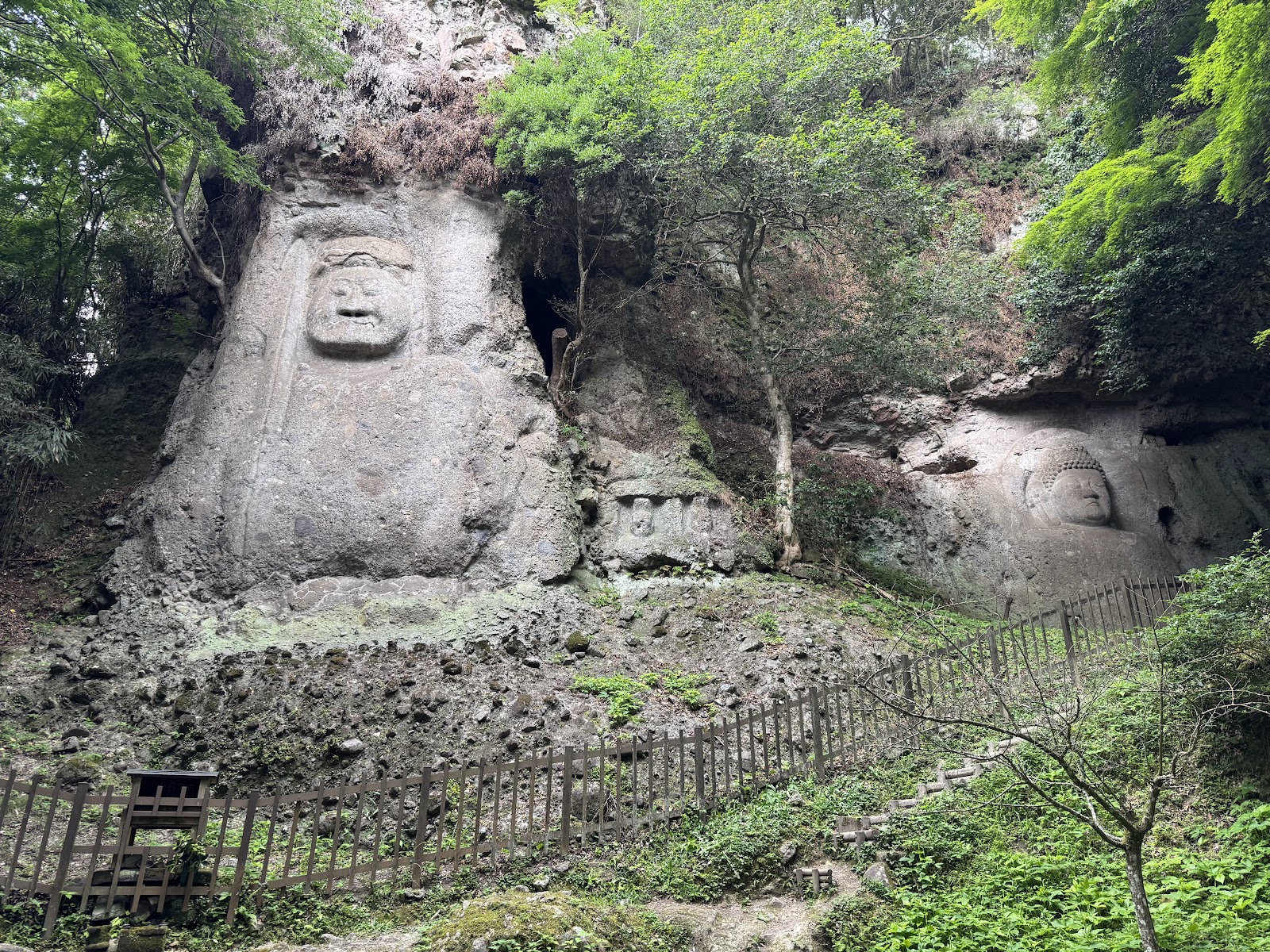
The Kumano Magaibutsu are among the largest and most impressive rock-carved Buddhist images in Japan, two colossal figures cut directly into a cliff face deep in the Kunisaki Peninsula. Ancient, monumental and reached by a famously rugged stairway, they are one of the definitive experiences of the peninsula's extraordinary Rokugo Manzan religious culture, within a drive of Beppu.
Magaibutsu are Buddhist images carved in relief onto natural rock, a form of devotional art particularly associated with the Kunisaki region, where the soft local stone and the fervent mountain Buddhism of Rokugo Manzan combined to produce numerous such carvings. The two figures at Kumano are the greatest of them. One depicts Dainichi Nyorai, the cosmic Buddha at the heart of esoteric Buddhism, and the other the fierce, sword-bearing wisdom king Fudo Myoo, his features weathered but still powerful after the centuries. Believed to date from the Heian period, roughly the 12th century, they are designated Important Cultural Properties and a National Historic Site.
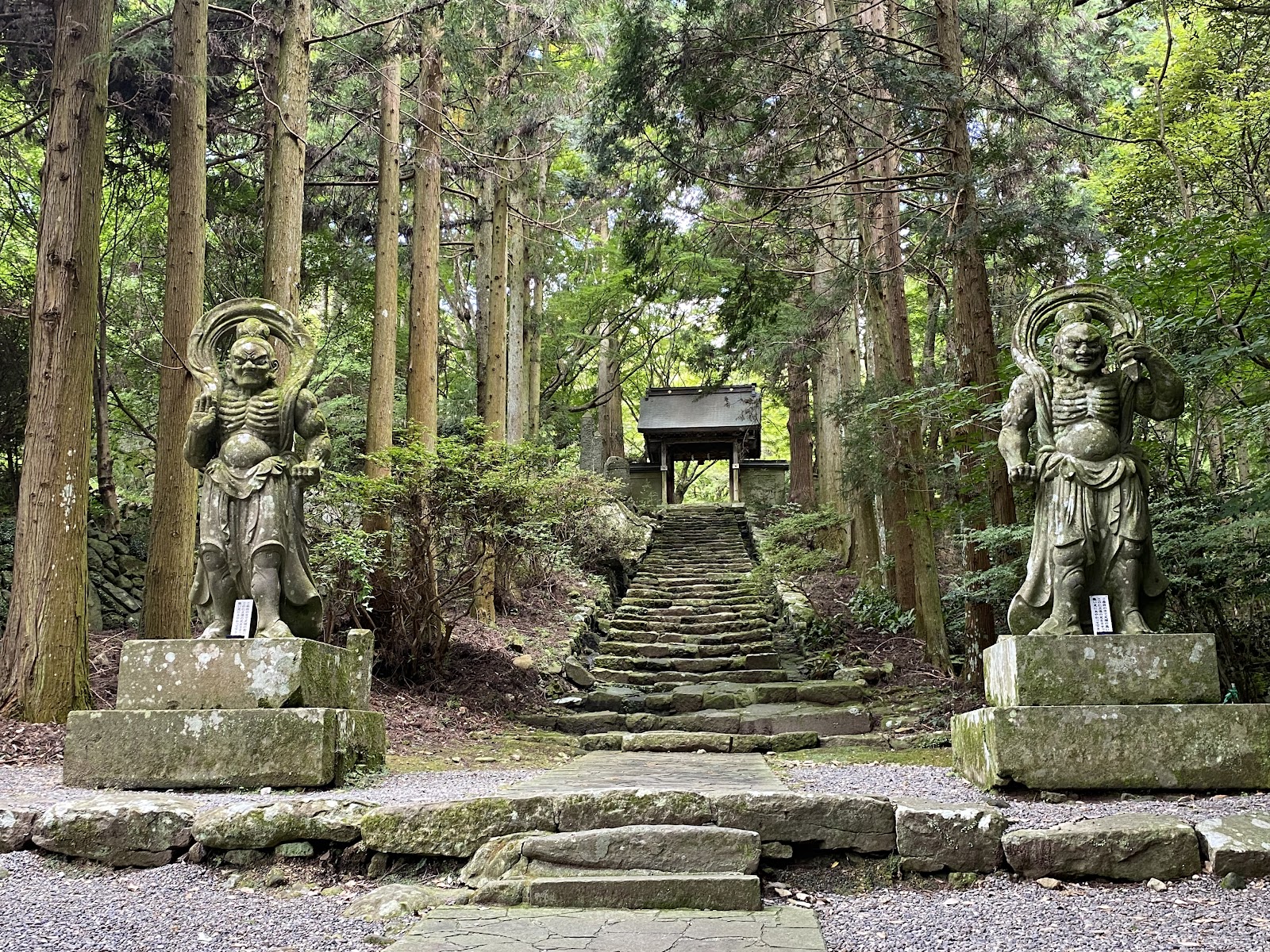
Reaching the carvings is part of their legend. From the car park, a path leads to a steep, wild stone stairway of large, irregular blocks that climbs the hillside. Local tradition holds that the steps were built in a single night by an oni, a demon, as a condition set by a deity, giving the ascent a suitably mythic quality. The climb is genuinely rough and can be slippery, so sturdy footwear is essential and walking sticks are provided, but the effort heightens the sense of pilgrimage. At the top of the stairway the two great Buddhas suddenly appear, carved into the rock and gazing out over the valley, an unforgettable reward for the climb.
Above the carvings, a further short path leads to a small Kumano shrine perched among the rocks, reflecting the seamless blending of Buddhism and Shinto that defines Rokugo Manzan. The whole site, wrapped in forest and silence, conveys the intense spirituality of the medieval monks and ascetics who worshipped here, and the surrounding trees bring colour in autumn.
The Kumano Magaibutsu are a highlight of any tour of the Kunisaki Peninsula and pair naturally with the other treasures of the region: the head temple of Futago-ji, the National Treasure hall of Fuki-ji, the fine statues of Maki Odo and the great shrine of Usa Jingu that presided over this whole religious world. Together they map out a landscape of faith found nowhere else in Japan.
Because the peninsula's interior has little public transport, a car is essentially required, about 55 minutes from Beppu, and visitors should allow around 50 minutes for the climb and the carvings, more if they are cautious on the steps. Physically demanding but deeply atmospheric, the Kumano Magaibutsu reward the effort with a rare encounter with monumental ancient Buddhist art in its original, wild mountain setting.
A local's tip
Climb the rugged stone steps carefully to reach the two giant rock-carved Buddhas, then continue a little further up to the small Kumano shrine perched above them.
Best time to visit
Dry days, as the stone steps become slippery when wet
Getting there
The rock carvings are on the Kunisaki Peninsula in Bungotakada, best reached by car, about 55 minutes from Beppu. From the car park, a path leads to a steep, uneven stone stairway said to have been built by an oni; sturdy shoes are essential.
Good to know
- Parking
- Restrooms
- Walking stick
Plan the whole trip offline
Kumano Magaibutsu is one of many places in the Real Japan app — with turn-by-turn directions, nearby spots and full offline maps you can use with no signal.