A north-facing Kannon hall paired in local belief with Zenko-ji, watching over the Bessho hot-spring valley.
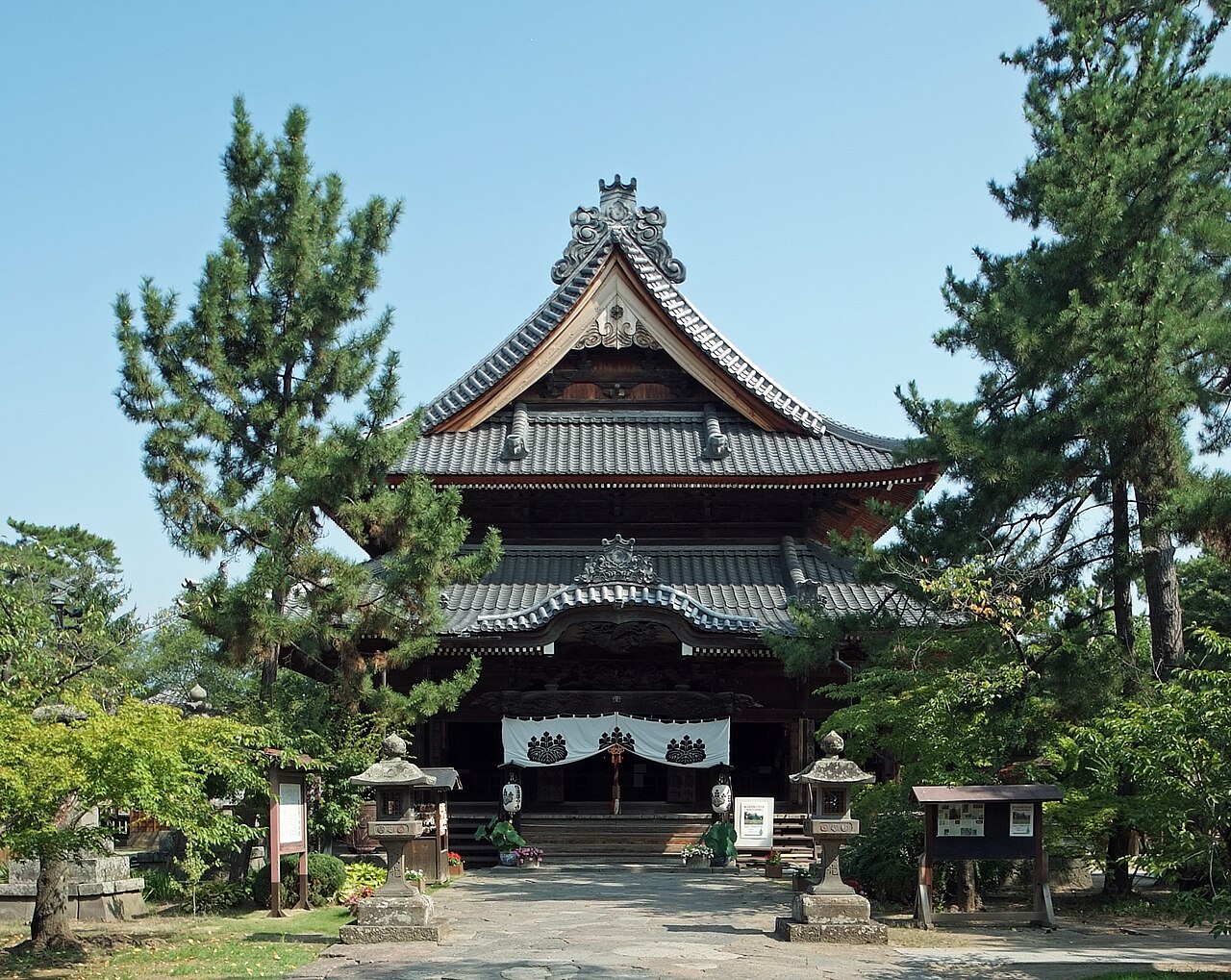
Kitamuki Kannon, literally the north-facing Kannon, is one of the most beloved temples of the Bessho Onsen area and a natural companion to the great Zenko-ji in Nagano City. Its name comes from the unusual orientation of its main hall, which faces north toward Zenko-ji, some 40 kilometres away across the mountains. Because Zenko-ji faces south, local tradition holds that the two temples gaze toward one another, and that a prayer is only complete when you have worshipped at both: Zenko-ji for salvation in the next life, and Kitamuki Kannon for happiness and blessings in this one. Pilgrims have made the paired visit for centuries.
The temple was founded, by tradition, in the early Heian period, and enshrines a Senju Kannon, the thousand-armed bodhisattva of compassion. It belongs to the same cluster of historic temples that earned Bessho Onsen its old nickname, the Kamakura of Shinshu, a reference to the concentration of important medieval Buddhist sites in this quiet hot-spring valley. The approach climbs a stone stairway lined with lanterns to a compact but atmospheric precinct perched on the hillside.
From the terrace in front of the main hall there is a fine open view north across the Ueda basin and the tiled roofs of the spa town below, a reminder of why the site was chosen. The hall itself is modest but dignified, its dark timbers weathered by mountain winters, and the grounds hold a scattering of Jizo statues, a bell tower and old cedar trees. A famous weeping cherry tree, the Aizen-zakura, blooms here in spring and draws photographers, while autumn brings warm colour to the maples on the slope.
Kitamuki Kannon is woven into the fabric of Bessho life. The town has been a hot-spring resort since at least the Heian period, and the temple is featured in classical literature, including references in works associated with the poet-monks who once gathered here. Its enduring popularity owes much to the simple, human appeal of its promise: while other temples look to the afterlife, this one is dedicated to well-being in the here and now.
The temple sits within a compact cluster of sights that makes Bessho Onsen an ideal half-day trip. The National Treasure octagonal pagoda of nearby Anraku-ji is only a short walk away, as are the town's historic public bathhouses. To reach Kitamuki Kannon, take the Hokuriku Shinkansen to Ueda, then the delightful little Ueda Electric Railway Bessho Line to its terminus at Bessho Onsen; from there it is a 10 to 12 minute walk through the old streets. Finish with a soak in one of the free or low-cost communal baths, whose smooth alkaline waters have soothed travellers for over a thousand years.
A local's tip
It faces north toward Zenko-ji; local belief holds that you should visit both temples to complete your prayer.
Best time to visit
Spring for cherry blossoms
Getting there
A 10-12 minute walk from Bessho Onsen Station, the terminus of the Ueda Electric Railway Bessho Line.
Good to know
- Parking
- Restrooms
Plan the whole trip offline
Kitamuki Kannon is one of many places in the Real Japan app — with turn-by-turn directions, nearby spots and full offline maps you can use with no signal.