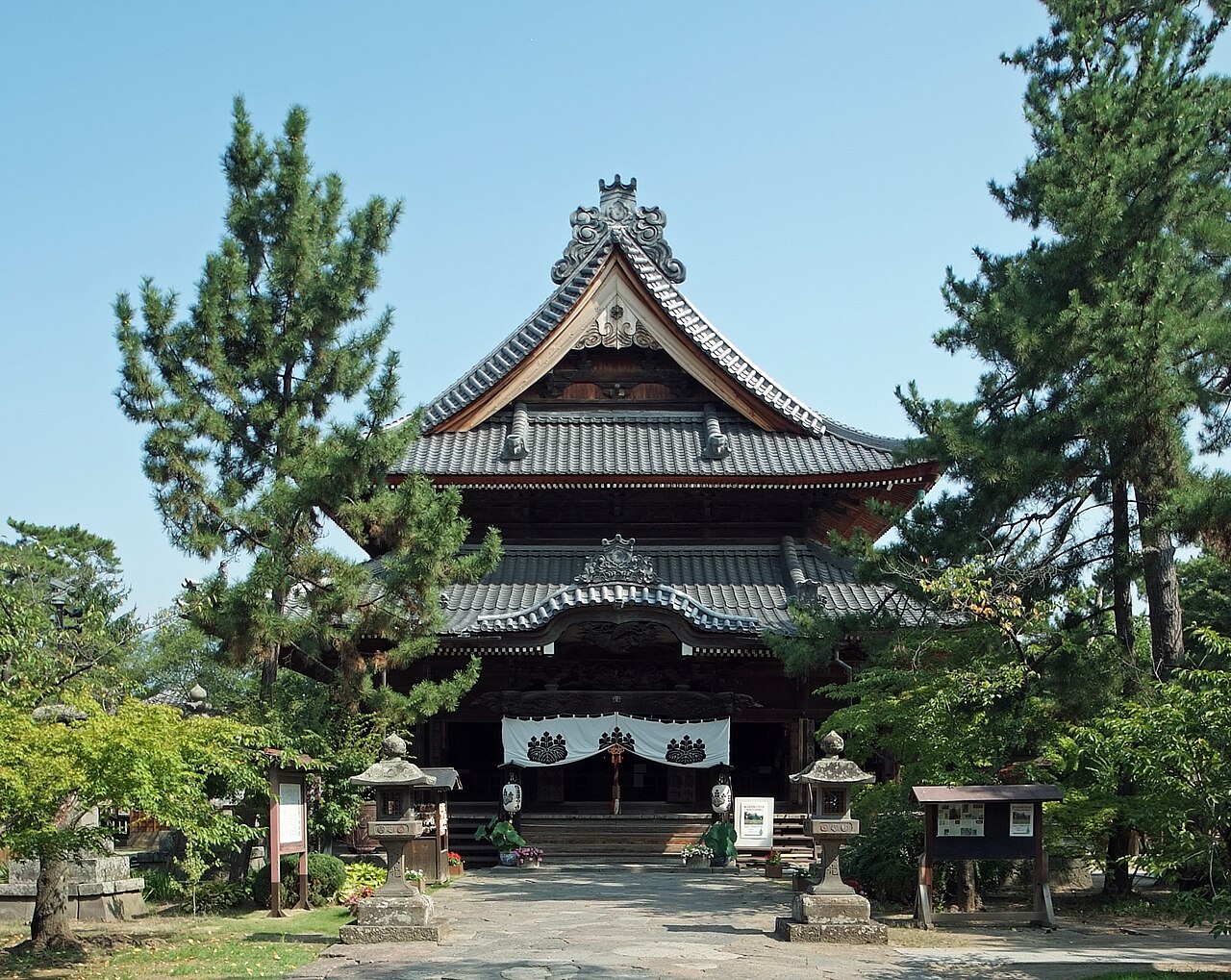
A historic temple beside the ruins of Shinano's 8th-century provincial monastery, famed for its January fire festival.
Shinano Kokubun-ji stands on the plain between Ueda and Komoro, occupying a site of exceptional historical depth: it is the living successor to the Nara-period provincial temple, or kokubunji, established here in the 8th century as part of a nationwide system of state monasteries. In 741 the emperor decreed that every province should build a monastery and a convent to protect the realm through Buddhist prayer, and the substantial remains of Shinano's original kokubunji lie in a park directly beside the present temple, making this a place where more than 1,200 years of religious history are laid out side by side.
The ancient temple precinct, now an archaeologically significant historic site, preserves the stone foundations and layout of the original 8th-century complex, including the bases of its pagoda, main hall and lecture hall. Interpretive signage helps visitors picture the scale of the vanished monastery, which would have dominated the surrounding rice plain as a symbol of central authority in this remote eastern province. Wandering the grassy foundations, especially when cherry trees bloom in spring, gives a vivid sense of continuity with the classical age of Japanese Buddhism.
The active temple that carries on the tradition is a Tendai establishment with a fine three-storey pagoda and an atmospheric main hall. Its most famous event is the Yowatashi festival, held on 8 January, one of the great fire and fortune festivals of eastern Nagano. Crowds gather as flames light the winter night, and worshippers come to receive the temple's celebrated good-luck talismans and the small sculpted rice-cake and papier-mache charms sold at stalls along the approach, believed to bring prosperity and a bountiful year. The festival draws visitors from across the region and fills the usually tranquil grounds with warmth and noise in the depths of winter.
Because it sits in the fertile Ueda basin, Shinano Kokubun-ji pairs naturally with the area's other attractions, from Ueda Castle and the historic hot springs of Bessho Onsen to the old post towns strung along the nearby highways. The combination of an intact working temple, extensive ancient ruins and a lively traditional festival makes it a satisfying and easy stop that reveals a layer of Japanese history, the state Buddhism of the Nara court, that is rarely so tangibly present elsewhere.
Access could hardly be simpler. The temple sits just a five-minute walk from Shinano-Kokubunji Station on the Shinano Railway Line, the local line that took over the old JR route between Ueda and Komoro after the Hokuriku Shinkansen opened. From Tokyo, ride the Shinkansen to Ueda and change to the Shinano Railway for a couple of stops. The gentle setting, free access to both the temple grounds and the ancient ruins, and the proximity of the station make it an effortless addition to any tour of the Ueda and Komoro area.
A local's tip
The adjacent ruins of the ancient Nara-period provincial temple can be walked freely; visit on 8 January for the fiery Yowatashi festival and its famous good-luck talismans.
Best time to visit
Early January for the Yowatashi fire festival
Getting there
A 5-minute walk from Shinano-Kokubunji Station on the Shinano Railway Line, between Ueda and Komoro.
Good to know
- Parking
- Restrooms
Plan the whole trip offline
Shinano Kokubun-ji is one of many places in the Real Japan app — with turn-by-turn directions, nearby spots and full offline maps you can use with no signal.