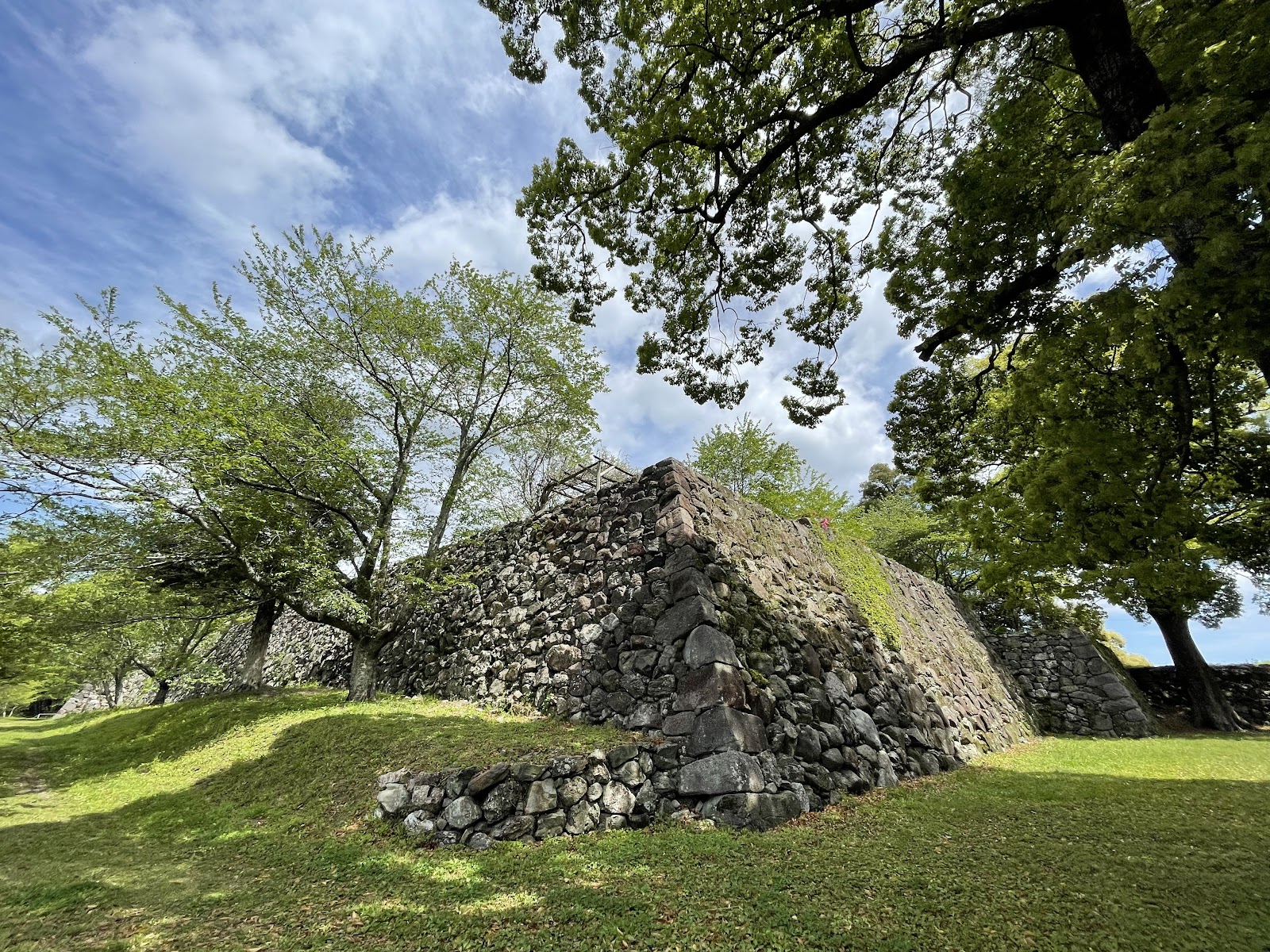
A 14th-century hill castle near Ise with layered stone walls and a moat, cradled in a quiet park.
Tamaru Castle (Tamaru-jo) crowns a low hill in the town of Tamaki, in the Watarai District just west of Ise, and its ruins reward anyone curious about how Japanese castles evolved over three centuries. First raised in 1336 by Kitabatake Akiyoshi as a base to guard the approaches to Ise, it began life as a medieval mountain fort and was steadily rebuilt and enlarged as warfare and masonry advanced. By the end of the Edo period it was held by the Kuno clan, hereditary retainers of the Kii Domain, and its ruins are now designated a Mie Prefecture Historic Site.
The castle occupies a strategic knoll between the Kushida and Miyagawa rivers, and even in ruin its defensive logic is obvious. Earthen ramparts, dry and wet moats, and terraced baileys climb the hill, while the surviving stone walls are the real draw for enthusiasts. Here you can read the history of Japanese castle building in a single site: sections of nozurazumi, the rough piling of unshaped stones typical of the earliest fortifications; uchikomihagi, where roughly shaped stones are wedged with smaller fillers; and kirikomihagi, the tightly fitted precision-cut masonry of later, more peaceful times. Few castle ruins let you compare all three so easily.
Today the grounds form Shiroyama Park, a peaceful, lightly visited spot that locals treasure. In early April the hill erupts in cherry blossom, and the walls and moats framed by pink petals make this the standout season to come; autumn brings quieter colour among the maples. Interpretive signs and a small local museum nearby help fill in the story, and the summit affords a gentle view over the surrounding plain toward the mountains that ring Ise.
Because it sits just two stops from Ise-shi on the JR Sangu Line, Tamaru makes an easy and atmospheric add-on to a Grand Shrine pilgrimage, offering a completely different, martial side of the region's long history. The walk from Tamaru Station is flat and short, and the ruins are free and open at all hours. Paths are unpaved, so wear comfortable shoes, and allow around an hour to loop the baileys and study the walls.
What makes Tamaru special is precisely its lack of reconstruction and crowds. There is no concrete keep, no ticket booth, no souvenir bustle, just weathered stone, grass-covered ramparts and the layered evidence of centuries of change. For travellers who like their history quiet and authentic, and who enjoy piecing together a place from its bones, Tamaru Castle is a small, genuine pleasure and a fine counterpoint to the sacred sites for which the Ise region is far better known.
A local's tip
Look closely at the stone walls: you can spot three different masonry techniques side by side, spanning the Warring States period to the Edo era.
Best time to visit
Early April for cherry blossom
Getting there
Take the JR Sangu Line to Tamaru Station, two stops from Ise-shi toward Matsusaka. The wooded castle hill of Shiroyama Park is a flat 10-minute walk from the station.
Good to know
- Parking
- Restrooms
Plan the whole trip offline
Tamaru Castle Ruins is one of many places in the Real Japan app — with turn-by-turn directions, nearby spots and full offline maps you can use with no signal.