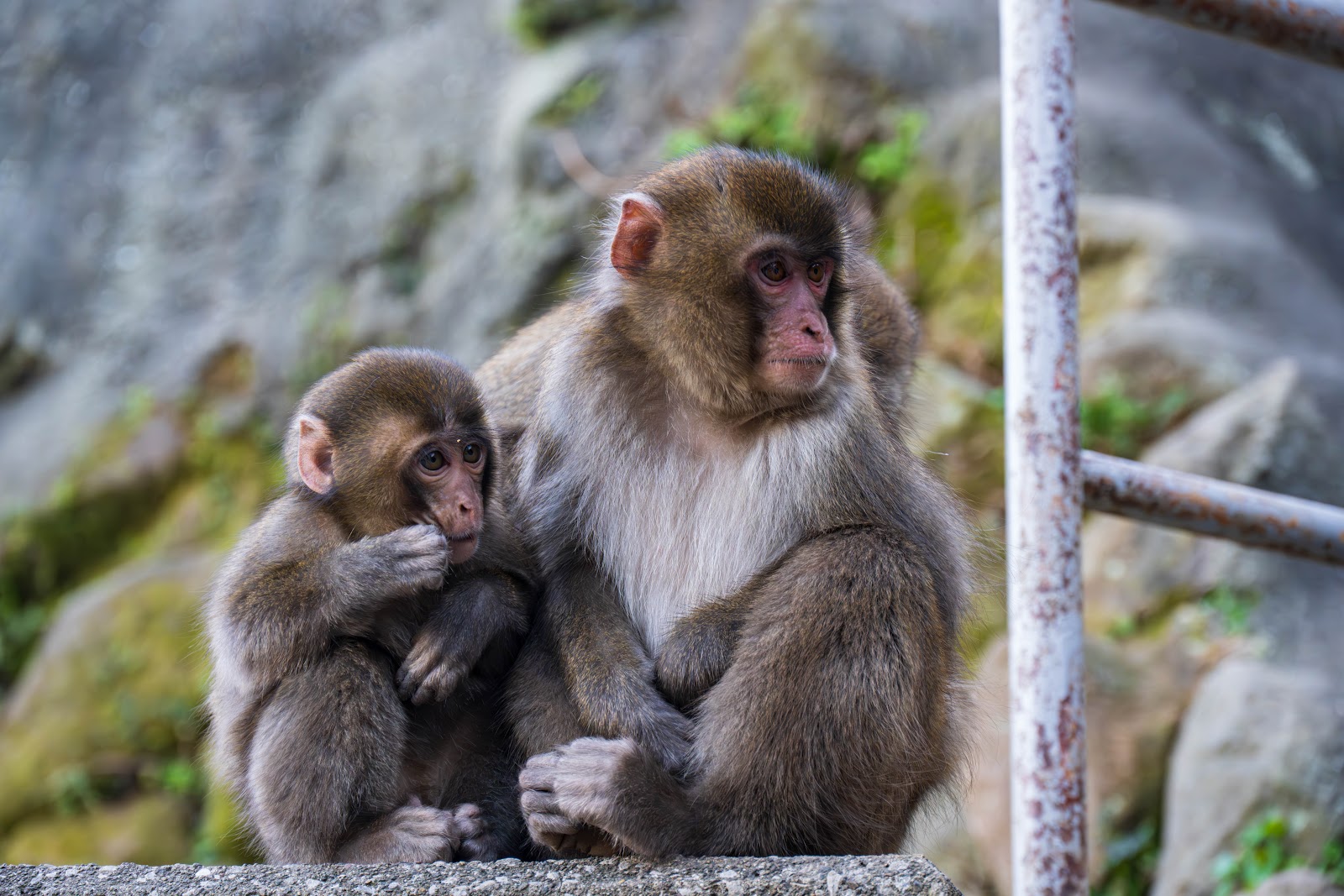
A forested mountain on the coast where two large troops of over 1,000 wild Japanese macaques roam freely and come down to be fed each day.
Takasakiyama Natural Zoological Garden is a forested coastal mountain rising between Beppu and Oita that is home to more than 1,000 wild Japanese macaques - the famous "snow monkeys" of Japan, here in a mild seaside setting rather than the snowy north. Unlike a conventional zoo, the monkeys are entirely wild and free-ranging; they live on the mountain and descend of their own accord to a feeding area near the base, where visitors can watch them at remarkably close quarters as they groom, squabble, nurse infants and jostle over food.
The site has been managed since 1953 as a way to reduce conflict between the macaques and local farmers, drawing the monkeys down the mountain with regular feeding rather than letting them raid crops. Today the population is organised into two large troops, known as Group B and Group C, which take turns coming down to the feeding ground on a rotating schedule to avoid confrontation. Watching the social dynamics - the strict hierarchies, the alliances, the boss monkeys - is genuinely absorbing, and staff give informative talks explaining the behaviour and the individual animals' histories.
Getting from the coastal entrance up to the feeding area takes only a few minutes on foot along a shaded path, or you can ride a short monorail (the "Sarudench") for a small extra fee - handy for young children, older visitors or hot days. The surrounding forest is beautiful in its own right, with cherry blossoms in spring and coloured leaves in autumn, and the mountain's slopes offer glimpses of Beppu Bay below.
The cardinal rule is that these are wild animals. Visitors are asked not to make direct eye contact (a challenge among macaques), not to touch or feed them, and not to carry food or shiny objects openly, since a monkey may simply take them. Follow the guidance and the experience is safe and delightful; ignore it and you may get an unwelcome close encounter. The monkeys are habituated to people and largely indifferent, walking past visitors' feet as if they were not there.
Across the road on the seafront sits the Oita Marine Palace Aquarium "Umitamago," making the pair a natural half-day combination for families - monkeys on the mountain, sea creatures by the shore, linked by a large car park and bus stop. Many visitors do both in a single outing from Beppu.
Takasakiyama offers a different flavour of nature from Beppu's geothermal hells: living, breathing and social rather than mineral and geological. It is one of the best places in Japan to observe wild primate behaviour up close, and its long-running research and management have made it important to Japanese primatology. Allow around 90 minutes, more if you combine it with the aquarium.
Facilities include restrooms, a gift shop, a cafe and the monorail, and while the feeding area itself is fairly flat, the approach involves gentle slopes. Morning visits around feeding time tend to be liveliest, and spring and autumn add seasonal colour to an already scenic mountainside just fifteen minutes from central Beppu.
A local's tip
Ride the monorail up if you have kids or tired legs, but the walk is short. Do not make eye contact with the macaques or carry visible food - they are wild, not tame.
Best time to visit
Morning feeding times; spring and autumn
Getting there
Between Beppu and Oita on the coast. Take a Kamenoi or Oita Kotsu bus from Beppu Station bound for Oita and alight at Takasakiyama (about 15 minutes), or drive to the large seaside car park.
Good to know
- Cafe
- Parking
- Monorail
- Gift shop
- Restrooms
Plan the whole trip offline
Takasakiyama Natural Zoological Garden is one of many places in the Real Japan app — with turn-by-turn directions, nearby spots and full offline maps you can use with no signal.