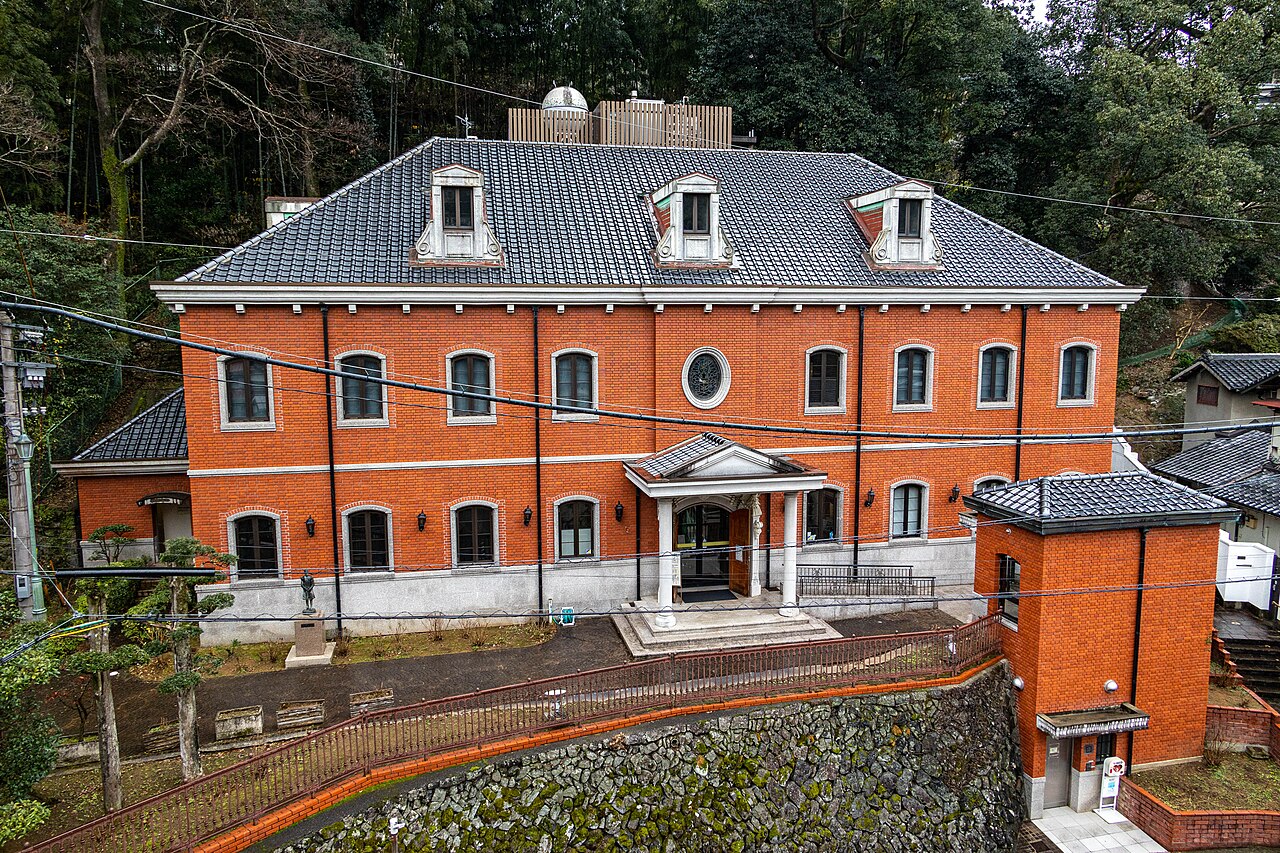
A museum on the home site of Philipp von Siebold, the German doctor who bridged Japanese and Western science from Dejima.
The Siebold Memorial Museum stands in the quiet Narutaki district on the eastern hills of Nagasaki, on the very ground where one of the most consequential foreigners in Japanese history made his home. Philipp Franz von Siebold, a German physician and naturalist, arrived in Nagasaki in 1823 as the resident doctor of the Dutch trading post on Dejima, and in the few years he spent there he did more than almost anyone to open a two-way channel of knowledge between Japan and the West. This modest museum, opened in 1989 in a building styled after his Dutch homeland, tells his remarkable story.
Siebold was nominally attached to Dejima, the tiny fan-shaped artificial island that was Japan's only point of contact with Europe during the long era of national seclusion. But his medical skill won him unusual privileges, and he was permitted to establish a school and clinic at Narutaki, just outside the town. There he taught Western medicine, science and natural history to Japanese students, who came from across the country to study under him—many of them going on to become leading figures in Japan's modernisation. In an age when the country was sealed off from the outside world, the Narutaki School was one of the few places where Western learning flowed directly to Japanese minds, and its influence on the later opening and modernisation of Japan was profound.
The traffic of knowledge ran both ways. Siebold was an insatiable collector and observer, and he systematically documented Japan's plants, animals, geography, culture and daily life. He assembled vast collections of specimens and artefacts that he shipped back to Europe, and his subsequent writings introduced Japan to Western scholars in unprecedented detail; a number of Japanese plants still bear scientific names he assigned. His career was not without scandal—in the so-called Siebold Incident of 1828, he was found in possession of maps of Japan, which were forbidden exports, and was expelled from the country, though he later returned after the ban on him was lifted.
The museum displays materials relating to Siebold's life and work: reproductions and artefacts connected to his medical teaching, his natural-history studies, his collections and his writings, along with exhibits on the Narutaki School and the students he trained. The building itself, designed to evoke Siebold's residence in Leiden in the Netherlands, sets the tone, and the adjoining small park preserves the historic site of the school, so that a visit combines the indoor exhibits with a stroll across the ground where this extraordinary exchange of ideas took place.
This is a specialised, modestly sized museum rather than a blockbuster attraction, and it is all the more rewarding for the quiet, uncrowded atmosphere and the very low admission price. For anyone interested in the history of science, medicine, or the story of how a secluded Japan began to absorb Western knowledge, it is a genuinely illuminating stop, and it deepens the wider narrative of Dejima and Nagasaki's role as the nation's window on the world.
The museum lies a little outside the main sightseeing cluster, a few minutes' walk from the Shinnakagawamachi tram stop toward the Narutaki hills. Combine it with the temple district or the Dejima site to round out a picture of how, through this one small port, Japan and the wider world exchanged not just goods but ideas.
A local's tip
The adjacent small park preserves the site of Siebold's Narutaki School—combine the museum with a stroll where Japan's first Western-style medical students once studied.
Best time to visit
Daytime; a quiet, uncrowded stop
Getting there
From the Shinnakagawamachi tram stop walk toward the Narutaki district; the museum stands on the site of Siebold's former home and medical school, up a gentle slope.
Good to know
- Restrooms
Plan the whole trip offline
Siebold Memorial Museum is one of many places in the Real Japan app — with turn-by-turn directions, nearby spots and full offline maps you can use with no signal.