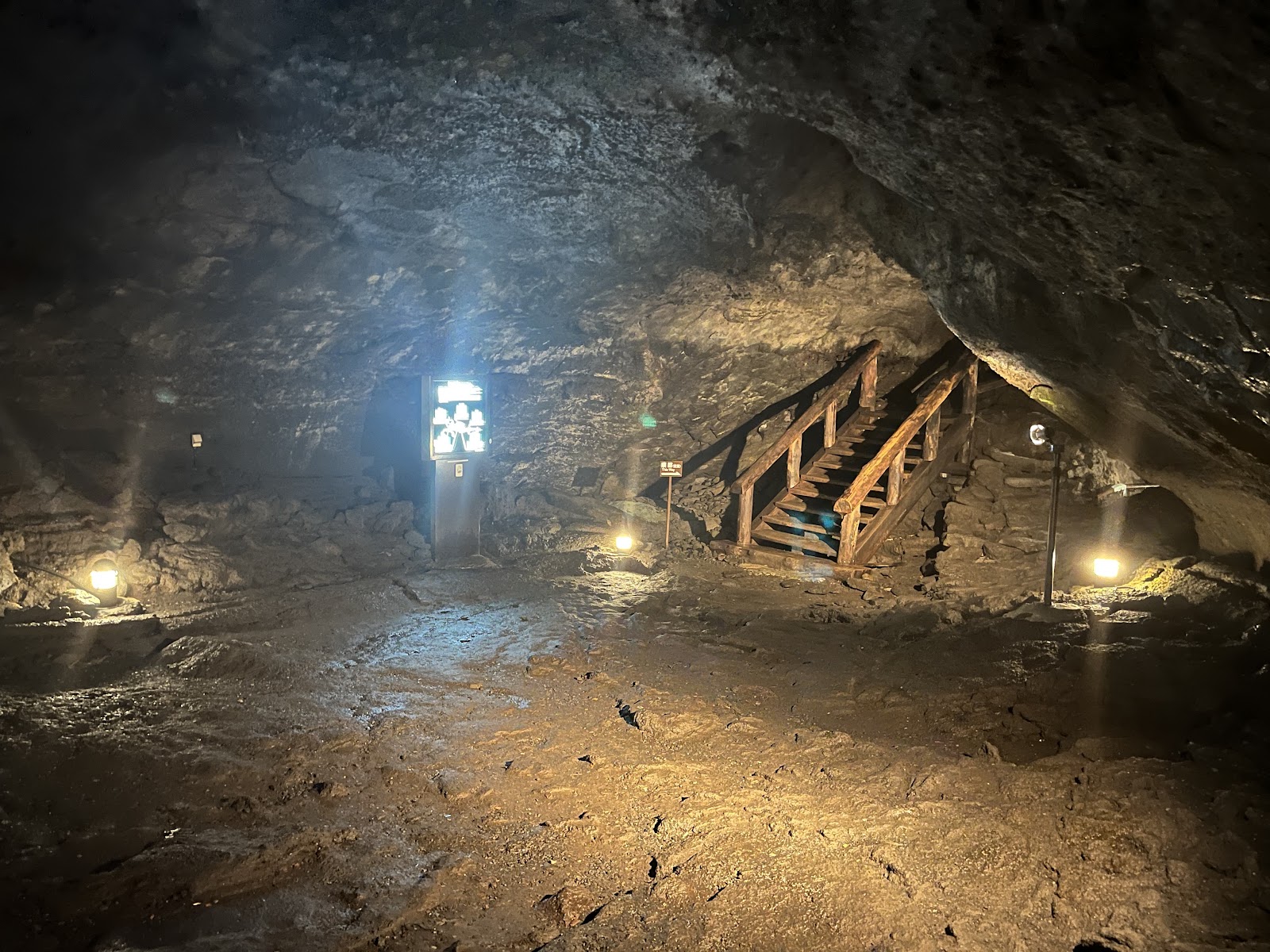
The largest lava cave in the Mount Fuji area, a warm winter roost for bats, open for guided-style exploration.
The Saiko Bat Cave, or Saiko Komori-ana, is the largest lava cave in the entire Mount Fuji area and one of the most interesting of the many volcanic caves hidden within the Aokigahara forest near the shore of Lake Sai. Like its neighbours the Wind Cave and Ice Cave, it was formed during the great eruption of Mount Fuji in the year 864, when flowing lava cooled and crusted over on the outside while the still-molten rock inside drained away, leaving a long hollow tube. The result is a complex, branching cave with a total passage length far greater than the other tourist caves of the region, part of it opened up for visitors to explore.
The cave takes its name from the bats that have long used it as a home. Unlike the nearby Ice and Wind Caves, which stay bitterly cold, the Bat Cave maintains a relatively stable and comparatively warm temperature deep inside, making it a suitable place for bats to hibernate through the harsh Fuji winter. Several species have historically roosted here in large numbers. Over the years human disturbance reduced the population, and a portion of the cave is now set aside as a protected conservation zone, closed to visitors, where the bats can shelter undisturbed; the animals are rarely seen along the public route, but the cave’s ecological role is central to its story and is explained in displays at the adjacent nature centre.
Exploring the cave is a mild adventure. Visitors are given helmets at the entrance, and for good reason — the ceiling drops low in several places, requiring a crouch or a duck, and the lava walls are rough and uneven underfoot. Lighting guides the way through the accessible passages, revealing the ropey textures, ledges and chambers created by the flowing lava more than a thousand years ago. It is more physically involved than the smoother tourist caves, which makes it especially fun for families with older children and for anyone who enjoys a bit of scrambling. A jacket is useful, as the interior is cool.
Above ground, the site includes a small nature centre and interpretive facilities that explain the volcanic geology of the lava caves and the biology of the bats, tying the cave into the wider natural story of Aokigahara and the eruptions that shaped this landscape. The surrounding forest is classic Sea of Trees terrain, and short trails connect the area to the other caves and to Lake Sai.
The Bat Cave is reached by the Fujikyu Saiko sightseeing bus (the Green Line) from Kawaguchiko Station, which loops around Lake Sai and stops close to the entrance; it is open seasonally, generally from spring through autumn, and closed in the depths of winter. Because it stays cool inside, it makes a refreshing stop on a hot summer day. A visit takes under an hour and combines naturally with the Wind Cave, Ice Cave and the Aokigahara nature trails for a half-day exploring the volcanic underworld at the foot of Mount Fuji.
A local's tip
Helmets are handed out at the entrance for good reason — the ceiling is low in places; the bats hibernate in a protected inner section, so you are helping conserve them by keeping to the lit route.
Best time to visit
Any time in the open season; a good hot-day escape
Getting there
Take the Fujikyu Saiko sightseeing (Green Line) bus from Kawaguchiko Station to the Saiko Komori-ana (Bat Cave) stop near the eastern shore of Lake Sai.
Good to know
- Restrooms
- Nature center
- Helmets provided
Plan the whole trip offline
Saiko Bat Cave is one of many places in the Real Japan app — with turn-by-turn directions, nearby spots and full offline maps you can use with no signal.