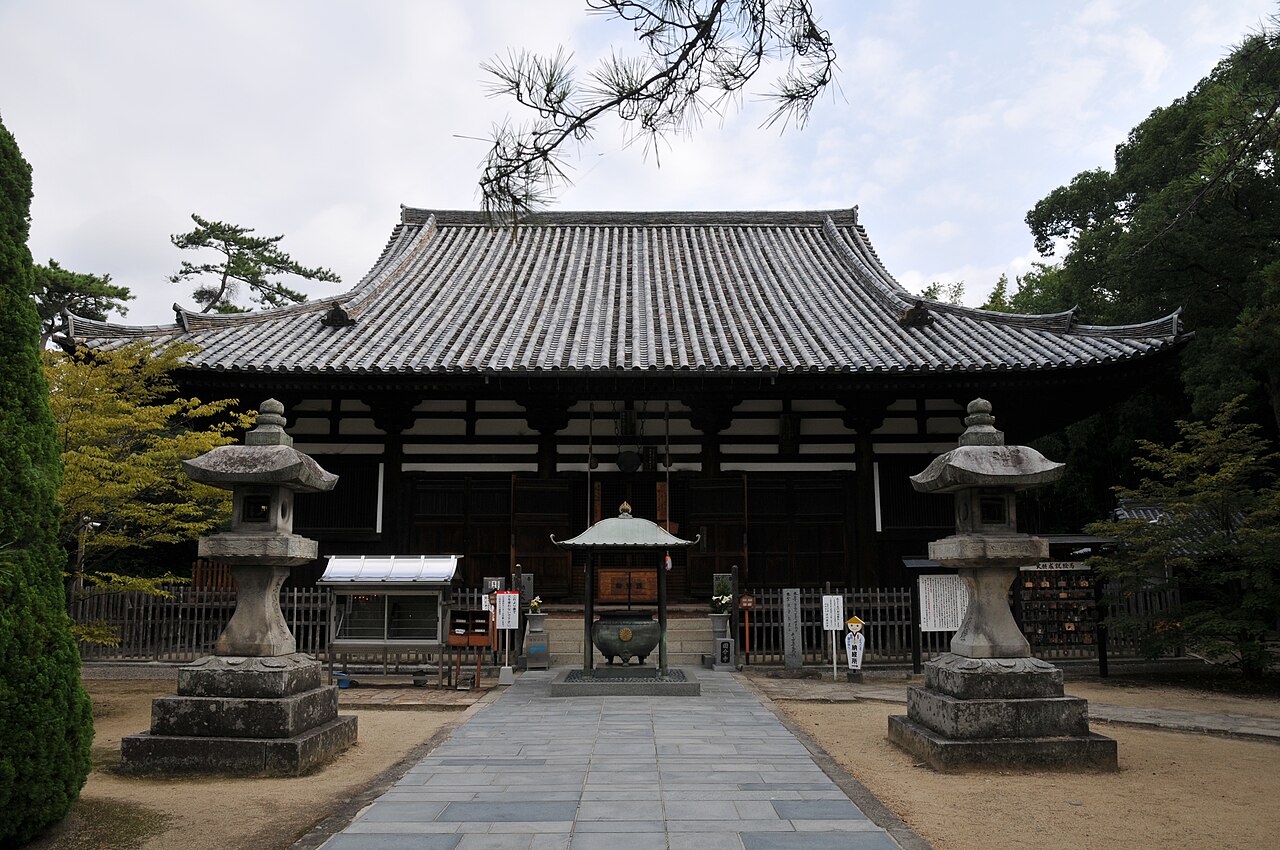
The 82nd pilgrimage temple high on the Goshikidai plateau, famous for its cow-demon Ushioni legend.
Negoro-ji is the 82nd temple of the Shikoku pilgrimage, set high on the wooded Goshikidai plateau that rises between Takamatsu and Sakaide. Remote, atmospheric and wrapped in mountain forest, it is a temple where legend and landscape combine to create one of the more memorable stops on the whole circuit.
The temple traces its founding to the early 9th century and the monk Chishо, with the ubiquitous Kobo Daishi (Kukai) also woven into its history. Its principal image is a Senju (thousand-armed) Kannon, and the sprawling mountain precinct includes a striking multi-storey main hall, a Daishi hall, and a covered walkway lined with thousands of small bodhisattva statues left by worshippers — a quietly moving sight as they recede into the trees. Cedars and maples press close, and mountain mist often drifts through the halls, giving Negoro-ji a mysterious, faintly otherworldly air that feels appropriate to its most famous tale.
That tale is the Ushioni. According to local legend, a fearsome horned monster with the body of a bull terrorised the Goshikidai in the 16th century, killing travellers and livestock, until the villagers begged a renowned archer named Yamada Kurando Takakiyo to destroy it. He slew the beast and offered its horns to Negoro-ji, where they are said to be preserved to this day. A vivid bronze statue of the Ushioni now stands near the temple, part fearsome guardian, part beloved mascot, and finding it is a highlight for many visitors. The story has made Negoro-ji a favourite with those who enjoy Japan's rich tradition of yokai and monster folklore.
Beyond the legend, the temple is simply a beautiful place to be. The grounds are extensive and layered up the hillside, connecting halls, shrines and stone lanterns by mossy paths and stairways. Ancient trees, including a celebrated old camphor and towering cedars, shade the precinct, and the elevation keeps the air cool even in summer. Autumn is the star season, when the maples blaze red and gold against the dark cedar forest, but spring cherry blossom and the fresh green of early summer are lovely too.
Practically, Negoro-ji is a mountain temple and reflects it: there is no convenient train, and most visitors arrive by car or taxi up the plateau road, or on foot as part of the long walking pilgrimage between temples 81 (Shiromine-ji) and 83 (Ichinomiya-ji). Parking and restrooms are available at the top. Pilgrims perform the standard devotions — purification, incense, candles, sutra chanting at the main and Daishi halls, and collection of the temple stamp.
Allow around 50 minutes to explore fully, including the walkway of statues and the hunt for the Ushioni. Combine Negoro-ji with nearby Shiromine-ji for a rewarding Goshikidai temple loop with plateau viewpoints along the way. As ever, keep your visit respectful and quiet, mindful that ohenro pilgrims are here on a genuine spiritual journey through some of Kagawa's most beautiful high country.
A local's tip
Find the bronze statue of the Ushioni, the horned cow-demon of local legend said to have terrorised the mountain until a master archer slew it — the temple's most famous story.
Best time to visit
Autumn for maple colour
Getting there
Best reached by car or taxi up the Goshikidai plateau road from central Takamatsu or Sakaide; there is no direct train, and the mountain setting rewards drivers.
Good to know
- Parking
- Restrooms
Plan the whole trip offline
Negoro-ji (Temple 82) is one of many places in the Real Japan app — with turn-by-turn directions, nearby spots and full offline maps you can use with no signal.