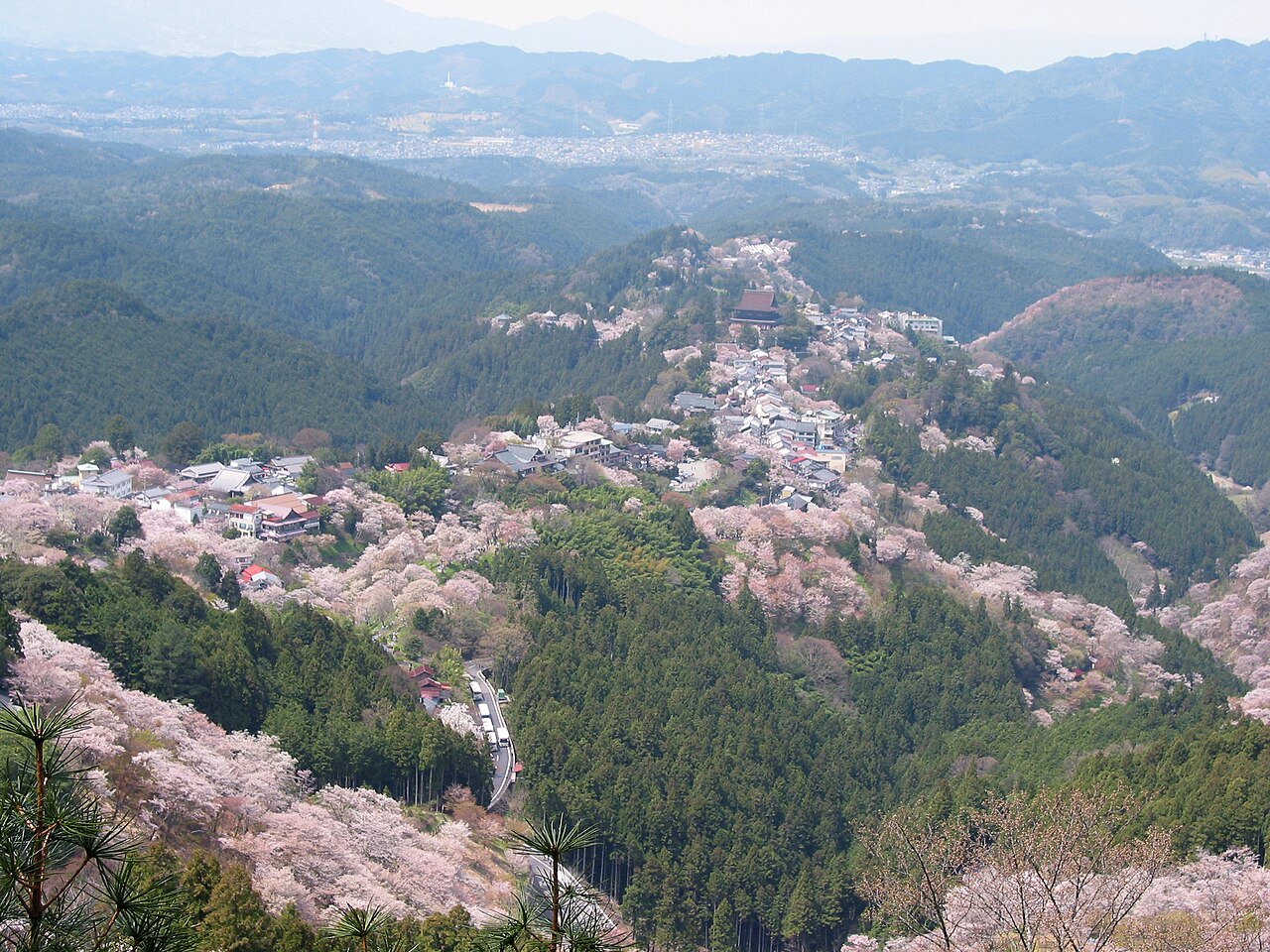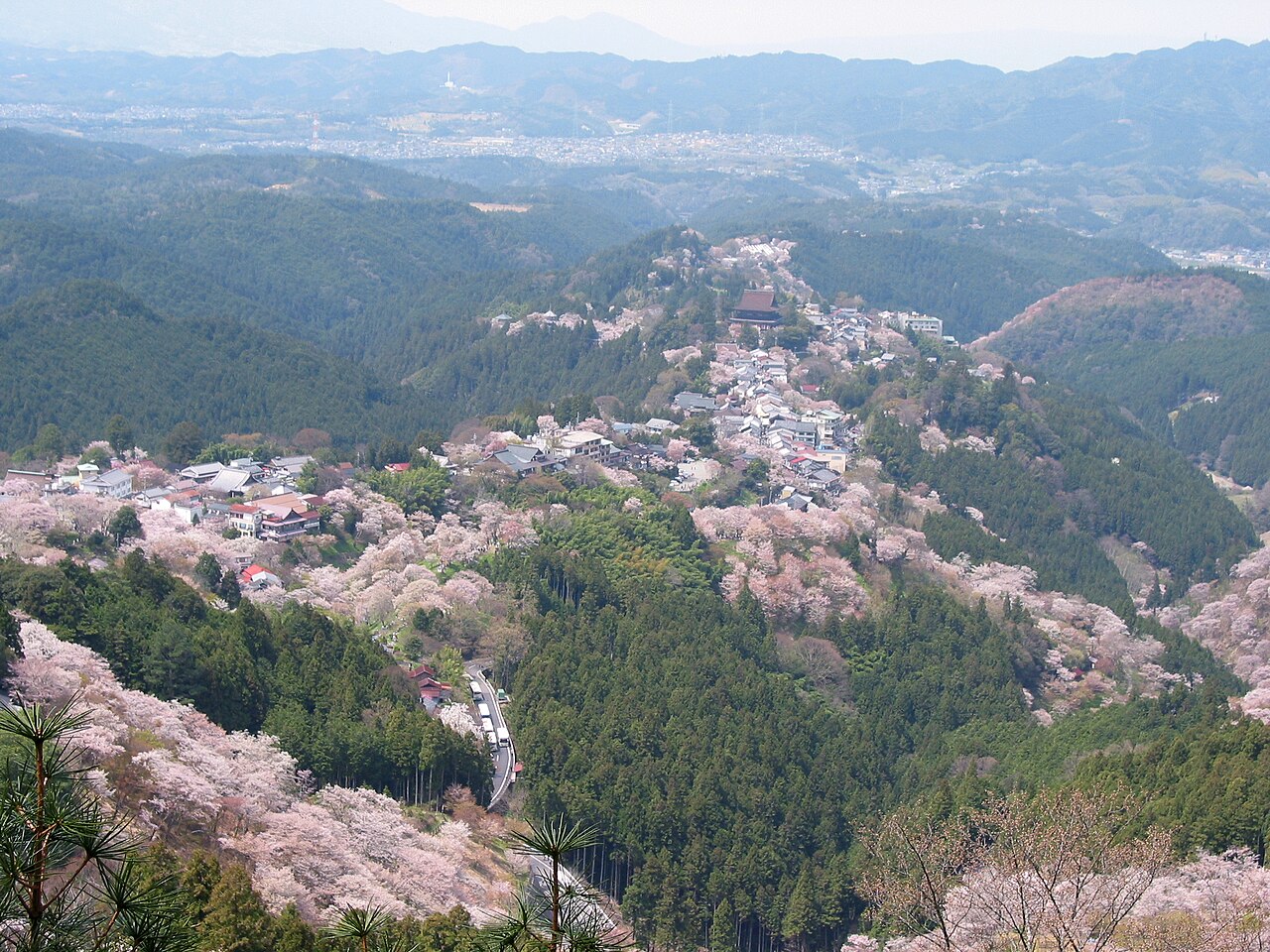
Japan's most famous cherry-blossom mountain, with 30,000 trees rising in tiers up a sacred UNESCO-listed peak.
Mount Yoshino, or Yoshinoyama, in the mountainous south of Nara Prefecture, is the most celebrated cherry-blossom destination in all of Japan. Some 30,000 cherry trees are said to grow across its slopes, planted over more than a thousand years, and when they bloom in April the entire mountainside turns to drifts of pink and white rising in tiers toward the summit. Because the trees are planted at different elevations, the blossom opens in successive waves up the mountain, extending the flowering season and giving rise to the poetic names for its four main groves: Shimo Senbon, Naka Senbon, Kami Senbon and Oku Senbon — the lower, middle, upper and inner thousand trees.
Yoshino's cherries are far more than a scenic display; they are rooted in religion. The mountain is a sacred centre of Shugendo, the ascetic mountain faith, and the cherry tree is revered here as a sacred plant associated with the deity of the great temple of Kinpusen-ji. For over a millennium pilgrims and devotees planted cherries as offerings, which is why the mountain came to be so densely covered. Yoshino forms part of the UNESCO World Heritage Site known as the Sacred Sites and Pilgrimage Routes in the Kii Mountain Range, and its temples, shrines and old pilgrimage paths make it a place of deep cultural as well as natural importance.
The experience of a visit is that of a mountain temple town. From the station a cable car or a walking path climbs to the main street, which is lined with temples, shrines, traditional inns, and shops selling local specialities such as kuzu arrowroot sweets, persimmon-leaf sushi and cherry-themed treats. Kinpusen-ji, whose vast wooden main hall is among the largest in the country, stands at the heart of the town, and the historic Yoshimizu Shrine offers one of the classic viewpoints across the blossoming valleys. Walking trails connect the four groves, climbing steadily from the busy lower slopes to the quieter upper and inner groves, where the crowds thin and the mountain scenery opens out.
Spring is overwhelmingly the peak season, roughly early to mid-April, when the blossom draws large numbers of visitors and accommodation books out far in advance; arriving early in the day and hiking higher up the mountain is the best way to escape the busiest lower crowds. But Yoshino is worth visiting in other seasons too: fresh green in early summer, a fine display of autumn foliage in November, and a quiet, atmospheric temple town in winter. The higher trails also offer genuine hiking, with the option to continue deep into the Omine mountains along ancient pilgrimage routes.
Getting there takes some planning, as Yoshino lies well south of Nara and Osaka. The usual approach is the Kintetsu Yoshino Line to its terminus at Yoshino Station, reached from Osaka Abenobashi or by changing at Kashiharajingu-mae, a journey of roughly one to one and a half hours; from the station a cable car or footpath leads up into the town. Allow the better part of a day, and ideally more during blossom season, to do the mountain justice. For anyone in the region in April, Mount Yoshino is one of Japan's essential natural sights.
A local's tip
Hike beyond the crowded Shimo Senbon lower slopes up toward the Naka, Kami and Oku Senbon groves - the blossom thins the crowds and the mountain views open up.
Best time to visit
Early to mid-April for the cherry blossom
Getting there
Take the Kintetsu Yoshino Line to its terminus, Yoshino Station, then a cable car or a walk up to the temple town. From Osaka Abenobashi or via Kashiharajingu-mae the trip is roughly 1 to 1.5 hours.
Good to know
- Food
- Wi-Fi
- Cable car
- Restrooms
Plan the whole trip offline
Mount Yoshino is one of many places in the Real Japan app — with turn-by-turn directions, nearby spots and full offline maps you can use with no signal.