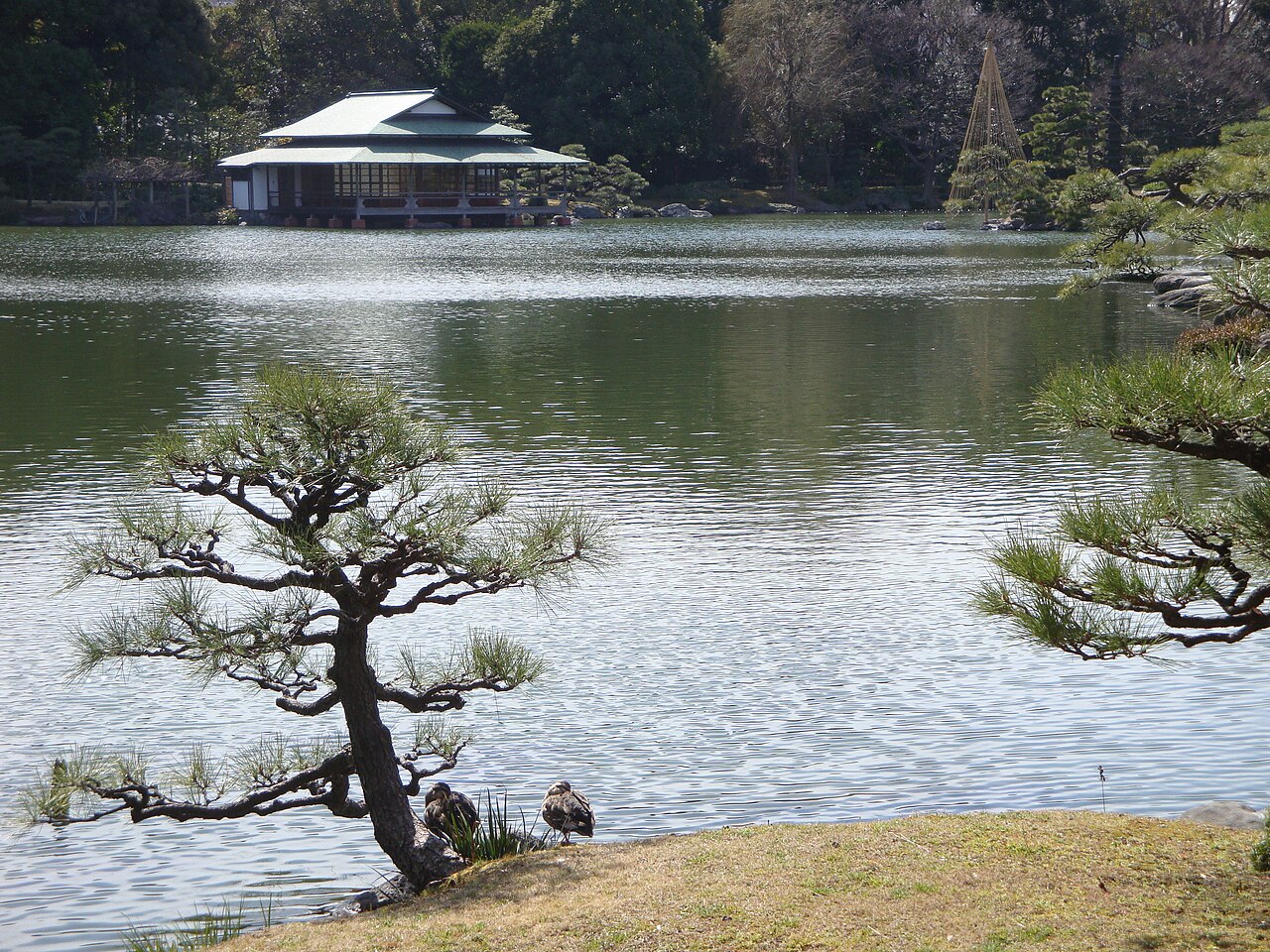
A tranquil Meiji-era stroll garden built by Mitsubishi's founder, famous for stepping stones over a carp-filled pond.
Kiyosumi Garden is a compact but exquisitely composed strolling garden in the old Fukagawa district east of the Sumida River, prized for its intimacy and its unusually direct relationship with water. Where grander gardens keep visitors on the bank, Kiyosumi invites them out across the pond itself on the isowatari—lines of flat stepping stones set just above the surface—so that the carp, turtles, and waterbirds glide past almost at your feet.
The grounds trace back to an Edo-period merchant's residence, but the garden as seen today was created between 1878 and 1885 by Iwasaki Yataro, founder of the Mitsubishi conglomerate, as a retreat for entertaining guests and rewarding employees. Iwasaki used his shipping fleet to bring in dozens of magnificent named rocks from every corner of Japan—fifty-five prized specimens in all—which are arranged around the pond as a kind of geological catalogue of the country. A large central pond with three islands, gentle hills, a dry waterfall, and a graceful wooden teahouse pavilion, the Ryotei, completes the classic stroll-garden design.
Kiyosumi carries a poignant piece of modern history: during the fires that followed the Great Kanto Earthquake of 1923, the garden's open space and water sheltered thousands of local residents, and the Iwasaki family afterward donated the eastern portion to the City of Tokyo, which opened it as a public park in 1932. A stone monument in the grounds is inscribed with Matsuo Basho's most famous haiku about a frog leaping into an old pond, linking the garden to the poet who once lived nearby.
The visiting experience is quiet and contemplative, and because the garden is small it can be savoured fully in about an hour. The pondside teahouse, available for rent, often frames wedding photographs, and the reflections of its dark timber in the water are a favourite of photographers. Iris beds and hydrangeas bring colour in June, cherry blossom in spring, and maples in autumn, while the resident wildlife—herons, kingfishers, and dozens of red-eared turtles—gives the garden life in every season.
Paths are flat and the main circuit is largely accessible, though the stepping stones themselves require sure footing and are best avoided in the rain. A rest house and restrooms sit near the entrance, and admission is only 150 yen, making this one of the best-value garden experiences in Tokyo. The best time to arrive is right at opening on a still morning, when the pond becomes a flawless mirror before the breeze picks up. Kiyosumi-shirakawa has in recent years become Tokyo's specialty-coffee district, so the garden pairs perfectly with a cup at one of the neighbourhood's celebrated roasters just a few minutes' walk from the gate. The nearby Fukagawa Edo Museum and the Museum of Contemporary Art Tokyo make the area a genuinely rewarding half-day, but it is the garden's rare intimacy—the sense of walking on the water among the rocks Iwasaki gathered from the whole of Japan—that lingers longest in the memory.
A local's tip
Cross the pond on the isowatari stepping stones rather than the path—each stone is placed to slow you down and frame a different view of the water, and it is the single best way to spot the resident turtles and kingfishers up close.
Best time to visit
Early morning for still reflections; June for iris and hydrangea
Getting there
From Kiyosumi-shirakawa Station (Tokyo Metro Hanzomon Line or Toei Oedo Line) take exit A3 and walk about 3 minutes east to the garden gate.
Good to know
- Restrooms
- Rest house
- Wheelchair
Plan the whole trip offline
Kiyosumi Garden is one of many places in the Real Japan app — with turn-by-turn directions, nearby spots and full offline maps you can use with no signal.