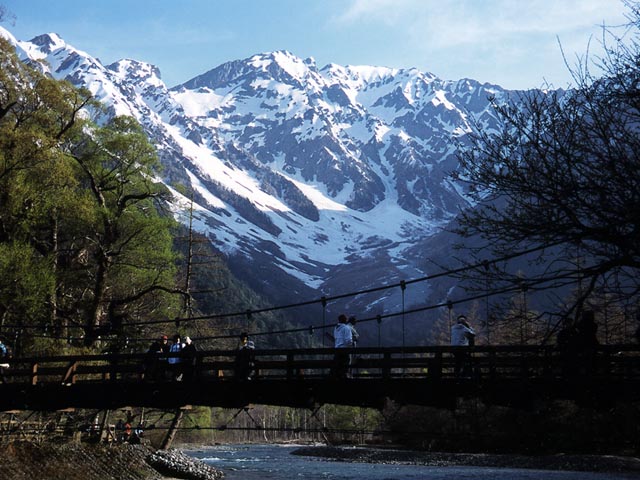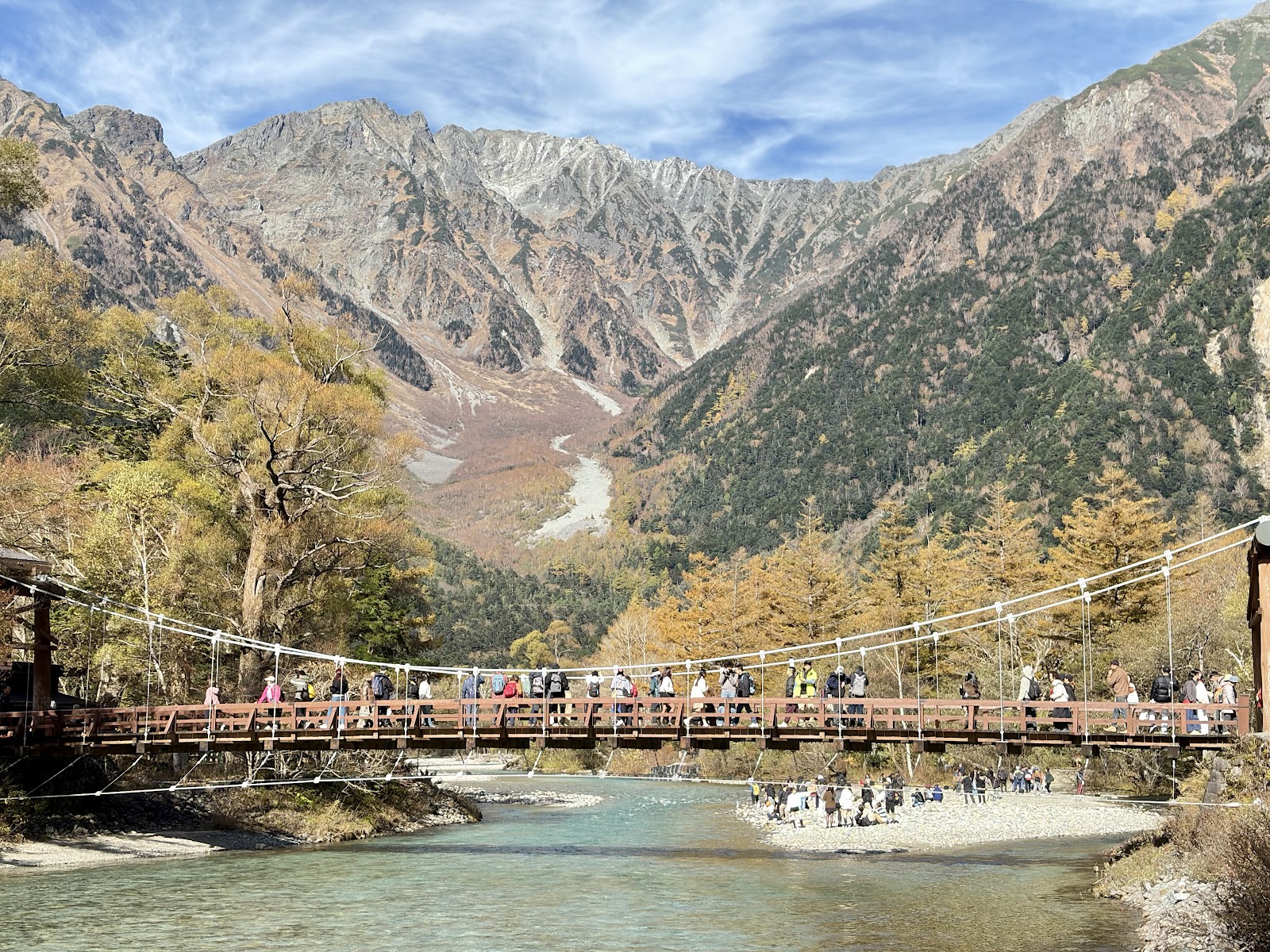
The iconic wooden suspension bridge over the crystal Azusa River, the symbolic heart of Kamikochi with the Hotaka range towering behind.
Kappa Bridge (Kappabashi) is the beating heart of Kamikochi, a high mountain valley cradled at 1,500 metres inside the Chubu Sangaku National Park. The wooden suspension bridge spans the milky-turquoise Azusa River, and from its planks you look straight up at the jagged Hotaka mountain range and the smoking cone of Mount Yakedake, an active volcano. It is one of the most photographed spots in the entire Japanese Alps, and for good reason: few places in Japan concentrate so much alpine grandeur into a single, easily reached viewpoint.
The bridge takes its name from the kappa, the mischievous water-sprite of Japanese folklore, and the pools beneath it are so clear and green they look almost supernatural. The current bridge is the fifth to stand here since the Meiji era; the crossing was made famous by the British missionary and mountaineer Walter Weston, who explored these peaks in the 1890s and helped introduce recreational alpinism to Japan. A festival each June still honours him, and a relief plaque marks his contribution a short walk downstream.
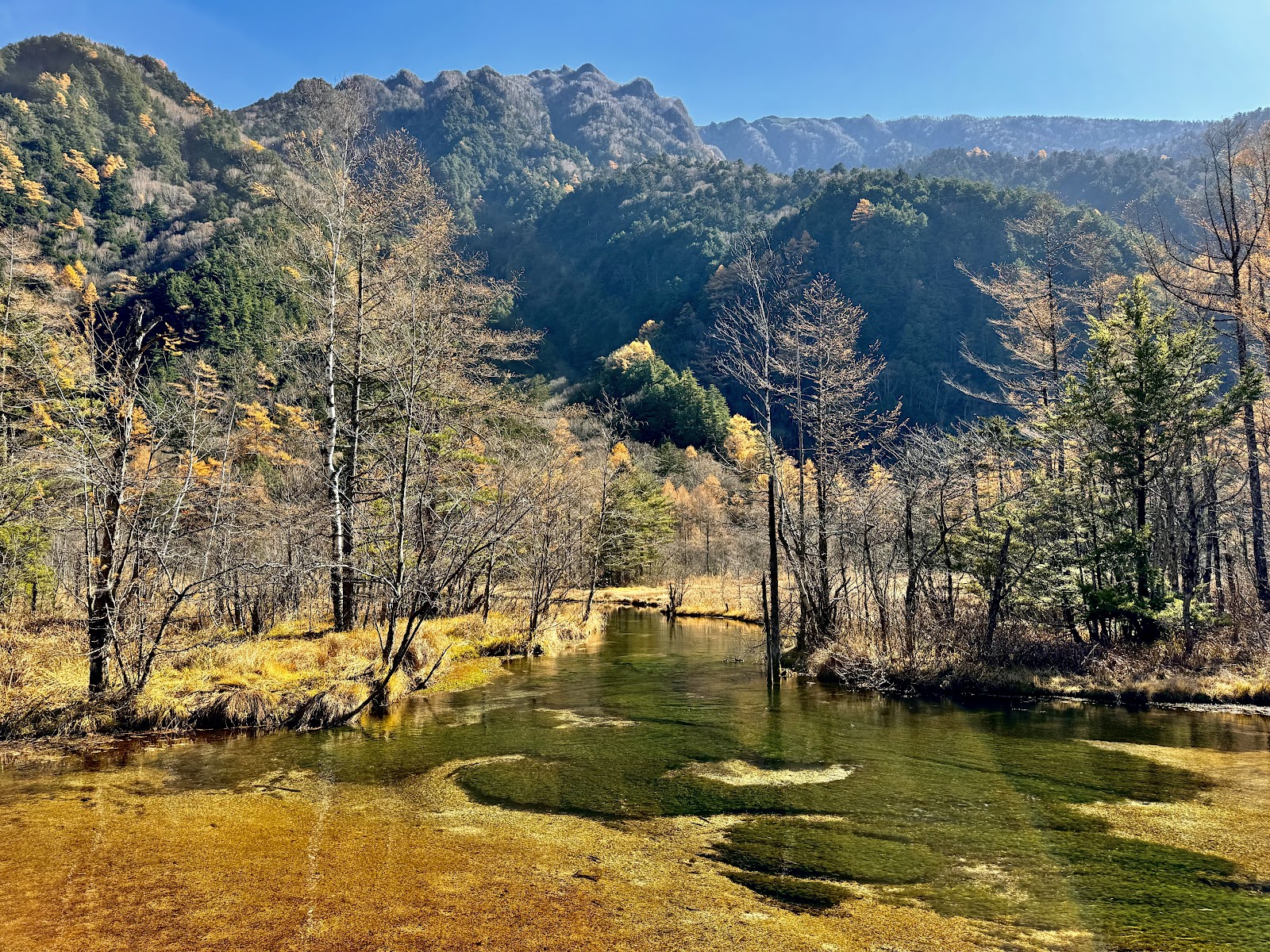
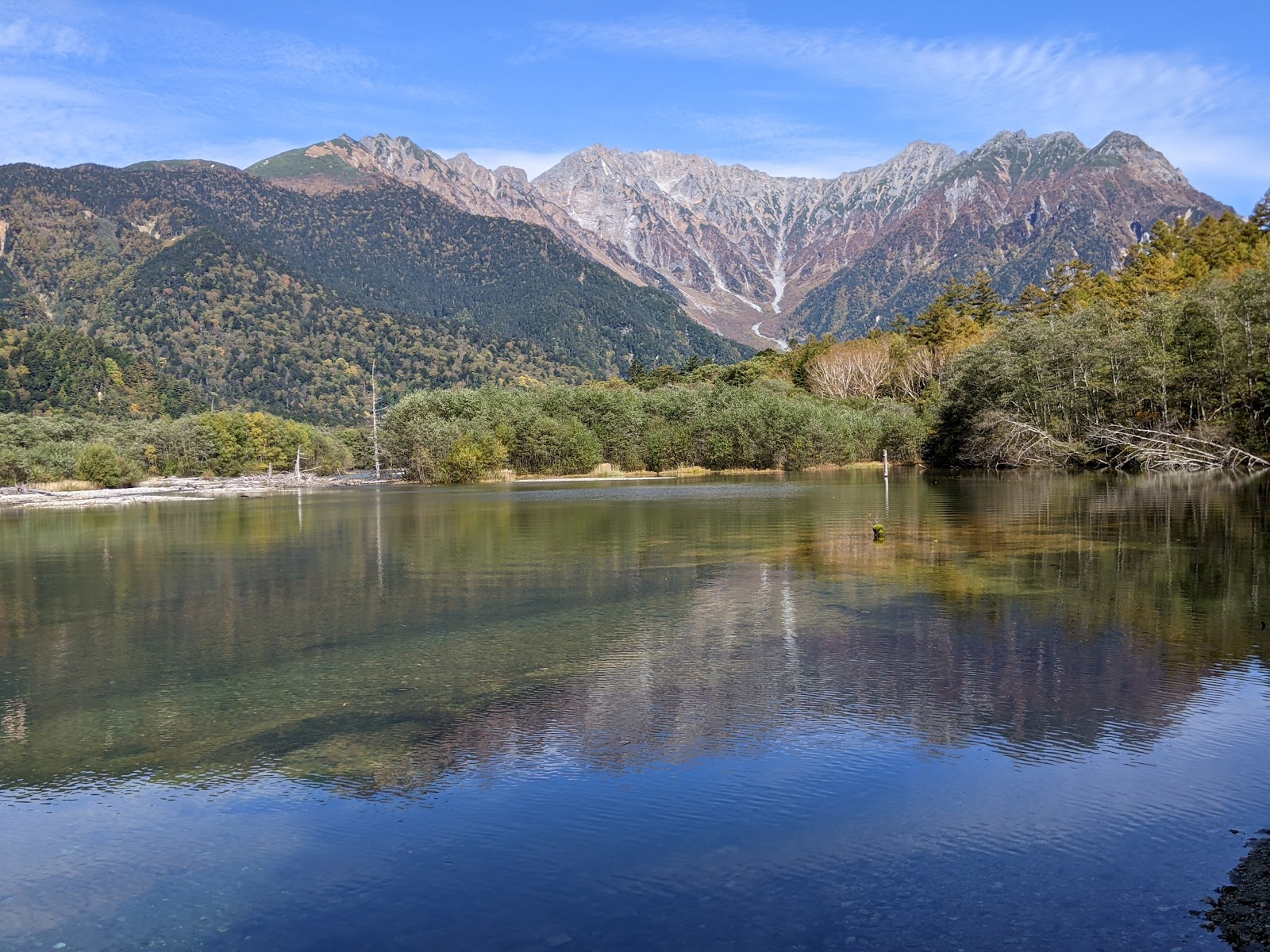
Most visitors use Kappa Bridge as the launch point for gentle valley walks. Downstream a flat riverside path leads in about an hour to the mirror-still Taisho Pond; upstream, an easy trail runs to Myojin Pond in roughly an hour, threading through wetland boardwalks, larch forest and marshy meadows where Japanese macaques often forage. Because private cars have been banned from Kamikochi since the 1970s, the air is exceptionally clean and the only sounds are the river, birdsong and the crunch of boots.
The visiting experience is deliberately unhurried. Around the bridge you will find lodges, a visitor centre, coffee stands and souvenir shops, so you can pair a serious sunrise photo session with an unhurried apple-pie-and-coffee break. Accessibility is good by mountain standards: the immediate riverside area is flat and partly paved, suitable for families and older visitors, though the longer trails require proper shoes.
Timing matters enormously. The valley opens from mid-April, greets fresh green in May and June, glows with alpine flowers in high summer, and peaks in beauty during the autumn koyo of early-to-mid October, when the larches turn gold against the still-snow-dusted Hotaka summits. Kamikochi closes entirely from mid-November to mid-April, so plan around the season. Getting here is part of the ritual: from Matsumoto you ride the Alpico railway to Shin-Shimashima and transfer to a bus (or drive to the Sawando park-and-ride and take the shuttle), since no private vehicles are allowed beyond the tunnel. Arrive early, walk softly, and Kappa Bridge rewards you with one of the defining images of mountain Japan.
A local's tip
Arrive before 8am: the tour crowds vanish and the Hotaka peaks are usually cloud-free before mid-morning.
Best time to visit
Early morning in autumn for clear Hotaka views
Getting there
From Matsumoto take the Alpico line to Shin-Shimashima, then the Kamikochi bus (private cars are banned year-round); the bridge is a 5-minute walk from the bus terminal. Kamikochi is closed mid-November to mid-April.
Good to know
- Wi-Fi
- Restrooms
- Restaurants
Plan the whole trip offline
Kappa Bridge is one of many places in the Real Japan app — with turn-by-turn directions, nearby spots and full offline maps you can use with no signal.