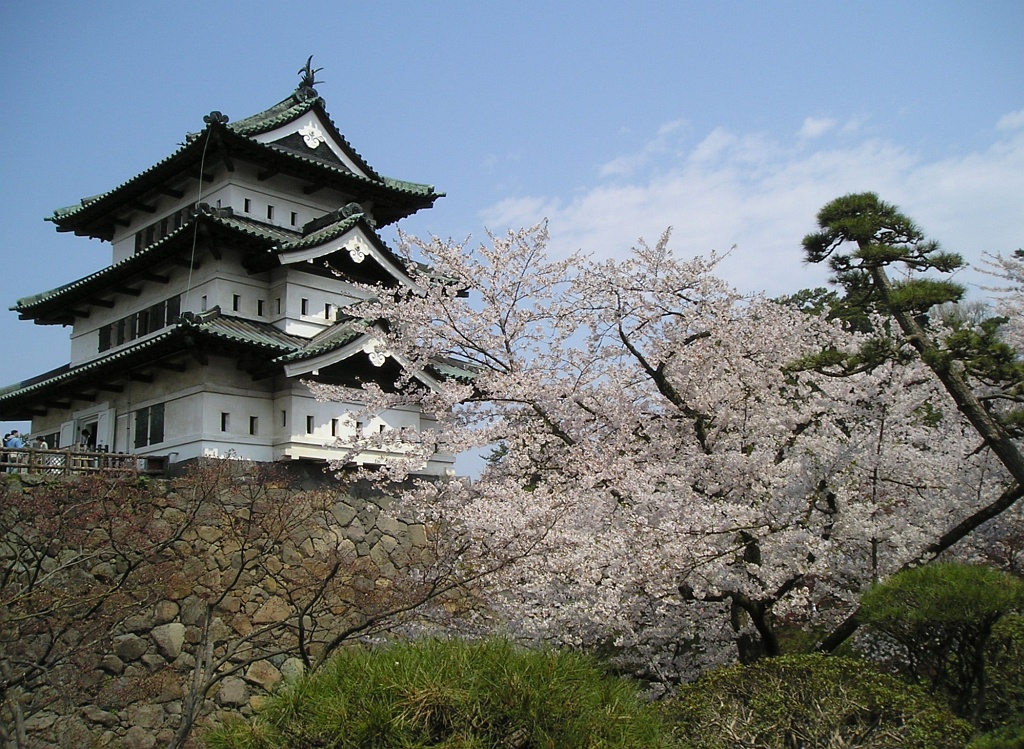
One of Japan's twelve surviving original castle keeps, ringed by 2,600 cherry trees whose fallen petals form the famous moat 'flower raft.'
Hirosaki Castle stands at the heart of Hirosaki Park, the seat of the Tsugaru clan who ruled this corner of northern Honshu for more than two and a half centuries. Completed in 1611 by Tsugaru Nobuhira, the castle originally rose five stories, but that keep was destroyed by a lightning-sparked fire in 1627 when its gunpowder store ignited. The present three-story keep was rebuilt in 1810 and is one of only twelve original castle towers surviving in Japan, making it a genuine Edo-period structure rather than a modern concrete reconstruction.
The keep is compact but atmospheric, its dark timber and white plaster set above stone ramparts and a wide moat. In 2015 engineers found the stone base beneath it was bulging and unstable, so the entire tower was moved roughly 70 meters on rails in a rare 'hikiya' relocation to allow the foundation to be repaired — a slow operation that became an attraction in itself. The keep is set to return to its original position once the stonework is finished.
Hirosaki is most famous for cherry blossoms. The park holds around 2,600 trees, and during the Hirosaki Cherry Blossom Festival in late April and early May the moats fill with fallen petals to form a pink carpet known as the 'hanaikada,' or flower raft. Local gardeners adapted apple-orchard pruning techniques for the cherry trees, which is credited with producing unusually dense, long-lived blossoms. Illuminated at night and mirrored in the water, the scene is regularly ranked among Japan's finest hanami spots.
Beyond the keep, the park preserves three original turrets, five gates, and its moat system, all designated Important Cultural Properties. Autumn brings vivid maple colour, and winter snow lanterns during the Hirosaki Snow Lantern Festival give the grounds a quieter beauty. The adjacent botanical garden and the nearby Fujita Memorial Garden reward a longer stay.
Visiting is straightforward. The park is open and free to enter year-round; only the castle keep and botanical garden charge a small fee, and a combined ticket is available. Paths are broad and mostly level near the moats, though the inner bailey involves some steps and gentle slopes. Allow at least ninety minutes, and considerably longer in blossom season when crowds are heavy.
Getting there: from Tokyo take the Tohoku Shinkansen to Shin-Aomori, then transfer to the JR Ou Main Line for Hirosaki Station, roughly three and a half to four hours in total. From Hirosaki Station the castle is about a 25-to-30-minute walk, or a short ride on the 100-yen Dotemachi Loop Bus to the Shiyakusho-mae stop beside the park's southeast corner. During the blossom festival, extra buses and clear signage make the route easy. Comfortable shoes are essential, and in April a warm layer is wise — Tsugaru spring evenings stay genuinely cold long after the trees have bloomed.
A local's tip
Come at dusk during the blossom festival to catch the illuminated keep reflected in the moat before the daytime crowds thin, then cross to the west moat for the 'hanaikada' petal raft.
Best time to visit
Late April cherry blossom season
Getting there
From Shin-Aomori take the JR Ou Main Line to Hirosaki (approx. 40 min); from Hirosaki Station walk about 25-30 min or ride the Dotemachi Loop Bus (100 yen) to Shiyakusho-mae by the park's southeast corner.
Good to know
- Wi-Fi
- Parking
- Restrooms
Plan the whole trip offline
Hirosaki Castle is one of many places in the Real Japan app — with turn-by-turn directions, nearby spots and full offline maps you can use with no signal.