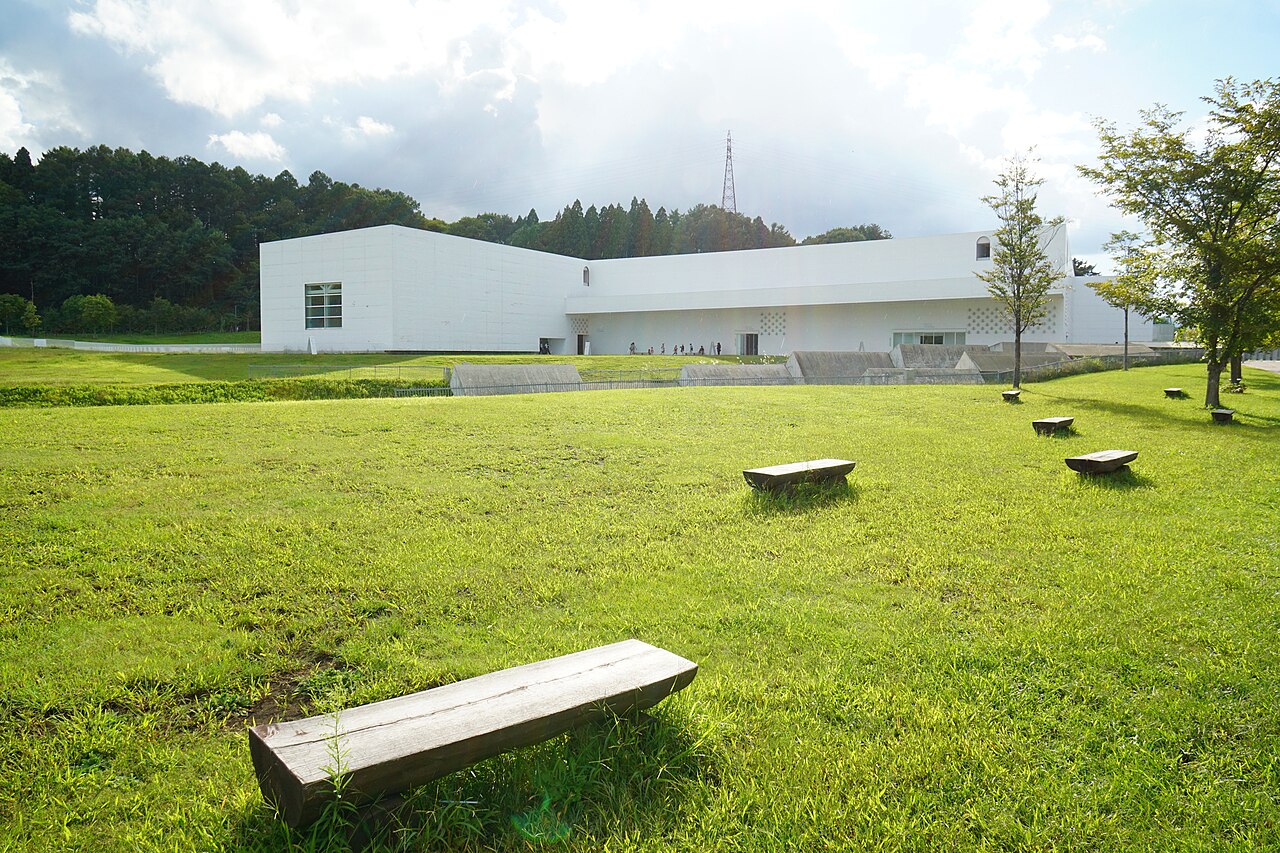
A striking white-and-earth museum showcasing Aomori-born artists like Nara Yoshitomo, next to the Sannai-Maruyama Jomon ruins.
The Aomori Museum of Art opened in 2006 on the edge of the city, deliberately placed beside the Sannai-Maruyama archaeological site — one of Japan's most important Jomon-era settlements and now part of a UNESCO World Heritage listing. That neighbouring made the building's concept: architect Aoki Jun designed the museum as a dialogue between excavation and structure, with crisp white volumes settling into trenches cut from the reddish earth, echoing the archaeologists' dig next door. The result is one of the most admired pieces of contemporary museum architecture in the Tohoku region.
The collection's great strength is its focus on artists connected to Aomori Prefecture. The best known is Nara Yoshitomo, the internationally celebrated painter of wide-eyed, faintly rebellious children, who was born in Hirosaki. The museum holds a major body of his work, and its signature piece is 'Aomori-ken,' a roughly 8.5-metre-tall white dog sculpture that sits patiently in a deep open-air courtyard, visible from surrounding galleries and beloved as the museum's mascot. Other rooms feature the woodblock printmaker Munakata Shiko, another Aomori native whose bold, spiritual prints won global recognition, and the avant-garde artist and writer Terayama Shuji.
Beyond its local heroes, the museum owns a remarkable set of theatre backdrops painted by Marc Chagall for a 1942 production of the ballet 'Aleko.' Three of the enormous canvases are displayed together in a soaring, purpose-built hall known as the Aleko Hall, their colour and scale making the room a highlight of any visit; the fourth is periodically loaned and rotated in. The museum balances this permanent collection with an active program of temporary exhibitions spanning modern and contemporary art.
Moving through the building is part of the pleasure. Galleries connect via stark white corridors and staircases that alternate with earthen-walled spaces, so the mood shifts constantly between clinical brightness and cave-like intimacy. The design is barrier-free with lifts throughout, and a shop and cafe round out the visit. Allow around ninety minutes for the permanent galleries, more if a special exhibition is on.
Getting there: from Tokyo, ride the Tohoku Shinkansen to Shin-Aomori Station, the closest rail hub. From there the easiest option is the city loop bus toward Sannai-Maruyama, which reaches the museum in about ten minutes; walking takes roughly twenty. Coming from central Aomori Station, the same loop bus route serves the museum in around twenty minutes. Because the Sannai-Maruyama Jomon site sits immediately adjacent and is free to enter, most visitors combine the two into a single outing — the reconstructed pit dwellings and towering timber posts of a 5,000-year-old village make a fascinating counterpoint to the contemporary art next door. The museum closes on Mondays (or the following day when Monday is a holiday) and over the New Year period, so it is worth checking the calendar before travelling out from the city.
A local's tip
Head straight to the four-story sunken gallery to see Nara Yoshitomo's giant 'Aomori-ken' dog sculpture, then pair the visit with the free Sannai-Maruyama ruins next door for a full half-day.
Best time to visit
Year-round
Getting there
From Shin-Aomori Station take the city 'Nebutan-go' loop bus toward Sannai-Maruyama (about 10 min) to the museum stop, or walk roughly 20 min; it sits beside the Sannai-Maruyama Jomon site.
Good to know
- Cafe
- Shop
- Wi-Fi
- Restrooms
Plan the whole trip offline
Aomori Museum of Art is one of many places in the Real Japan app — with turn-by-turn directions, nearby spots and full offline maps you can use with no signal.