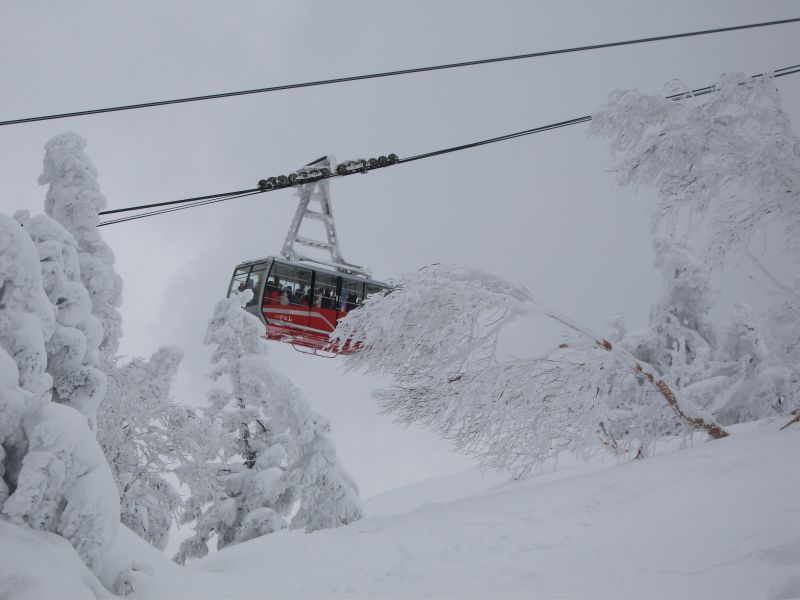
A 10-minute gondola to the Hakkoda Mountains for blazing autumn color and winter's famous frost-covered 'snow monster' trees.
The Hakkoda Mountains rise just south of Aomori city, a cluster of volcanic peaks that offer some of northern Japan's most dramatic seasonal scenery. The Hakkoda Ropeway carries visitors from a base station in the foothills up to the shoulder of Mount Tamoyachi at around 1,300 metres, a ride of roughly ten minutes that lifts you over dense forest and open slopes to a summit-station world quite unlike the city below.
Hakkoda is celebrated in two seasons above all. In autumn, usually peaking in the first half of October, the mountainsides erupt into a mosaic of crimson, orange, and gold as the beech, maple, and mountain ash turn — the colour arrives here earlier than almost anywhere else in Honshu, and the gondola glides directly over the canopy. In deep winter the same slopes host the 'juhyo,' or snow monsters: conifers so thickly plastered with wind-driven snow and frost that they swell into ghostly white figures, a phenomenon Hakkoda shares with only a handful of Tohoku mountains. Skiers and sightseers ride up together to walk among them.
From the summit station, a network of boardwalk trails loops across the alpine wetland known as the Tamoyachi marsh, giving easy, near-level walking with panoramic views back toward Aomori Bay and, on clear days, the Tsugaru Peninsula. Longer and more serious trails climb the surrounding peaks and descend toward the hot-spring hamlet of Sukayu Onsen, whose vast wooden mixed bath is a Tohoku institution and a natural pairing with a mountain day. Hikers should treat these upper routes with respect: Hakkoda's weather is notoriously fickle, and the mountains are infamous for a 1902 army training exercise in which a battalion was caught in a blizzard and nearly wiped out, a tragedy that still shapes local caution about winter conditions.
The short summit loop is manageable for most visitors in good weather, but the boardwalks can be slippery and the wind fierce, so sturdy shoes and warm, windproof layers are essential even in summer, when the city may be warm. The ropeway itself suspends service in high winds or storms, so it is wise to check operating status before committing to the trip out. Allow two to three hours including the ride and a summit walk.
Getting there: Hakkoda has no rail station, so the usual approach is by bus from Aomori. The JR Bus Tohoku 'Mizuumi-go' line runs from Aomori Station toward Lake Towada and stops at the ropeway base in about an hour; because it is a JR bus, holders of a Japan Rail Pass can ride it at no extra charge, a useful saving. The base station sits right beside the bus stop, with parking for those driving. Many travellers combine Hakkoda with Sukayu Onsen, Oirase Gorge, and Lake Towada, all strung along the same scenic route deeper into the Towada-Hachimantai highlands.
A local's tip
In late winter ride up to see the frost-caked 'juhyo' snow monsters, but check wind conditions first — the ropeway suspends operations in high wind, and the summit is far colder than the city.
Best time to visit
Autumn foliage (mid-Oct) and winter 'snow monsters'
Getting there
From Aomori Station take the JR Bus Tohoku 'Mizuumi-go' line toward Towadako (about 60 min) to the Hakkoda Ropeway stop; the gondola base is beside the bus stop.
Good to know
- Cafe
- Wi-Fi
- Parking
- Restrooms
Plan the whole trip offline
Hakkoda Ropeway is one of many places in the Real Japan app — with turn-by-turn directions, nearby spots and full offline maps you can use with no signal.