A preserved network of hand-dug wartime tunnels where Japanese naval commanders made their last stand.
The Former Japanese Navy Underground Headquarters is a haunting and remarkably preserved network of tunnels carved into a hill in Tomigusuku, just south of Naha, from which the Imperial Japanese Navy directed its part of the Battle of Okinawa in 1945. Descending into these narrow, humid passages offers one of the most direct and sobering encounters with the island's wartime tragedy that a visitor can have.
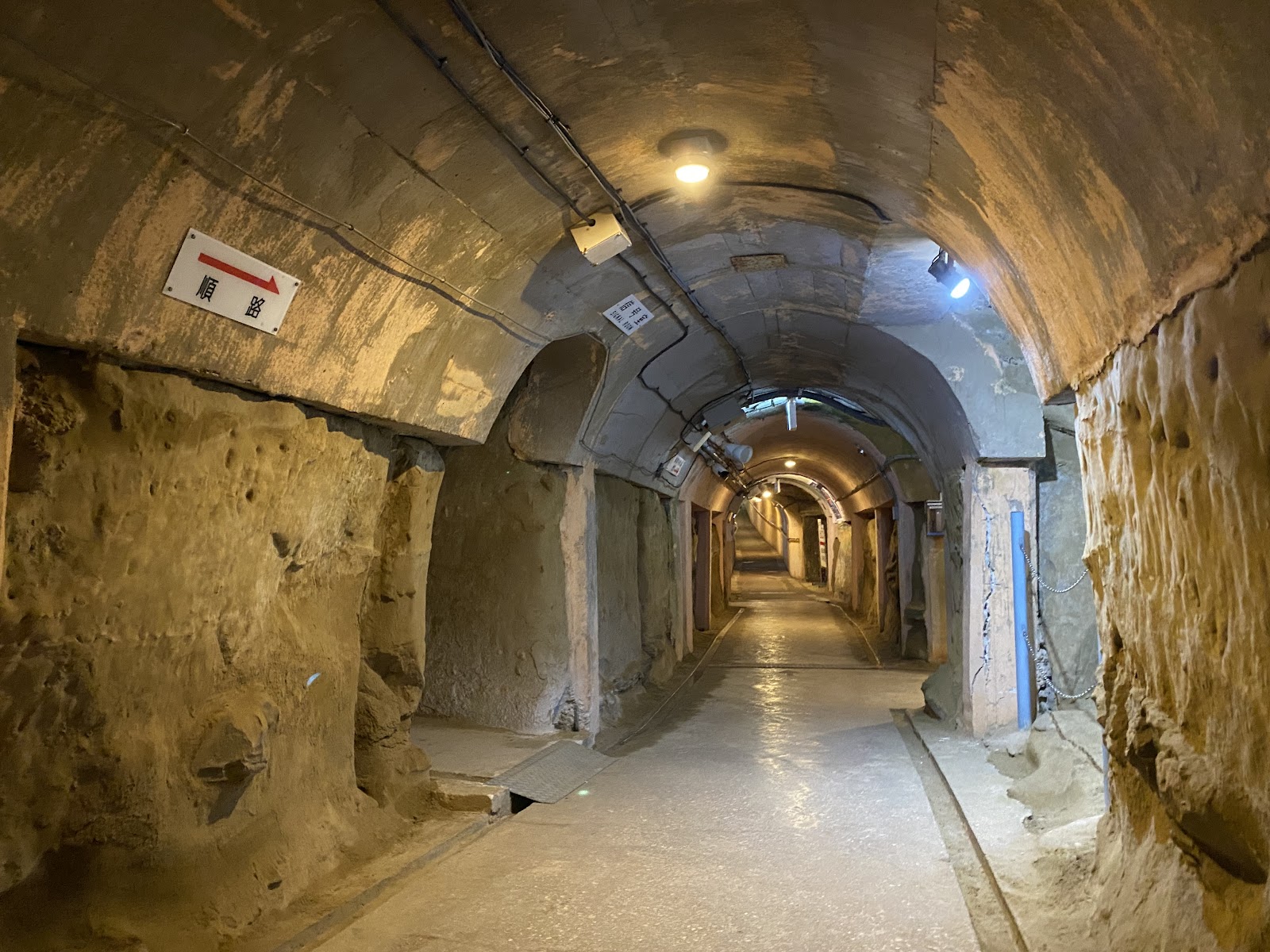
The tunnels were dug largely by hand by naval personnel and conscripted labor in late 1944, forming an underground labyrinth of some four hundred and fifty meters, of which roughly three hundred meters are open to the public today. The complex once sheltered around four thousand men and included an operations room, a code room, staff quarters, medical facilities and the commander's own room, all connected by cramped concrete-reinforced corridors buried deep enough to survive the ferocious American bombardment above.
The headquarters is inseparable from the figure of Rear Admiral Minoru Ota, who commanded the naval forces here. As the battle turned hopeless and the position was surrounded, Ota sent a famous final telegram to his superiors on the mainland, not asking for reinforcements but pleading that the people of Okinawa, who had suffered and sacrificed so greatly in support of the military, be shown special consideration by the nation in the future. That message, reproduced at the site, is remembered as a rare acknowledgment of the civilian suffering that defined the battle. In the closing days, rather than surrender, Ota and his senior officers took their own lives within these tunnels.
Walking through the preserved passages, visitors pass the operations room with its rough-hewn walls, the commander's quarters and the staff room, where the plaster is still scarred by the fragments of the grenades the officers used to end their lives. The atmosphere underground is close and still, and the sense of the final hours endured here by thousands of young men is powerfully immediate. Interpretive panels, many with English translations, explain the layout and the events, and personal effects and artifacts recovered from the tunnels are displayed in a small exhibition hall above ground.
On the surface, a monument and a peaceful garden overlook the surrounding city and the sea beyond, providing a place for quiet reflection after the intensity of the tunnels. From this vantage point it is easy to grasp the strategic value the hill once held and to contemplate how thoroughly the landscape has recovered from the devastation of 1945.
The headquarters complements the larger Peace Memorial Museum and the Himeyuri Peace Museum farther south, and together the three sites give a rounded understanding of the Battle of Okinawa from the perspectives of the military command, the civilian population and the mobilized students. Because the passages are narrow and involve steps and low ceilings, the visit requires a moderate level of mobility, and it can feel claustrophobic for some.
The site sits on a hill in Tomigusuku, reachable by local bus and a short walk or by a roughly twenty-minute taxi ride from central Naha, with free parking for drivers. Allow about an hour to walk the tunnels, view the exhibits and take in the garden and viewpoint above. It is a moving and essential stop for anyone seeking to understand Okinawa's wartime history.
A local's tip
Look closely at the pockmarked walls of the staff room — the scars were left by the hand grenades with which the naval officers took their own lives in the final days of the battle.
Best time to visit
Morning, before tour groups arrive
Getting there
From Naha Bus Terminal take a local bus toward Tomigusuku and Uebaru (about 25-30 minutes) to the Tomigusuku-jomae stop, then walk roughly 10 minutes uphill; or take a taxi from central Naha in about 20 minutes. Free parking is available.
Good to know
- Parking
- Restrooms
Plan the whole trip offline
Former Japanese Navy Underground Headquarters is one of many places in the Real Japan app — with turn-by-turn directions, nearby spots and full offline maps you can use with no signal.