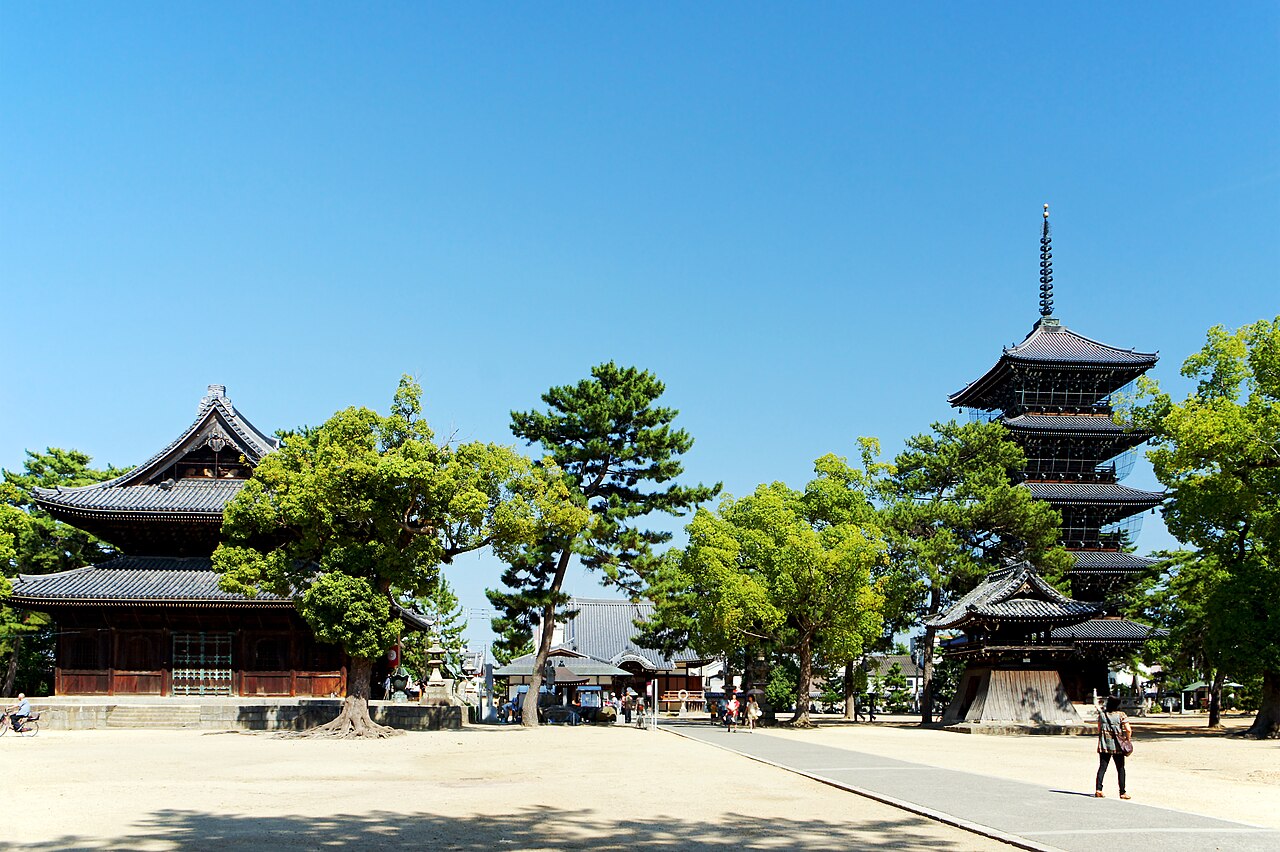
Birthplace of Kobo Daishi and 75th temple of the Shikoku pilgrimage, with a soaring five-story pagoda.
Zentsu-ji, in the city of the same name in western Kagawa, is one of the most important temples on the entire island of Shikoku, for it stands on the birthplace of Kukai — better known by his posthumous title Kobo Daishi — the towering 8th-9th century monk who founded the Shingon school of Esoteric Buddhism and who is the guiding spiritual figure of the famous 88-temple Shikoku pilgrimage. As the 75th temple on that circuit and the head temple of its own branch of Shingon Buddhism, Zentsu-ji holds a place of special reverence, and pilgrims in white robes come from across Japan to honor the great master at the very place he was born.
The temple was founded in the early 9th century, traditionally said to have been established by Kukai himself upon his return from studying esoteric Buddhism in China, and named after his father. Its spacious grounds are divided into two main precincts. The eastern precinct, the Garan, contains the main worship halls and the temple's most striking landmark: a magnificent five-story pagoda, nearly 45 meters tall, which soars above the surrounding trees and rooftops and is one of the tallest and most beautiful pagodas in Shikoku. A great camphor tree said to date from Kukai's own time also stands here, a living link to the temple's origins.
The western precinct, the Tanjo-in, marks the actual site of Kukai's birth and is the more sacred, contemplative heart of the temple. Here stands the Mieido, the founder's hall, and beneath it lies the temple's most famous devotional experience: the kaidan-meguri, a pitch-black underground passage that pilgrims walk in total darkness, one hand pressed to the wall, reciting invocations to feel a direct spiritual connection with Kobo Daishi. Emerging from the darkness is a moving moment of the pilgrimage, echoing similar dark-tunnel rituals at great temples elsewhere in Japan. A treasure hall displays religious art and relics associated with the temple's long history.
With its wide, gravel-and-tree-lined grounds, grand gates, and blend of imposing architecture and quiet sacred corners, Zentsu-ji rewards a leisurely visit whether or not one is walking the full pilgrimage. Cherry blossoms in spring and colored leaves in autumn frame the pagoda beautifully, and the presence of chanting pilgrims lends the temple a living, devotional energy that many find deeply atmospheric.
The grounds are free to enter, with a modest charge for the treasure hall and the dark-passage experience. The temple is an easy trip from Takamatsu on the JR Dosan Line, a walk of about 15 minutes from Zentsuji Station, and it pairs naturally with the nearby shrine town of Kotohira and Marugame Castle for a full day of western Kagawa's highlights.
For anyone interested in the Shikoku pilgrimage, the life of Kobo Daishi, or simply grand and serene temple architecture, Zentsu-ji is an essential and moving destination, the spiritual cradle of one of Japan's most revered religious figures.
A local's tip
Walk the pitch-black kaidan-meguri passage beneath the Mieido hall, running your hand along the wall as pilgrims do to feel a connection with Kobo Daishi.
Best time to visit
Year-round; pilgrim season brings a lively atmosphere
Getting there
Take the JR Dosan Line from Takamatsu to Zentsuji Station; the temple is about a 15-minute walk.
Good to know
- Shop
- Parking
- Restrooms
Plan the whole trip offline
Zentsu-ji Temple is one of many places in the Real Japan app — with turn-by-turn directions, nearby spots and full offline maps you can use with no signal.