A scattered 'museum without walls' of glass pavilions along Towada's main street, with permanent installations by leading contemporary artists.
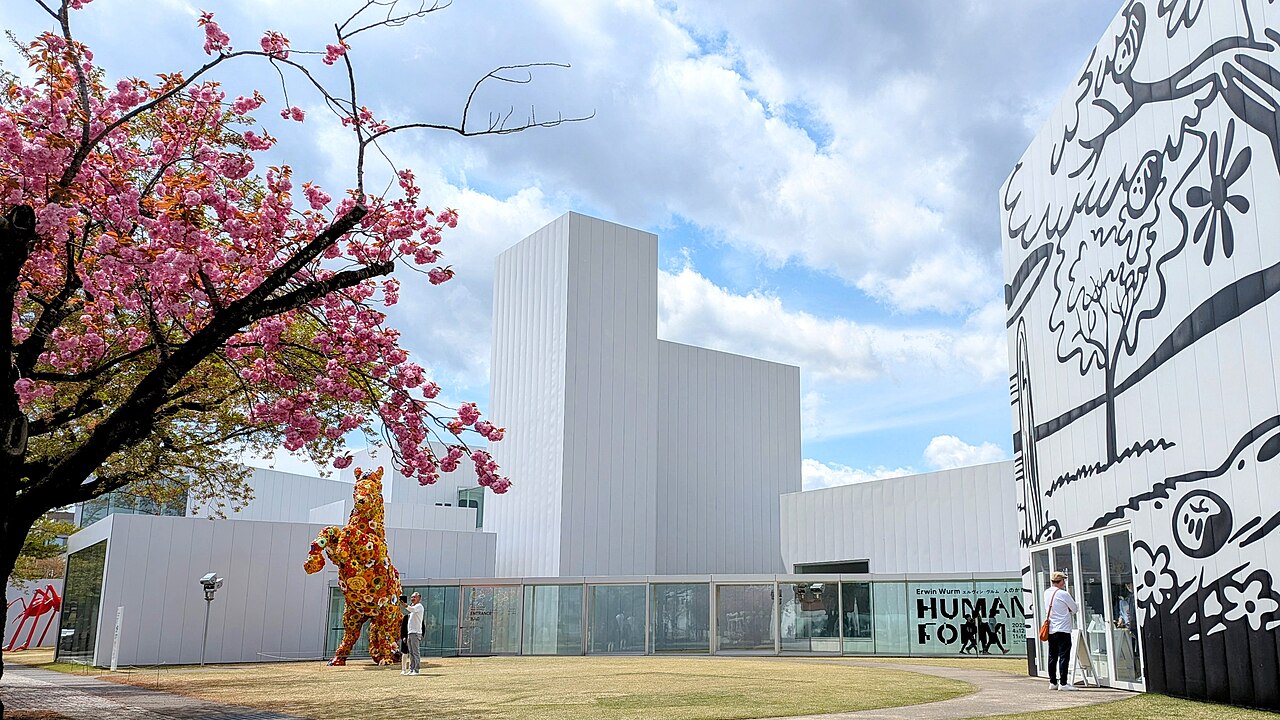
The Towada Art Center reimagines what a regional art museum can be. Opened in 2008 as the centrepiece of the Arts Towada project, it was designed by architect Nishizawa Ryue of the firm SANAA not as a single monolithic building but as a cluster of separate white cubes, linked by glass corridors, spread along Towada's main boulevard, Kanchogai-dori. Each cube houses a single commissioned work, so visitors move between free-standing pavilions, glimpsing the art through glass before entering, and the museum effectively spills out into the surrounding streetscape.
Rather than a rotating collection of paintings, the centre is built around permanent, site-specific installations by an international roster of contemporary artists. Ron Mueck's hyper-real 'Standing Woman,' four metres of unsettlingly lifelike sculpture, occupies its own room. Choi Jeong Hwa's flower-covered creature climbs an exterior wall, Ana Laura Alaez created an immersive mirrored space, and Noboru Tsubaki's enormous ant sculpture perches on the building. Because the works are fixed, the museum has a distinct personality that repeat visitors come to know, unlike institutions defined by their temporary shows.
The experience deliberately blurs the line between museum and town. Across the street, the free-to-enter Art Square gathers outdoor works into a public plaza, including Yayoi Kusama's exuberant grouping of polka-dotted pumpkins, mushrooms, and figures, which has become the town's photogenic emblem. The whole of Kanchogai-dori has been developed as an open-air gallery, with murals and installations along its length, so simply walking the boulevard is part of the visit and costs nothing.
Inside the ticketed pavilions, the atmosphere is calm, bright, and uncrowded — a marked contrast to Japan's blockbuster city museums. The layout is level and fully accessible, and a cafe and shop provide a pause. Because much of the appeal is outdoors and street-facing, mild-weather visits in spring through autumn are the most rewarding, though the interior works can be enjoyed year-round. Plan on around ninety minutes to two hours to take in both the paid galleries and the free square.
Getting there requires a little planning, as Towada is an inland city without its own train station. The nearest Shinkansen stop is Shichinohe-Towada on the Tohoku Shinkansen; from there a local bus runs to the Towada city centre in roughly 35 minutes, stopping close to the museum on Kanchogai-dori. Buses also connect from Hachinohe Station. Drivers will find parking nearby. Because the town sits on the approach to Lake Towada and the Oirase Gorge, the art centre pairs naturally with a wider trip into the Towada-Hachimantai region — a day that can move from cutting-edge contemporary sculpture to some of Tohoku's finest natural scenery. Note that the museum closes on Mondays and over New Year, so confirm opening days before making the journey out.
A local's tip
The free outdoor 'Art Square' across the street holds Yayoi Kusama's polka-dot pumpkins and mushrooms and Ron Mueck's giant sculptures — you can enjoy a lot without buying a ticket.
Best time to visit
Year-round; outdoor works best in mild weather
Getting there
From Shichinohe-Towada Shinkansen Station take a bus toward Towada city centre (about 35 min) to the Kanchogai-dori / Art Center stop; the museum lines the main Kanchogai-dori boulevard.
Good to know
- Cafe
- Shop
- Wi-Fi
- Restrooms
Plan the whole trip offline
Towada Art Center is one of many places in the Real Japan app — with turn-by-turn directions, nearby spots and full offline maps you can use with no signal.