The oldest Shingon temple in Kyushu, home to Japan's largest seated wooden Buddha and an atmospheric walk through darkness.
Tochoji, sometimes written Tocho-ji, is one of the most venerable temples in Fukuoka and, by tradition, the oldest Shingon Buddhist temple on the island of Kyushu. It was founded in 806 by the monk Kukai, better known by his posthumous title Kobo Daishi, immediately after his return from studying esoteric Buddhism in Tang China. He is said to have prayed here for the eastward spread of the teachings, and the temple has remained an active centre of the Shingon school ever since. After fire destroyed the original buildings in the late sixteenth century, the powerful Kuroda clan, lords of Fukuoka Castle, rebuilt and relocated it to its present site in Hakata, and members of the Kuroda family are buried in the grounds.
The temple's showpiece is the Fukuoka Daibutsu, a colossal seated wooden Buddha completed in 1992 after four years of carving. Rising 10.8 metres and weighing around 30 tonnes, it is the largest seated wooden Buddha statue in Japan, backed by a golden halo 16.1 metres high carved with countless smaller Buddhas. Beneath and behind the statue runs the Jigoku-Gokuro Meguri, the Path of Hell and Paradise: visitors first pass painted scenes of Buddhist hells, then grope through a completely dark corridor with one hand on the wall until they reach a metal ring said to represent the Buddha's wisdom, emerging back into the light as a small symbolic rebirth. It is free, brief and genuinely moving.
The temple holds treasures far older than the modern giant. Its Senju Kannon, a thousand-armed goddess of mercy carved from a single block of Chinese black pine in the Heian period, was designated a National Treasure and is displayed on special occasions. The hexagonal Rokkakudo hall, built in 1842, contains revolving sutra shelves and opens to the public on the twenty-eighth of each month, the day associated with Fudo Myoo. A five-storey vermilion pagoda, completed in 2011, rises above the compound and photographs beautifully against the sky.
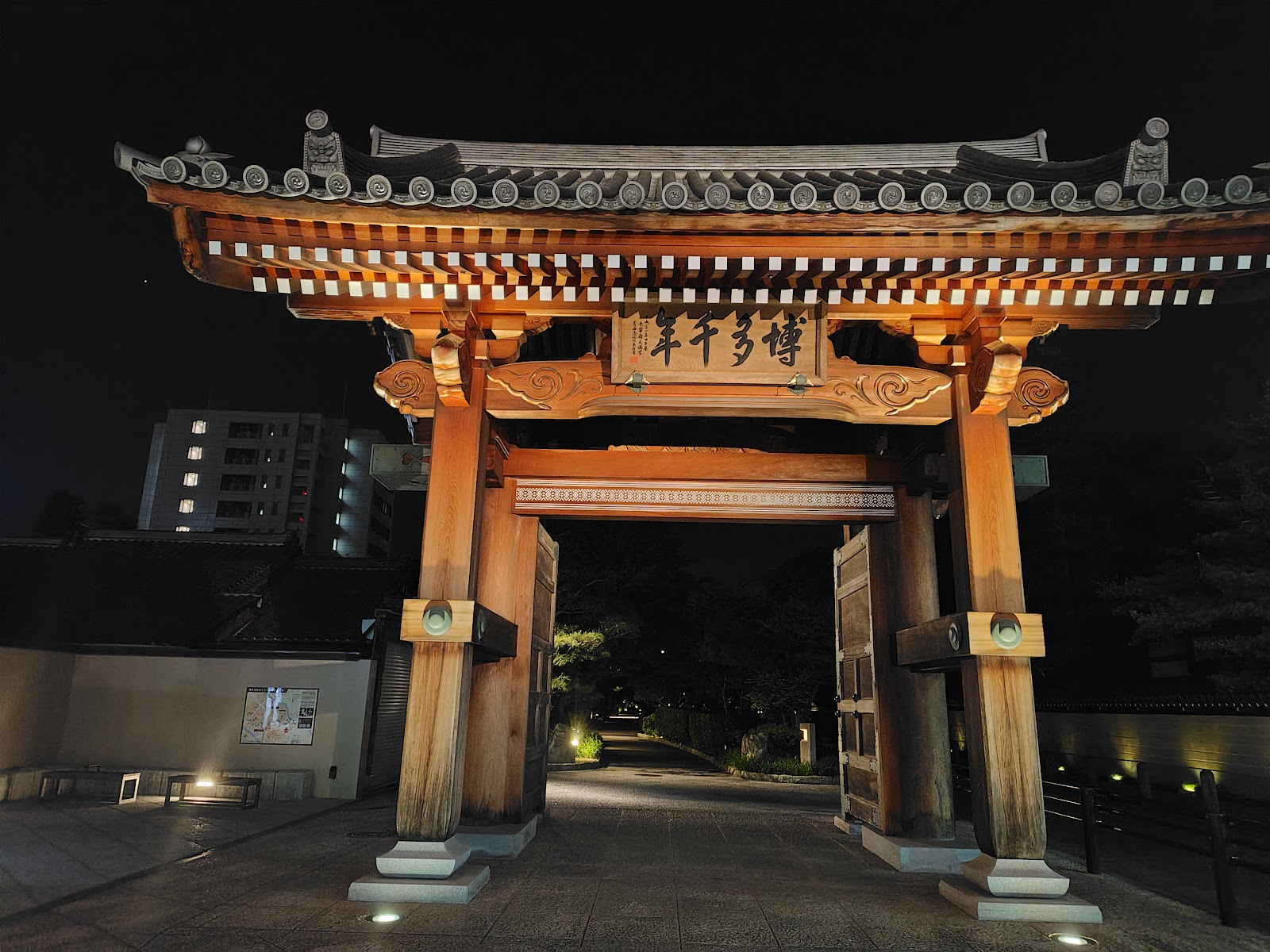
Because Tochoji sits directly above Gion subway station and just a few minutes from Kushida Shrine and Shofukuji, it slots naturally into a temple-and-shrine walk through historic Hakata. The grounds are compact and can be seen in half an hour, but they reward an unhurried visit: light a stick of incense, walk the dark passage, then sit for a moment before the towering Buddha as the smell of sandalwood fills the hall. Admission to the grounds and the Great Buddha is free, making this one of the most rewarding stops in the city for travellers on any budget, and a quiet counterpoint to the neon and shopping of nearby Nakasu and Canal City.
A local's tip
Below the Great Buddha is a pitch-black passage called the Path to Hell and Paradise; feel your way along the wall in the dark to reach the ring of enlightenment before returning to the light.
Best time to visit
Any time; the 28th of the month for the open Rokkakudo hall
Getting there
The temple stands directly above Gion Station on the Fukuoka City Subway Airport Line, one stop from Hakata Station. Exit the station and it is a one-minute walk to the gate.
Good to know
- Restrooms
Plan the whole trip offline
Tochoji Temple is one of many places in the Real Japan app — with turn-by-turn directions, nearby spots and full offline maps you can use with no signal.