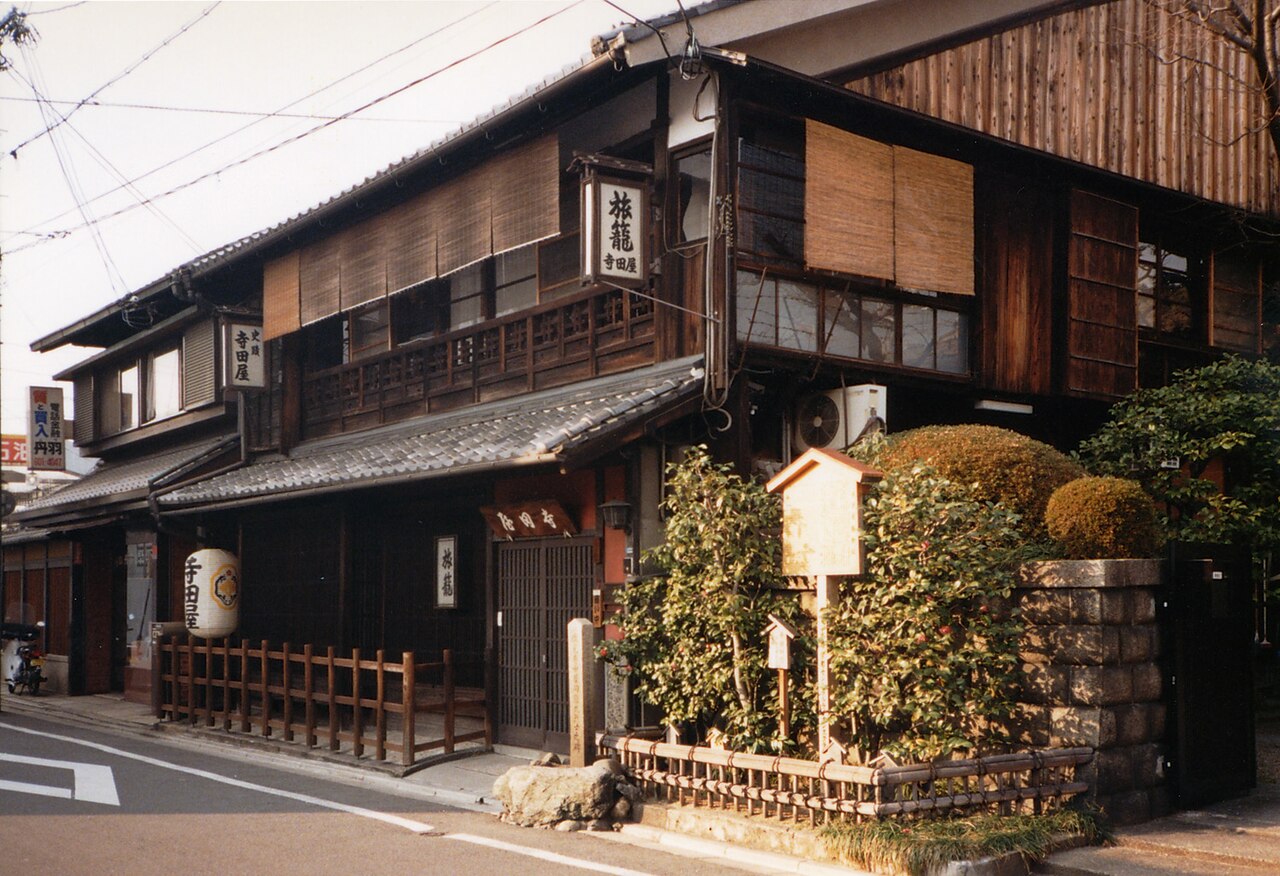
The historic Fushimi boatmen's inn where Sakamoto Ryoma narrowly escaped assassination in 1866.
Teradaya is a historic inn in the Fushimi district of southern Kyoto whose name is written into the drama of Japan's transition from feudal rule to the modern age. In the 19th century Fushimi was a bustling river port, the point where boats from Osaka along the Yodo River met the road to Kyoto, and inns like the Teradaya served the boatmen, merchants and travellers who passed through. It was precisely this position at a crossroads of movement and information that made the inn a haunt of the restless samurai activists of the Bakumatsu period.
Two events seared the Teradaya into history. The first, in 1862, was a bloody clash known as the Teradaya Incident, in which retainers of the Satsuma domain were sent to suppress a group of hot-headed radicals from their own domain who were plotting violence; the confrontation ended in a lethal fight among fellow clansmen in the inn. The second and more famous episode came in 1866, when the revolutionary strategist Sakamoto Ryoma was staying at the Teradaya and was surrounded by shogunate police intent on capturing or killing him. According to the celebrated account, Ryo, the young woman working at the inn who would later become Ryoma's wife, was bathing when she noticed the attackers massing outside; she rushed up the stairs, reportedly without stopping to dress, to warn him. Ryoma fought his way out with a pistol, wounded in the hands, and escaped to shelter under Satsuma protection, an escape that let him continue the political work that helped bring down the shogunate.
The wooden building destroyed during the Battle of Toba-Fushimi in 1868 was later reconstructed, and the Teradaya today operates as a museum and, in part, a working inn. Visitors can walk through the tatami rooms, see the narrow staircase associated with Ryo's famous dash, view a sword-scarred pillar, bullet marks and displays of period documents, portraits and memorabilia connected to Ryoma and the other figures of the age. A small statue and monument in the garden commemorate the events. It is worth noting that historians debate whether the present structure stands on the exact footprint of the original, which adds a layer of legend to the visit, but the atmosphere of the old inn and the power of the story carry the experience.
The visiting experience is compact and intimate: a self-guided walk through the preserved rooms takes around forty minutes, with signage mostly in Japanese, so a little background reading beforehand deepens the visit. The inn is small and can feel busy when tour groups arrive, so mornings are quieter.
Teradaya lies about a six-minute walk from Chushojima Station on the Keihan Main line, in the heart of the atmospheric Fushimi sake district, where willow-lined canals, old warehouses and famous breweries such as Gekkeikan cluster together. Combining the inn with a canal boat ride and a sake-tasting makes for a rewarding half-day that pairs the romance of the Restoration with the pleasures of one of Japan's great brewing towns.
A local's tip
The reconstructed inn is atmospheric, but note that scholars debate whether the current building sits exactly on the original spot destroyed in 1868; enjoy it as a shrine to the legend of Ryoma.
Best time to visit
Combine with a Fushimi sake-district stroll
Getting there
In the Fushimi district of southern Kyoto. Take the Keihan Main line to Chushojima Station and walk about 6 minutes through the old canal streets to the inn.
Good to know
- Restrooms
Plan the whole trip offline
Teradaya Inn is one of many places in the Real Japan app — with turn-by-turn directions, nearby spots and full offline maps you can use with no signal.