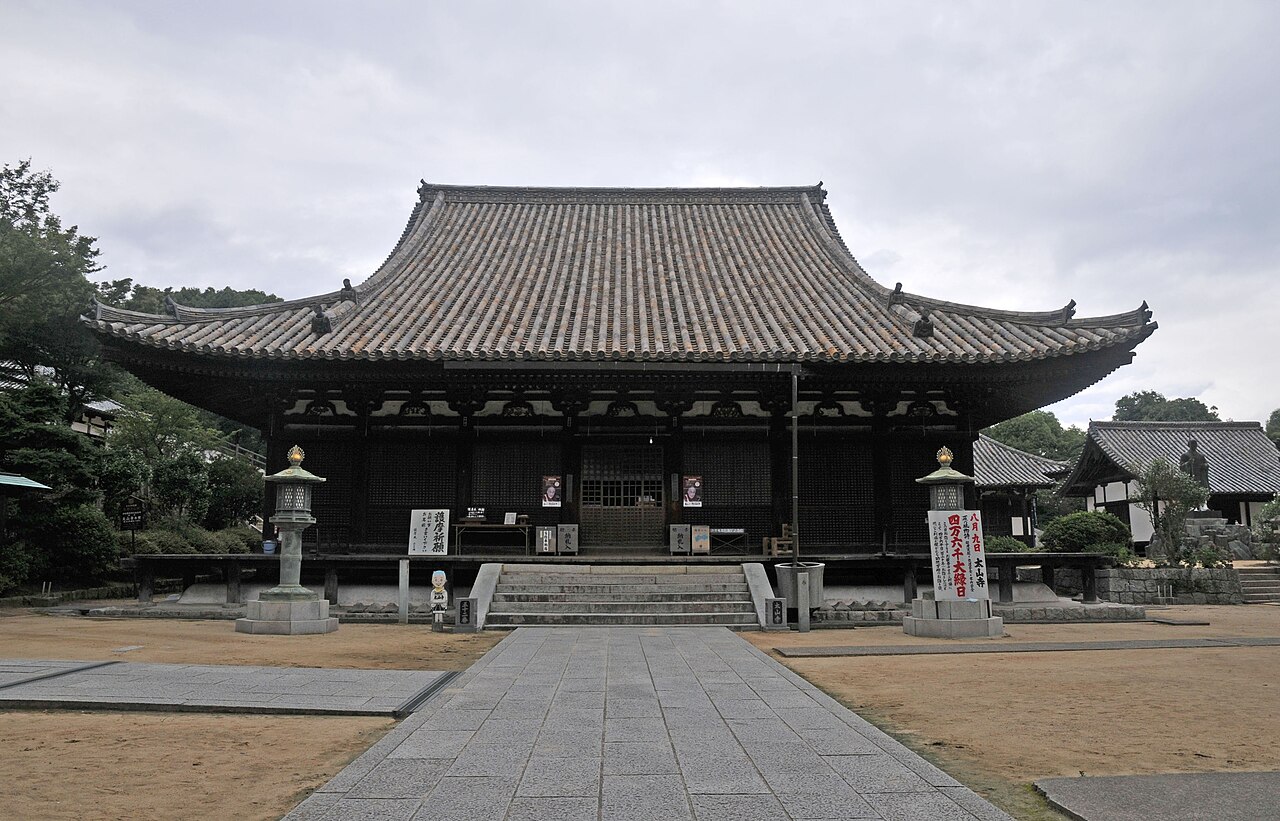
A serene Tendai temple in the Kobe hills whose 13th-century Main Hall is the city's only National Treasure.
Taisan-ji, set among the wooded hills of Ikawadani in the western Nishi ward of Kobe, is a temple of exceptional historical importance and quiet beauty - home to the only National Treasure in all of Kobe. Formally called Sanshinzan Taisan-ji, it is a temple of the Tendai school of Buddhism, and its tranquil, seldom-crowded grounds reward the traveler willing to venture beyond the city center with a genuine encounter with medieval Japan.
According to temple tradition, Taisan-ji was established in 716 on the instruction of Empress Gensho, founded by the statesman-monk Fujiwara no Umakai, making its origins some thirteen centuries old. Over the following ages it grew into a major religious complex. Its glory is the Main Hall, the Hondo: after an earlier hall was lost to fire in 1285, the present structure was completed around 1293, in the Kamakura period, and it survives today as one of the finest examples of the Wayo, or purely Japanese, architectural style of its era. In recognition of its beauty and rarity it has been designated a National Treasure of Japan - the highest rank of cultural property - and it is this hall that gives Taisan-ji its special standing. Standing before it, you look at woodwork and proportions essentially unchanged for over seven hundred years, a survivor of the age when Kamakura ruled Japan.
The temple precinct holds more than the Main Hall. There is a graceful three-storied pagoda, an Amida hall, gates and subsidiary buildings, and a garden, all set within a peaceful forested valley that feels a world away from Kobe's harbor and skyscrapers. The temple also preserves important Buddhist statues and cultural properties, and its setting - reached by a path through the trees - gives the whole visit the character of a retreat. In autumn the maples around the halls turn brilliant shades of red and gold, and the contrast of the ancient dark timber against the fiery leaves is unforgettable; spring brings its own softer beauty.
The visiting experience is contemplative and unhurried. Because Taisan-ji lies away from the usual tourist trail, you are likely to have much of it to yourself, free to walk the grounds slowly, sit before the National Treasure hall, and absorb the deep calm of a place that has been a site of worship for over a thousand years. Allow about an hour to do it justice.
Getting there takes a little effort, which is part of why it remains so peaceful. Take the Kobe Municipal Subway or the Sanyo Railway to Ikawadani in Nishi-ku, then continue by local bus or taxi toward Taisanji; the temple sits in the hills at the edge of the built-up area. Admission is a modest few hundred yen. For travelers with a serious interest in Japanese architecture, Buddhist history, or simply in finding the quiet, authentic corners that mass tourism has passed by, Taisan-ji is Kobe's hidden masterpiece - a National Treasure in a forest, waiting for those who make the journey.
A local's tip
The Main Hall is Kobe's only National Treasure - a rare surviving example of Kamakura-period Wayo architecture; take time to study its joinery.
Best time to visit
Autumn for maple color around the main hall
Getting there
In Ikawadani, Nishi-ku, western Kobe; take the subway or Sanyo line to Ikawadani, then a bus or taxi toward Taisanji - the temple is set in wooded hills away from the city.
Good to know
- Garden
- Parking
- Restrooms
Plan the whole trip offline
Taisan-ji Temple is one of many places in the Real Japan app — with turn-by-turn directions, nearby spots and full offline maps you can use with no signal.