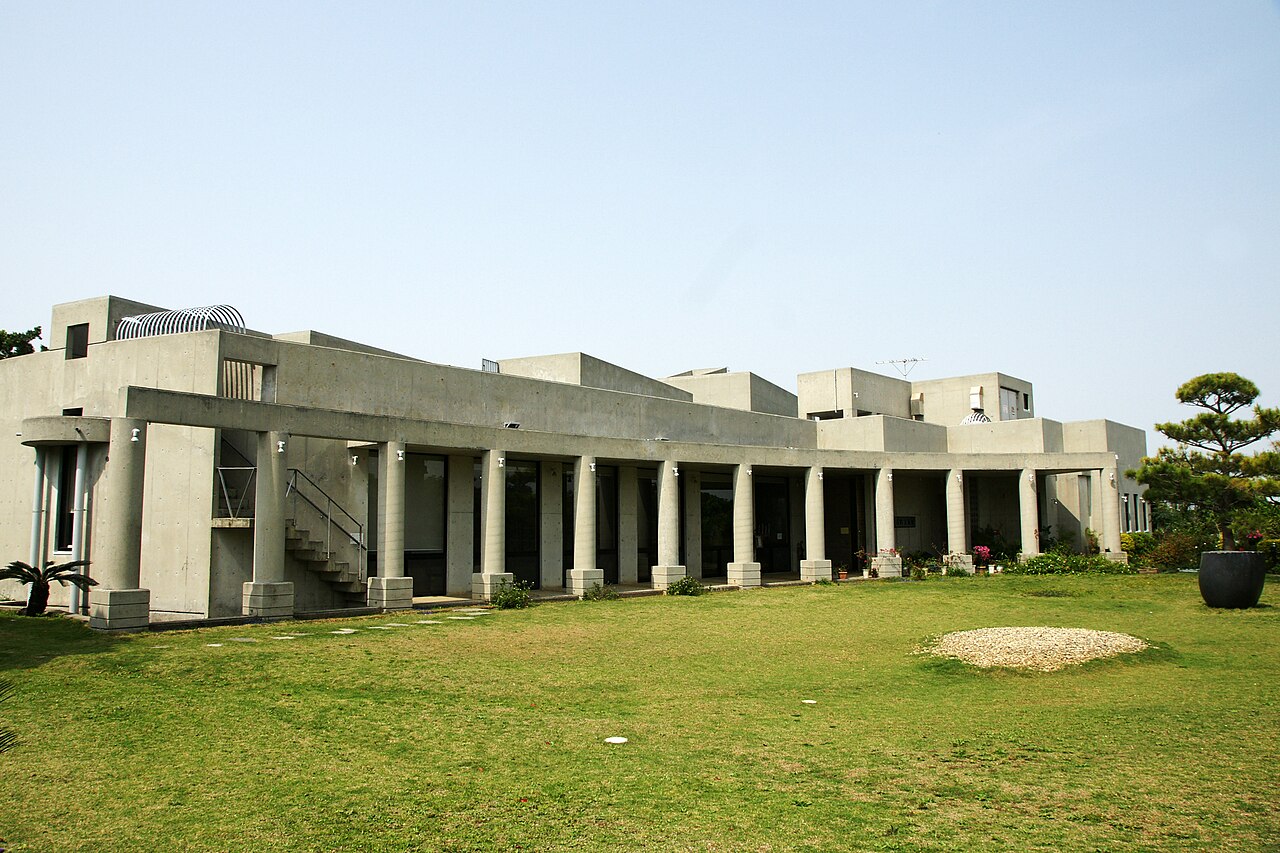
A private art museum on land reclaimed from a U.S. base, built around a monumental painting of the Battle of Okinawa.
The Sakima Art Museum is a small, deeply personal private museum in Ginowan that has become one of the most thought-provoking cultural destinations in Okinawa. Its story, its architecture and its collection are all bound up with the central dilemma of modern Okinawan life: the enormous presence of United States military bases on the island. The museum stands, quite literally, on land its founder reclaimed from the sprawling Futenma air base that presses against its walls.
The museum was established by Michio Sakima, whose family had ancestral land absorbed into the American base after the war. Through persistent negotiation he succeeded in having a portion of that land returned, and on it he built a museum dedicated to art that confronts war, suffering and the longing for peace. This origin gives the modest building an unusual moral weight, and the tension between the quiet galleries and the fighter jets and helicopters of the adjacent base is felt throughout a visit.
At the heart of the collection is the monumental painting known as the Battle of Okinawa, a vast folding-screen work by the celebrated husband-and-wife artists Iri and Toshi Maruki, who spent years documenting the atrocities of the twentieth century, most famously in their series on the atomic bombing of Hiroshima. Their Okinawa painting depicts the horror of the 1945 battle from the perspective of the island's civilians, its mass deaths, group suicides and the crushing of ordinary lives, in a sweeping, harrowing composition that dominates its gallery. Standing before it is an overwhelming and unforgettable experience, and the museum treats the work as the emotional and ethical center of everything it does.
The permanent collection also includes works by other artists who grapple with themes of war, humanity and peace, among them prints and paintings by European and Japanese figures such as Kathe Kollwitz, whose images of grief and maternal loss resonate powerfully alongside the Okinawan material. Temporary exhibitions extend these themes, and the intimate scale of the galleries encourages slow, reflective viewing rather than passive sightseeing.
The building itself is a work of quiet activism. Its most striking feature is a rooftop terrace, carefully oriented so that on the day of the summer solstice the setting sun descends into a deliberately placed notch in the parapet, framing a view directly over the fence and runways of the Futenma base. This poetic alignment turns the very landscape of military occupation into a meditation on peace and the passage of time, and the rooftop offers a sobering panorama of the base that has shaped the community around it.
A visit to the Sakima Art Museum is unlike any other on the island. It is not a place for casual entertainment but for reflection, and it pairs naturally with the Peace Memorial Museum and the wartime sites of the south to build a fuller picture of Okinawa's past and present. The museum lies beside Futenma in Ginowan, reached by bus from Naha in under an hour or a short drive with free parking. Allow around an hour for the galleries and the rooftop. Thoughtful, moving and quietly courageous, it rewards travelers willing to engage with the harder truths of Okinawan history.
A local's tip
Climb to the rooftop terrace, designed so that on the summer solstice the setting sun aligns with a notch overlooking the base — a deliberate artistic statement about peace and the land.
Best time to visit
Clear afternoon for the rooftop base view
Getting there
From Naha take a bus toward Ginowan and Futenma (about 40-50 minutes) to a stop near Futenma, then walk a few minutes; the museum sits right beside the fence of the U.S. Marine Corps Futenma air base. Free parking is available.
Good to know
- Parking
- Restrooms
Plan the whole trip offline
Sakima Art Museum is one of many places in the Real Japan app — with turn-by-turn directions, nearby spots and full offline maps you can use with no signal.