One of the Ryukyu Eight Shrines in Ginowan, famous for a 280-meter sacred limestone cave hidden beneath its grounds.
Futenma-gu, in the city of Ginowan in central Okinawa, is one of the Ryukyu Eight Shrines, the small group of shrines patronized by the Ryukyu Kingdom's government. What sets it apart from its siblings is what lies beneath it: a natural limestone cave about 280 meters long, roughly 50 meters of which is open to the public, containing an inner sanctuary and one of Okinawa's most significant archaeological sites. Artifacts from the late shell-mound period of some 3,000 years ago and animal fossils dating back around 20,000 years have been excavated here, making the cave a rare place where deep prehistory and living worship overlap.
The shrine's origins reflect Okinawa's layered spirituality. Long before it took Shinto form, the cave was a place of indigenous Ryukyuan worship, and the site later absorbed the Kumano deities that most of the Eight Shrines enshrine. Historically it also served as a guardian shrine for the castle town that grew up in this part of central Okinawa. Ginowan City designated the shrine and its cave a scenic spot in 1991, and a portion remains open to visitors free of charge.
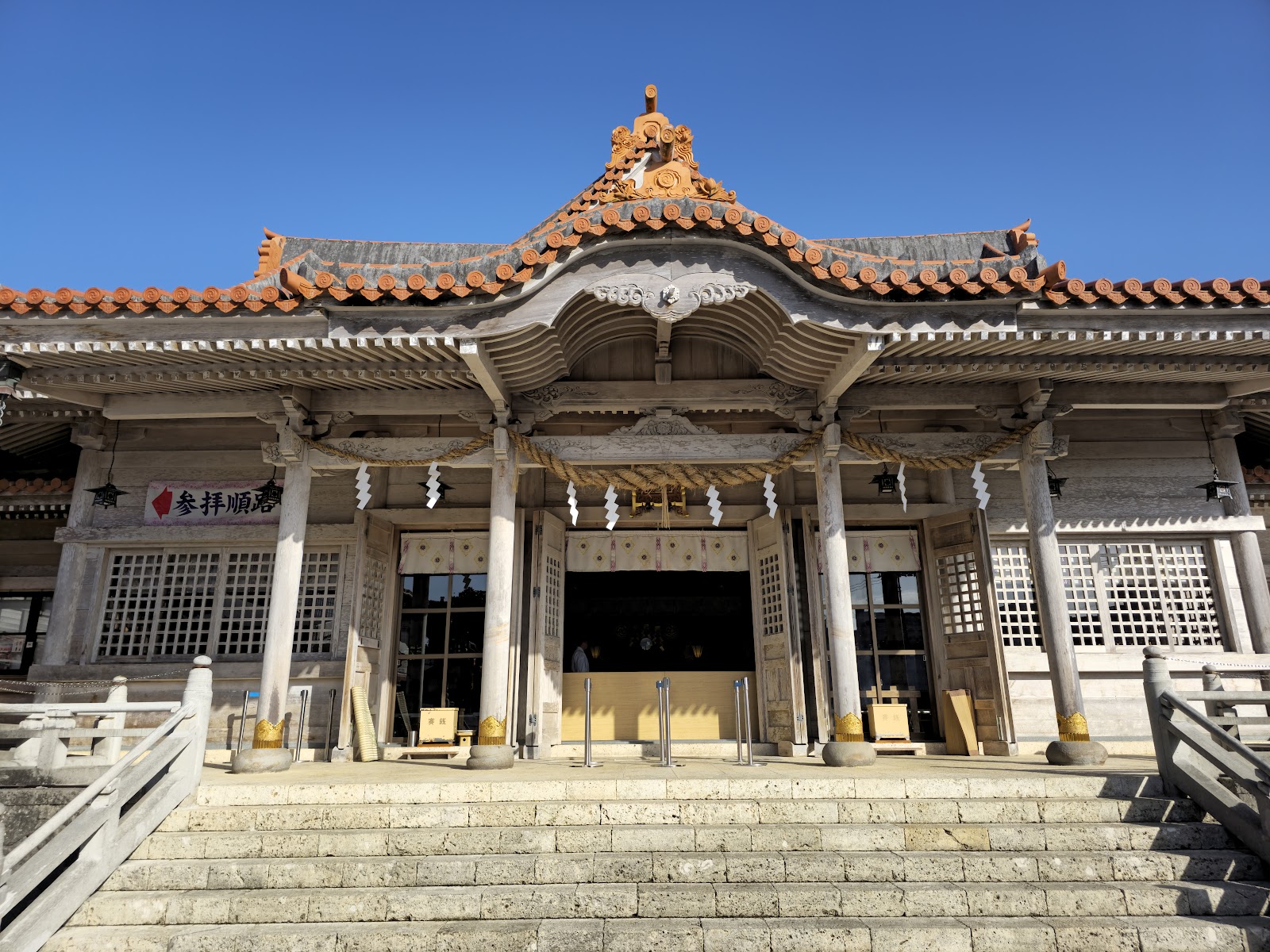
The visiting experience has two distinct halves. Above ground is a tidy, actively used shrine with a worship hall, torii, and the everyday rhythm of local prayer, hatsumode at New Year, and family blessings. Below is the cave, cool and dim, where a path leads past dripstone formations to the inner shrine deep in the rock. Descending from the bright subtropical grounds into the sacred cave is a genuinely memorable transition and the single best reason to make the trip out from Naha. To enter the cave you check in at the shrine office; access is free but hours are limited, so plan a daytime visit rather than an evening stop.
Highlights include the cave passage and inner sanctuary, the archaeological displays and signage explaining the excavated finds, and the contrast between the modern shrine and the ancient rock beneath it. Because the cave floor can be uneven and slightly slippery, wear sensible shoes; otherwise the site is easy and welcoming, with free parking and restrooms. Most visitors spend about forty minutes, longer if they linger in the cave.
Getting there requires a little planning because Ginowan lies well outside the reach of the Yui Monorail, which only serves Naha. The practical options are a city or highway bus from Naha Bus Terminal toward Futenma, alighting at the Futenma stop a short walk from the shrine, or a rental car, which reaches the site in roughly 30 to 40 minutes from central Naha. Okinawa has no JR line and no Shinkansen, so a JR Pass does not apply; IC cards can be used on local buses and the monorail. Futenma-gu pairs naturally with other central-Okinawa stops on a day of driving, and its sacred cave makes it one of the most distinctive shrine visits on the island.
A local's tip
Ask at the shrine office to enter the sacred limestone cave beneath the grounds; access is free but the opening hours are limited, so come during the day.
Best time to visit
Daytime, when the cave is open to visitors
Getting there
In Ginowan City, central Okinawa, with no monorail nearby. From Naha Bus Terminal take a highway or city bus toward Futenma and alight at the Futenma stop, a few minutes' walk from the shrine; by car it is about 30-40 minutes from central Naha with free parking. No JR exists on Okinawa.
Good to know
- Parking
- Restrooms
Plan the whole trip offline
Futenma Shrine (Futenma-gu) is one of many places in the Real Japan app — with turn-by-turn directions, nearby spots and full offline maps you can use with no signal.