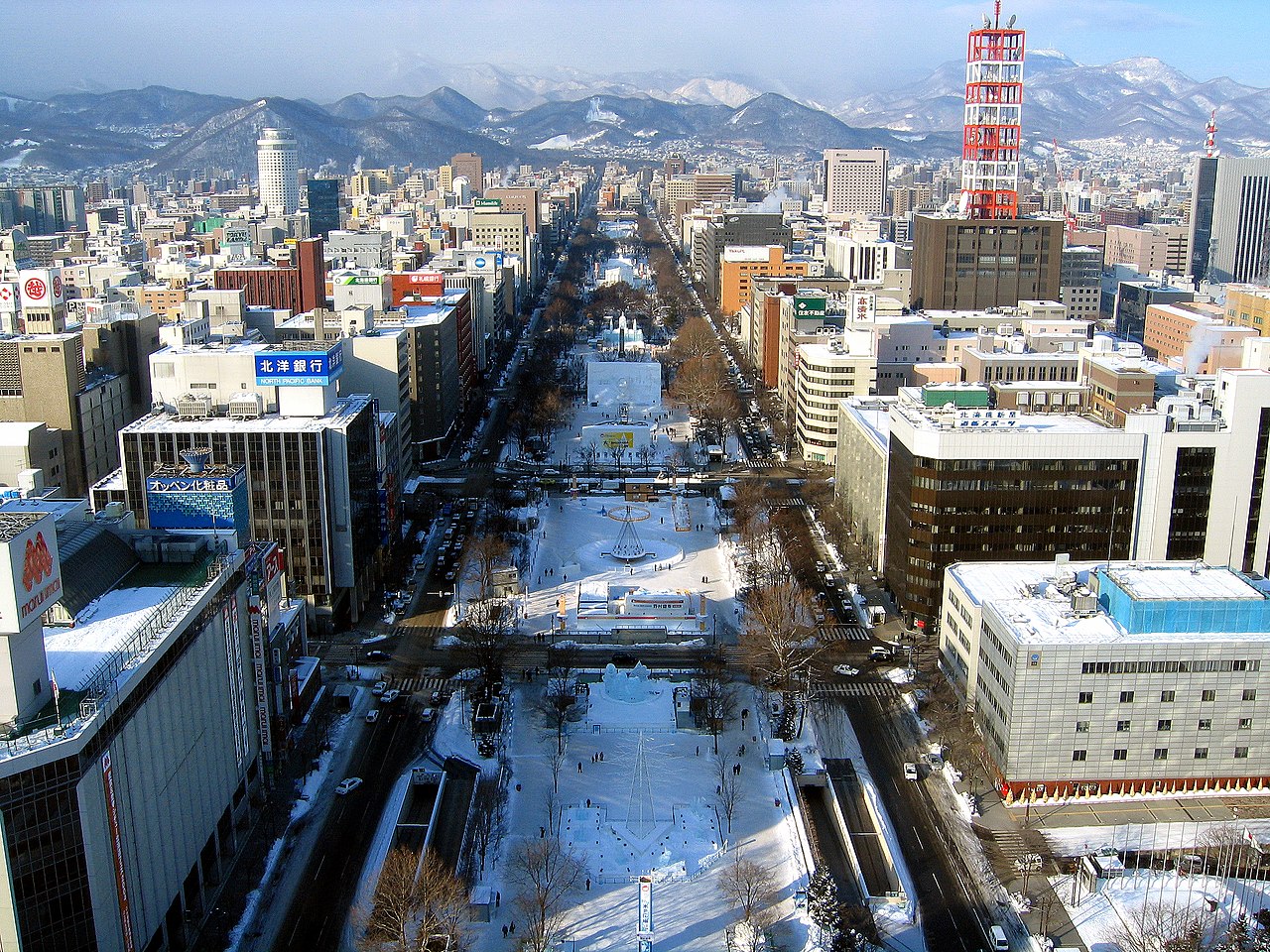
The green spine running through central Sapporo, home to the famous Snow Festival and summer beer gardens.
Odori Park is the great open-air living room of Sapporo, a strip of greenery roughly a hundred metres wide that runs for about a kilometre and a half through the exact centre of the city. Its name simply means "large street", and when Sapporo was laid out on a grid in the nineteenth century this corridor was designed as a firebreak dividing the administrative north from the commercial and entertainment south. Over time it was planted, landscaped and turned into a public park, and today it functions as the stage for nearly every major event in the Hokkaido capital.
The park is organised into blocks, each with its own character. There are fountains, rose beds, sculptures and lawns where office workers eat lunch, families picnic and travellers rest between sights. Groves of lilac and elm give shade in summer, and in autumn the trees turn gold and copper. At the eastern end stands the Sapporo TV Tower, whose observation deck gives the classic view straight down the green ribbon toward the mountains in the west, a composition that appears on countless postcards.
Odori's fame, however, rests on its festivals. Each February it becomes the main site of the Sapporo Snow Festival, one of Japan's largest winter events, when teams build colossal snow and ice sculptures, some several storeys tall, that draw millions of visitors from around the world. Illuminated at night and often themed around anime, landmarks or current events, these carvings turn the park into a glittering frozen gallery. In summer the mood flips completely: the Odori Beer Garden takes over the central blocks, with major Japanese brewers each running their own open-air section beneath the trees, and the smell of grilled food and the clink of glasses fills the warm evenings. Spring brings the Lilac Festival, and autumn hosts food fairs celebrating Hokkaido produce.
Because it sits directly above Odori subway station and threads through the heart of the city, the park is effortlessly accessible. Paths are flat and wide, making it easy for wheelchairs and strollers, and public restrooms are dotted along its length. You can drop into the park for a few minutes between shopping and dining, or linger for an hour watching the fountains and people.
A notable detail is the Black Slide Mantra, a spiral sculpture by the celebrated artist Isamu Noguchi that children are actively encouraged to climb and slide down, blurring the line between art and playground. Noguchi also contributed to the master plan of nearby Moerenuma Park, making Sapporo something of a showcase for his vision of public space.
The best time to visit depends entirely on what you want. Come in February for the surreal spectacle of the Snow Festival, in July or August for beer under the elms, or on any ordinary day for a calm green break in the middle of the grid. Whatever the season, Odori Park is where Sapporo gathers, and spending time here is the quickest way to feel the rhythm of the city.
A local's tip
During the summer Odori Beer Garden, buy from the far western blocks where seating is easier to find and prices from different brewers can be compared side by side.
Best time to visit
Summer for flowers and beer gardens; February for the Snow Festival
Getting there
Directly above Odori subway station in central Sapporo; every exit emerges into or beside the park.
Good to know
- Wi-Fi
- Restrooms
- Food stalls
Plan the whole trip offline
Odori Park is one of many places in the Real Japan app — with turn-by-turn directions, nearby spots and full offline maps you can use with no signal.