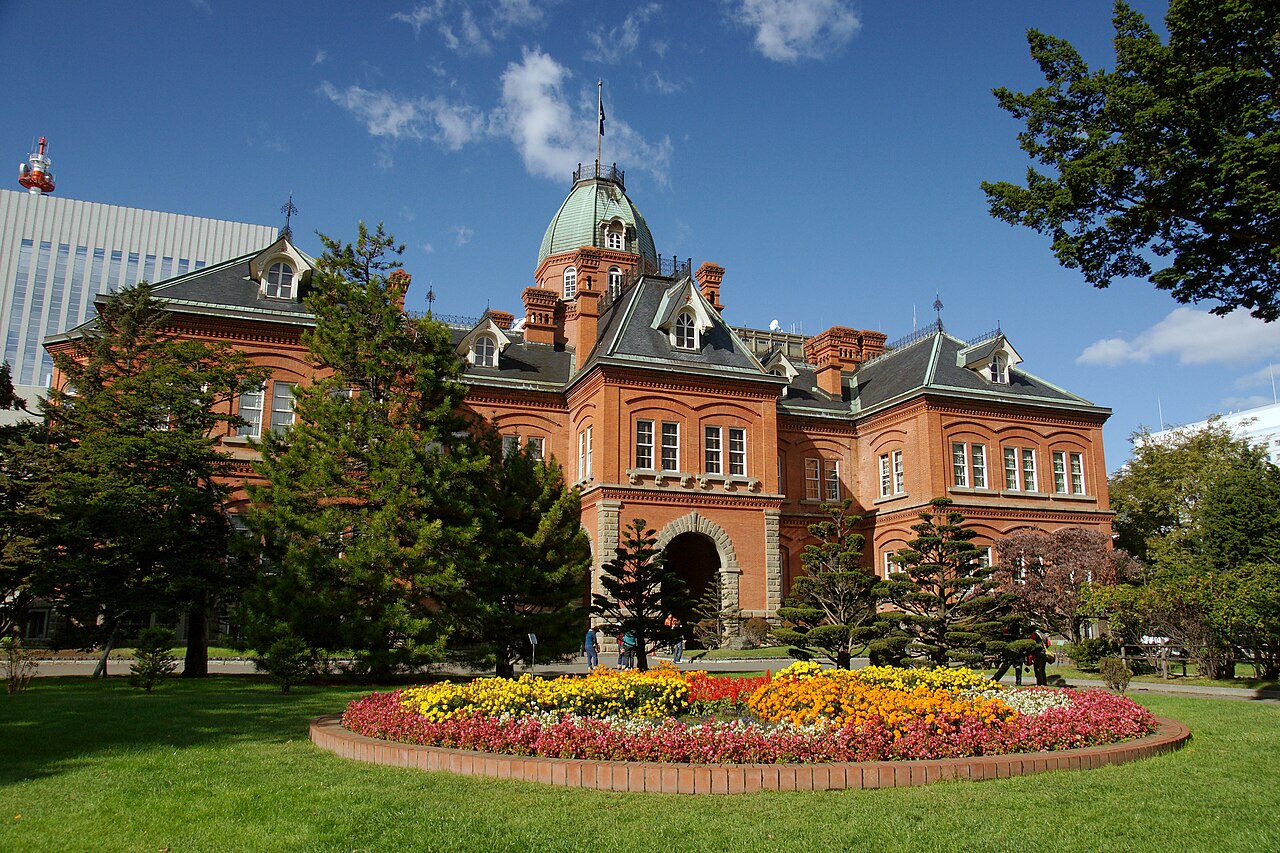
Sapporo's beloved red-brick former government building, an ornate American-influenced landmark set in a tranquil garden.
The Former Hokkaido Government Office, affectionately known to locals as Akarenga, meaning "red brick", is one of Sapporo's most photographed historic buildings and a proud emblem of Hokkaido's rapid nineteenth-century development. Completed in 1888, this grand neo-baroque structure served as the seat of the island's government for around eighty years. With its warm red-brick facade, symmetrical wings, central dome and ornamental gables, it stands in deliberate contrast to traditional Japanese architecture, embodying the outward-looking, Western-influenced ambition of the Meiji era.
The building was constructed using some 2.5 million locally fired bricks, an enormous undertaking that showcased Hokkaido's new industries and the government's determination to build a modern administrative capital in the north. Its American colonial and European styling reflects the strong foreign advisory presence that shaped early Hokkaido, and the octagonal dome that crowns it became an instant landmark on the young city's skyline. Above the entrance, the red star of the pioneer development agency, the Kaitakushi, is displayed, tying the building to the same frontier heritage seen across Sapporo.
For generations the Akarenga was not only an office but a symbol, appearing on postcards, in schoolbooks and in the civic imagination as the face of Hokkaido governance. When the administration moved to a modern tower nearby, the old building was preserved and opened to the public, housing archives and exhibitions on the history of the island's development, its relations with neighbouring regions, and the lives of its pioneers and indigenous Ainu people. Note that the building has undergone periods of restoration, so interior access can vary; the exterior and gardens, however, are the enduring draw.
The setting is a large part of the charm. The building faces a formal garden with lawns, mature trees and a pair of reflecting ponds that mirror the brick facade, creating one of the city's classic photo compositions. In spring the garden blooms, in autumn the trees blaze red and gold around the ponds, and in winter a thick coat of snow on the roof and grounds produces a scene of quiet, storybook beauty. Benches invite visitors to sit and take in the view, and office workers use the garden as a lunchtime refuge.
The experience is short, free and easy, making it a natural stop on a walk between Sapporo Station and Odori Park. The garden is flat and fully accessible, and most people spend around forty minutes strolling the grounds and, when open, touring the exhibits. English information is available inside.
A notable detail is the building's role as a touchstone of civic pride: it survived fires and the pressures of redevelopment to remain standing when many of its contemporaries were demolished, and its preservation reflects Sapporo's growing appreciation of its own young but distinctive heritage. Together with the nearby Clock Tower, it forms a compact ensemble that tells the story of how a frontier outpost became a major Japanese city in just a few decades.
The best time to visit is autumn for the foliage framing the ponds, or winter for the snow-laden facade, though the garden rewards a visit in any season. Reach it in about eight minutes on foot from Sapporo JR Station. It is an effortless, atmospheric introduction to the architecture and ambition of Hokkaido's pioneer age.
A local's tip
The reflecting pond in the front garden gives a near-perfect mirror image of the brick facade on a still day; come early morning before the wind picks up.
Best time to visit
Autumn for foliage around the garden pond; winter for snow on the red brick
Getting there
About eight minutes on foot south from Sapporo JR Station, or a short walk north from Odori Park.
Good to know
- Garden
- Benches
- Restrooms
Plan the whole trip offline
Former Hokkaido Government Office is one of many places in the Real Japan app — with turn-by-turn directions, nearby spots and full offline maps you can use with no signal.