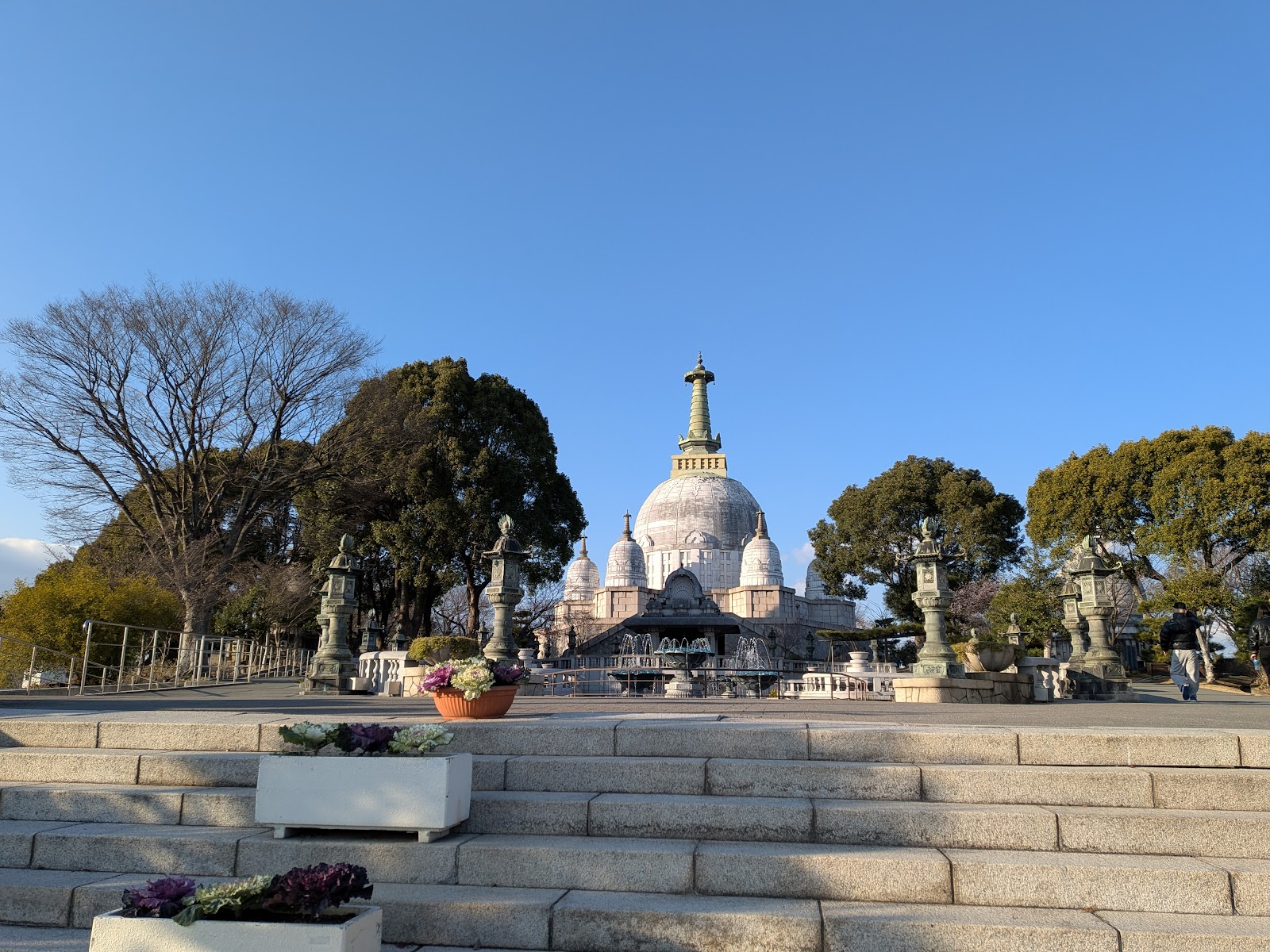
A serene hilltop cemetery park crowned by a large seated bronze Buddha and spring cherry blossoms.
On the wooded rise of Nagoyama southwest of Himeji Castle sits one of the city's more contemplative landmarks: the Himeji Great Buddha, a large seated bronze figure watching over the sprawling Nagoyama Reien cemetery park. Though far less famous than the White Heron Castle a few kilometers away, this quiet hill offers a peaceful, locals-only counterpoint to the tourist bustle and a genuinely striking image — a serene Buddha gazing out over the city and, in spring, a hillside blushing with cherry blossoms.
The original Great Buddha here dates from the early twentieth century, when it was cast as a symbol of peace and remembrance. Damaged and lost over the decades, the statue standing today is a modern recasting completed in 2010, seated in calm meditation on a stone pedestal. At several meters tall it is an imposing presence, and the surrounding plaza is deliberately open and uncluttered, letting the figure dominate the skyline of the hill. Steps lead up to the base, where visitors offer incense and quiet prayers, particularly during the equinox and Obon seasons when families come to tend ancestral graves.
Nagoyama Reien itself is a large public cemetery landscaped across the hillside, threaded with walking paths, stone lanterns, and stands of pine and cherry. It is a working burial ground rather than a manicured tourist garden, and that gives it an honest, lived-in dignity. In early April the cherry trees burst into bloom, and the contrast of pink blossoms against the dark bronze Buddha and grey headstones is quietly moving. Because few foreign visitors make the trip, you are likely to share the hill with only local families and the occasional caretaker.
The park sits between the castle and Tegarayama, making it easy to combine with other southern-Himeji sights. A short bus ride or a pleasant thirty-minute walk from the station brings you to the base, and from there gentle paths climb to the Buddha. There is no admission fee, the grounds are open around the clock, and basic restrooms and parking are available.
Allow around forty-five minutes to climb to the statue, walk a loop of the surrounding paths, and take in the views back toward the castle and out over the city. Bring water in summer, as the hill offers little shade near the top. For travelers who appreciate atmosphere over spectacle, Nagoyama rewards the detour: a place of remembrance where the everyday life of Himeji — its families, its seasons, its quiet faith — feels close at hand, all beneath the steady, peaceful gaze of the Great Buddha.
A local's tip
The current bronze Great Buddha was recast in 2010; climb the hill behind it in early April for cherry blossoms framing the statue with the castle visible in the distance.
Best time to visit
Spring for cherry blossoms
Getting there
From Himeji Station take a Shinki bus toward Nagoyama or Tegarayama (about 15 minutes) and walk up into the cemetery park, or take a taxi. By foot it is roughly a 30-minute walk southwest of the station.
Good to know
- Parking
- Restrooms
Plan the whole trip offline
Nagoyama Reien and Himeji Great Buddha is one of many places in the Real Japan app — with turn-by-turn directions, nearby spots and full offline maps you can use with no signal.