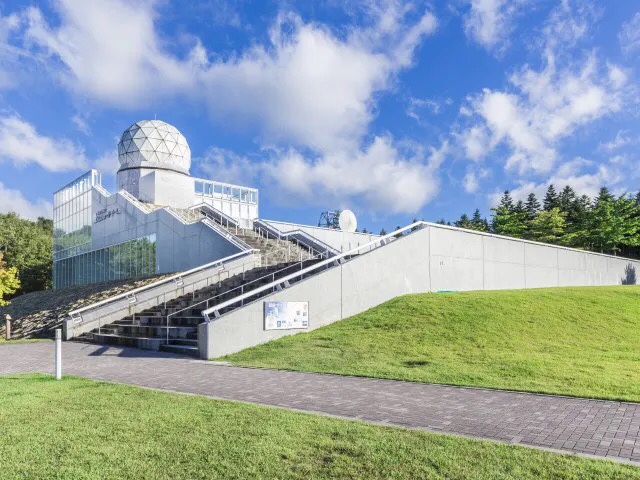
The relocated summit weather radar dome that once guarded Japan against typhoons, now a hands-on museum.
For nearly thirty-five years, a white spherical radar dome sat on the very summit of Mt. Fuji, at 3,776 metres, scanning the Pacific for approaching typhoons and giving Japan crucial early warning against the storms that regularly batter the archipelago. When newer satellite technology made it obsolete in 1999, the historic dome was carefully dismantled and rebuilt down in Fujiyoshida, where it now forms the Mt. Fuji Radar Dome Museum — a surprisingly moving tribute to human endurance and ingenuity.
The museum tells two intertwined stories. The first is technical: how the radar worked, how it detected distant typhoons, and how it transformed Japanese disaster forecasting in the 1960s and beyond. The second, and more affecting, is human: the extraordinary hardship of building and operating a weather station on Japan's highest, most exposed peak. Exhibits, photographs and film recount the near-impossible 1964 construction, the crews who wintered at the summit in brutal cold and thin air, and the daily struggle to keep the equipment running through storms and ice. The project even inspired a famous novel and film in Japan, and the museum captures that heroic, against-the-odds spirit.
The standout feature is the actual dome itself, which you can enter, along with hands-on exhibits that let visitors feel a fraction of the summit conditions. A refrigerated 'experience' room recreates the ferocious sub-zero wind that the observation crews endured, complete with the physical shock of the cold — a genuinely memorable and educational moment, especially for children, who tend to remember the shivering long after the facts. Interactive displays explain wind speed, atmospheric pressure and radar imaging in an accessible, playful way.
Historically, the site preserves a real artefact of national significance rather than a reconstruction: this is the same dome that stood on the roof of Japan for a generation. That authenticity gives the visit weight, and it complements the region's other museums nicely — where the World Heritage and Fujisan museums cover faith and art, this one honours science and grit.
The museum is located at the Michi-no-Eki Fujiyoshida roadside station, so it is easy to combine with a rest stop, a meal or shopping for local produce and Fuji-themed souvenirs. There is a cafe, a gift shop and ample parking, and the whole complex is a convenient pause on the drive up toward the Subaru Line and Fuji's Fifth Station.
The visiting experience is comfortable and family-friendly, mostly step-free apart from the dome interior, with English explanation on the key exhibits. Allow around 50 minutes. It is a strong all-weather choice, entertaining on rainy days and a welcome warm-up (or cool-down) any time of year. To get there, take a bus or taxi from Fujisan Station toward the Highland/Subaru Line road, or simply drive — the roadside-station location makes it one of the easiest museums in the area to reach.
A local's tip
There is a hands-on 'cold experience' room that recreates the -30C winds the summit crew endured — bundle up and try it for a visceral sense of what working atop Fuji was like.
Best time to visit
Any season; a good all-weather stop
Getting there
The museum is at the Michi-no-Eki Fujiyoshida roadside station; take a bus or taxi from Fujisan Station toward the Fuji Highland / Subaru Line road, or drive and use the roadside-station parking.
Good to know
- Cafe
- Parking
- Gift Shop
- Restrooms
Plan the whole trip offline
Mt. Fuji Radar Dome Museum is one of many places in the Real Japan app — with turn-by-turn directions, nearby spots and full offline maps you can use with no signal.