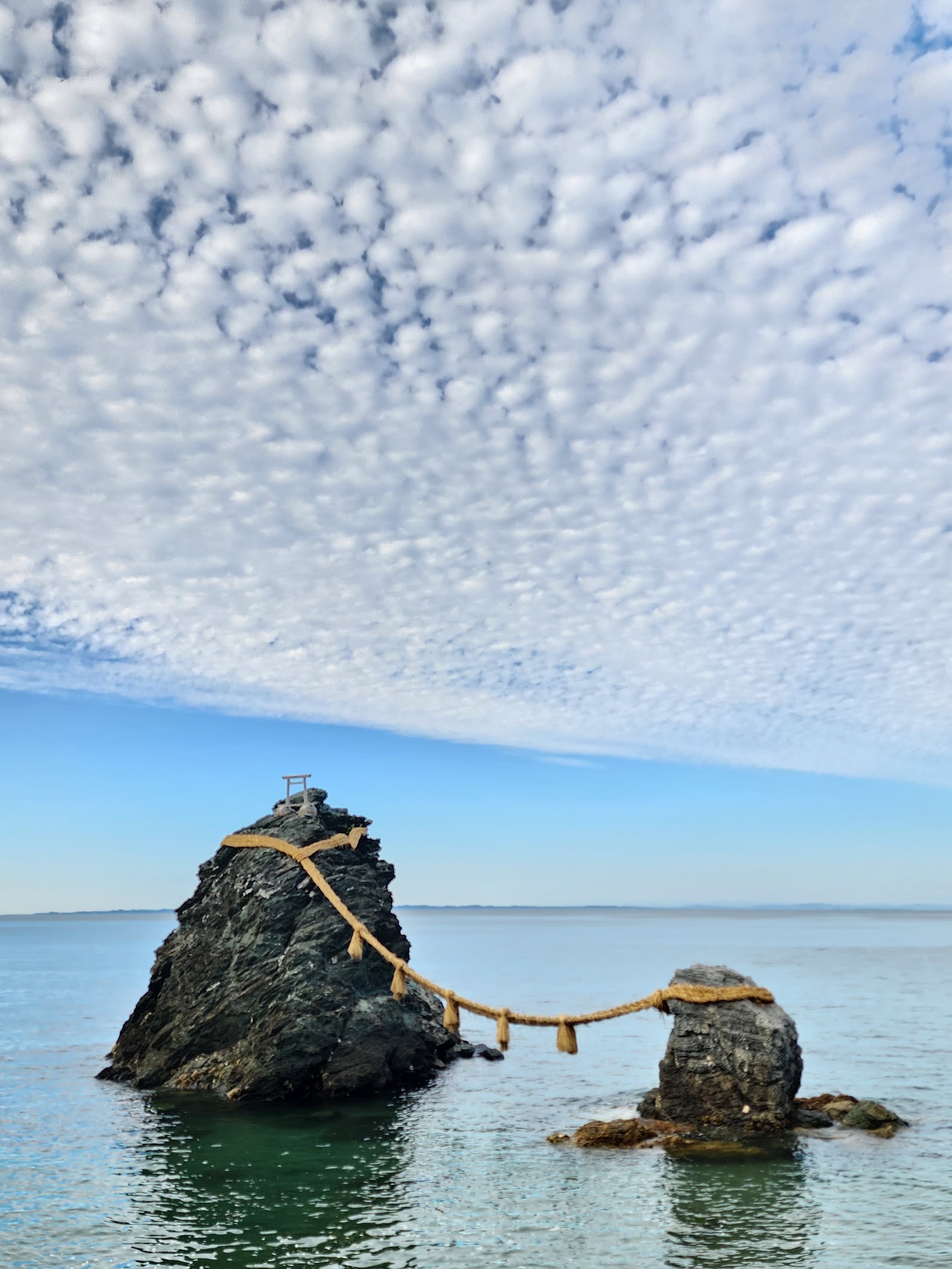
Two sea rocks joined by a sacred rope, symbolising marriage and the union of the creator deities, off the Futami coast.
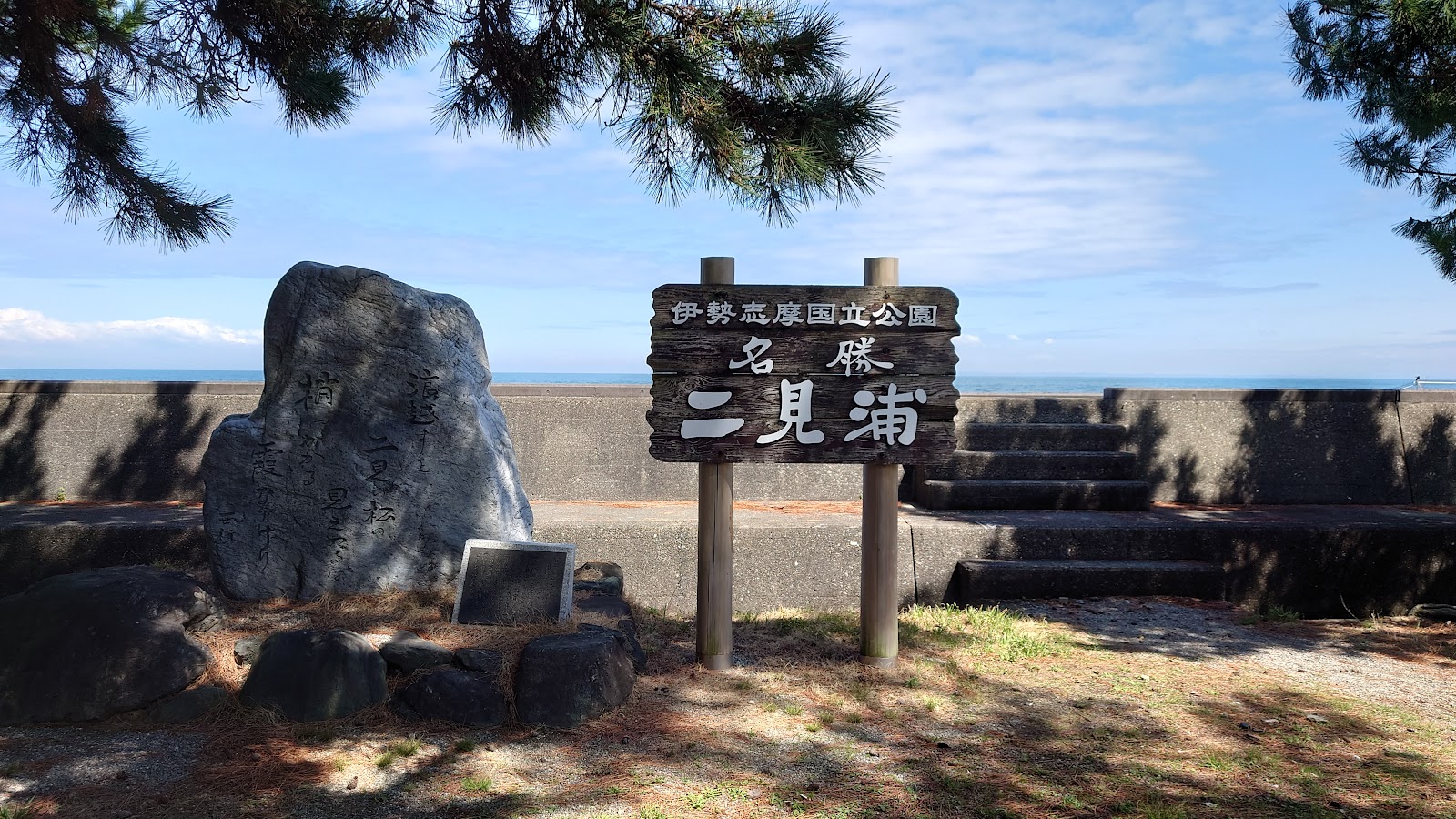
Meoto Iwa, the Married Couple Rocks, are two rugged sea stacks rising from the shallows off the Futami coast near Ise, bound together by a great shimenawa rope of braided rice straw. One of the most photographed sights in the region, they are both a natural landmark and a sacred site, embodying in stone the Shinto ideals of union, harmony and the presence of the divine in nature.
The rocks are associated with the shrine of Futami Okitama, which stands on the shore beside them and whose deity is Sarutahiko Okami, a guiding god. The larger rock, standing about nine metres tall, is considered the husband and is topped by a small torii gate; the smaller, some four metres tall, is the wife. Together they are said to represent the union of Izanagi and Izanami, the primordial couple of Japanese mythology who, according to the creation myths, gave birth to the islands of Japan and its gods.
The heavy sacred rope that links the two rocks is far more than decoration. It marks the boundary of a sacred realm and, in local belief, keeps the pair symbolically married. The rope weighs over a tonne and, weathered by wind and waves, is ceremonially replaced three times a year by priests and parishioners in a striking ritual that draws onlookers to the shore. In the space between the rocks lies a submerged stone said to be the true object of worship, a rock associated with Sarutahiko.
For visitors, the rocks are inseparable from the play of light over the sea. In the summer months, particularly around the solstice, the sun rises directly between the two stones, an auspicious and beautiful alignment, and on rare, exceptionally clear mornings the silhouette of distant Mount Fuji can be seen far beyond them. In winter the moon can take the sun's place in the gap. The shrine grounds are also home to numerous stone and bronze frogs, offered to Sarutahiko, whose Japanese name, kaeru, is a homophone for the verb to return, making the site popular with those praying for safe returns and reunions.
Historically, the Futami shore was where pilgrims to Ise Jingu would perform ritual purification in the sea before proceeding to the shrines, giving the area a lasting spiritual role as a place of cleansing. That heritage still colours the atmosphere today.
Meoto Iwa is reached by a short walk from Futaminoura Station and can be freely visited at any hour, with the shrine, souvenir shops and cafes clustered nearby. Sunrise is the classic time to come, but the rocks are photogenic in any light, and pausing on the shore to watch the rope-bound couple stand firm against the waves is a serene and quietly uplifting counterpoint to the forest shrines of central Ise.
A local's tip
Visit between May and July for the chance to see the sunrise, and on clear days distant Mount Fuji, framed between the two rocks.
Best time to visit
Sunrise in summer, when the sun rises between the rocks
Getting there
From Futaminoura Station on the JR Sangu Line it is about a 15-minute walk to the coast at Futami; the rocks and Futami Okitama Shrine sit together on the shore.
Good to know
- Parking
- Restrooms
- Souvenir shops
Plan the whole trip offline
Meoto Iwa (Married Couple Rocks) is one of many places in the Real Japan app — with turn-by-turn directions, nearby spots and full offline maps you can use with no signal.