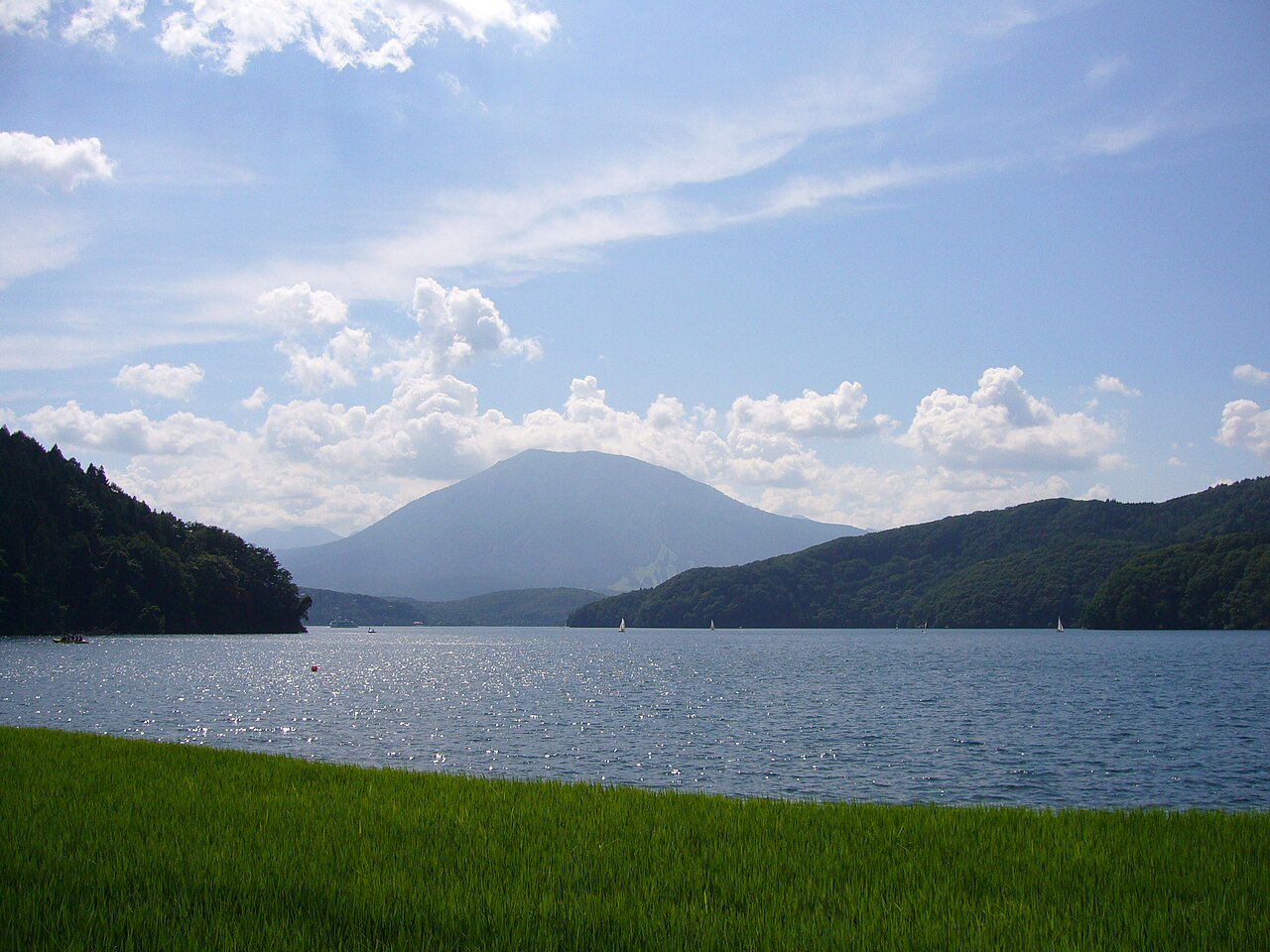
A tranquil highland lake near Mount Kurohime, ringed by forest and known for ancient elephant fossils.
Lake Nojiri is a peaceful highland lake in the far north of Nagano, set at about 650 metres among the foothills of Mount Kurohime and Mount Myoko, close to the border with Niigata. Ringed by wooded hills and dotted with a single small island, it has been a quiet summer resort for more than a century, favoured by international residents who built cottages along its shores in the early 20th century and gave one stretch the name International Village. Cooler and less crowded than the famous lakes further south, it offers a gentle, restorative escape into nature.
The lake is best known to scientists for an extraordinary discovery beneath its waters: the fossilised remains of Naumann's elephants and giant deer, Ice Age animals that roamed the area tens of thousands of years ago. Long-running excavations of the lakebed have yielded bones and tusks along with stone tools, suggesting the site was a hunting ground for early humans, and the finds are displayed at the Nojiriko Naumann Elephant Museum on the shore. A visit there adds a fascinating layer of deep time to what is otherwise a relaxed recreational lake, and it is especially good for families and anyone interested in prehistory.
Today Lake Nojiri is above all a place for gentle outdoor recreation. In summer its clean water draws swimmers, and visitors rent rowing boats, kayaks, canoes and stand-up paddleboards or take sailing lessons on the breezy afternoons; a small pleasure boat also cruises the lake. The wooded shoreline invites easy walking and cycling, birds are plentiful in the surrounding forest, and the nearby uplands of Mount Kurohime offer hiking and, in some seasons, wildflowers. In autumn the hardwoods around the lake turn glorious colours that reflect in the calm water, and lakeside cruises at that season are particularly lovely, while winter brings snow to the surrounding peaks and skiing to nearby slopes.
The lake's understated, cottage-country atmosphere is part of its charm. Rather than large resorts and crowds, it offers modest inns and holiday homes tucked among the trees, quiet coves and a sense of unhurried calm. This makes it a good base for exploring the wider Shinetsu highlands, including the Kurohime and Myoko areas and the surrounding forests, or simply for a slow day by the water. The northern location and altitude keep summers pleasantly cool.
Getting there is straightforward. From Nagano, itself about 90 minutes from Tokyo on the Hokuriku Shinkansen, take the Shinano Railway Kita-Shinano Line to Kurohime Station, then a short bus or taxi ride, roughly 10 minutes, brings you to the lakeshore; drivers reach it easily via the nearby expressway. Whether you come to paddle across its clear water on a summer afternoon, to see the Ice Age fossils drawn from its depths, or to watch the autumn colours mirrored on its surface, Lake Nojiri rewards visitors with a gentle, uncrowded slice of northern Nagano nature.
A local's tip
Ancient Naumann elephant fossils were dug from the lakebed; visit the on-site museum, then rent a boat or SUP on the water.
Best time to visit
Summer for water sports; autumn for foliage cruises
Getting there
From Nagano, take the Shinano Railway Kita-Shinano Line to Kurohime Station, then a bus or taxi to the lakeshore (about 10 minutes).
Good to know
- Parking
- Restrooms
- Boat rental
Plan the whole trip offline
Lake Nojiri is one of many places in the Real Japan app — with turn-by-turn directions, nearby spots and full offline maps you can use with no signal.