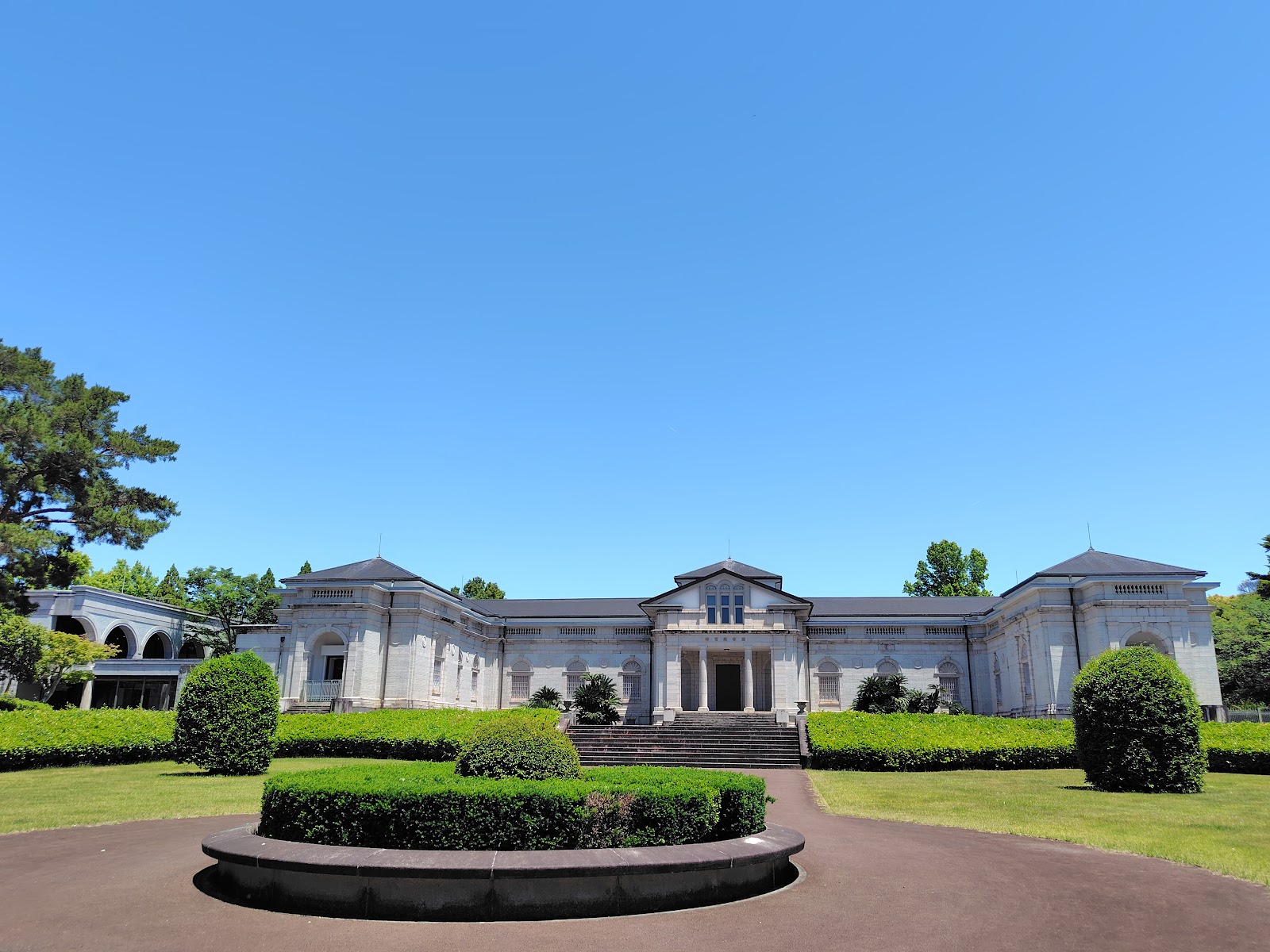
Ise Jingu's history museum in a chateau-style Meiji building, displaying ritual treasures and offerings to the shrine.
The Jingu Chokokan, often translated as the Museum of History, is the oldest of Ise Jingu's cluster of museums and one of the earliest purpose-built museums in all of Japan, opened in 1909. It occupies a stately Renaissance-revival building on the wooded slope of Kuratayama Park, positioned deliberately between the Outer and Inner Shrines so that pilgrims might absorb the history of the sanctuary as they travelled between its two halves. The architecture alone rewards the trip: a symmetrical stone-and-plaster facade modelled on a French chateau, designed by Katayama Tokuma, the architect behind Tokyo's Akasaka Palace, standing incongruously grand amid the cedars.
Inside, the collection illuminates the material world of Ise Jingu and its 1,500-year relationship with the imperial court. Displays include ceremonial objects, ancient documents, textiles, arms and armour, and the elaborate offerings presented to the deities over centuries. Because the shrine renews its sacred treasures every twenty years during the Sengu, the museum preserves and exhibits examples of the exquisitely crafted swords, mirrors, weaving implements and lacquered furnishings that embody the peak of traditional Japanese craft. Each object was made not for display but for the gods, and the quality reflects it.
The Chokokan also documents the long history of the Ise pilgrimage itself — the okage-mairi, mass movements of ordinary people who walked from across Japan to reach the shrine during the Edo period, sometimes millions in a single year. Maps, votive paintings and pilgrim paraphernalia bring alive an era when a journey to Ise was the trip of a lifetime, and the roadside towns of Oharaimachi and Furuichi thrived on the traffic.
Adjacent on the same grounds sit two sister institutions, the Jingu Agricultural Museum and the Jingu Museum of Fine Arts, so a visit here can easily expand to a half-day of quiet, uncrowded culture away from the shrine throngs. The surrounding Kuratayama Park is planted with cherry trees that bloom in spring and maples that turn in late autumn, and benches on the hillside offer a restful pause with views over the city rooftops toward Ise Bay.
For travellers, the Chokokan answers a question the shrines themselves leave unspoken: what has actually happened here across fifteen centuries, and why does it matter enough to rebuild everything, forever, every two decades. English signage is limited, so a guidebook or translation app helps, but the objects and the building speak for themselves. Allow about 75 minutes, and combine it with the neighbouring museums. The site is reached by the Ise city loop bus running between the Geku, the museums and the Naiku, making it a natural mid-pilgrimage stop rather than a detour, and parking is available for those driving the Ise-Shima region.
A local's tip
The grand Meiji-era building itself is a highlight — modelled on a French chateau, it was one of Japan's first purpose-built museums and is worth a slow look from the garden.
Best time to visit
Between visiting the Outer and Inner Shrines
Getting there
On the hillside of Kuratayama Park, roughly midway between the Geku and Naiku; reached by bus toward the Inner Shrine (alight near Chokokan-mae) or a 15-minute walk from Isuzugawa Station.
Good to know
- Parking
- Restrooms
- English signage
Plan the whole trip offline
Jingu Chokokan (Museum of History) is one of many places in the Real Japan app — with turn-by-turn directions, nearby spots and full offline maps you can use with no signal.