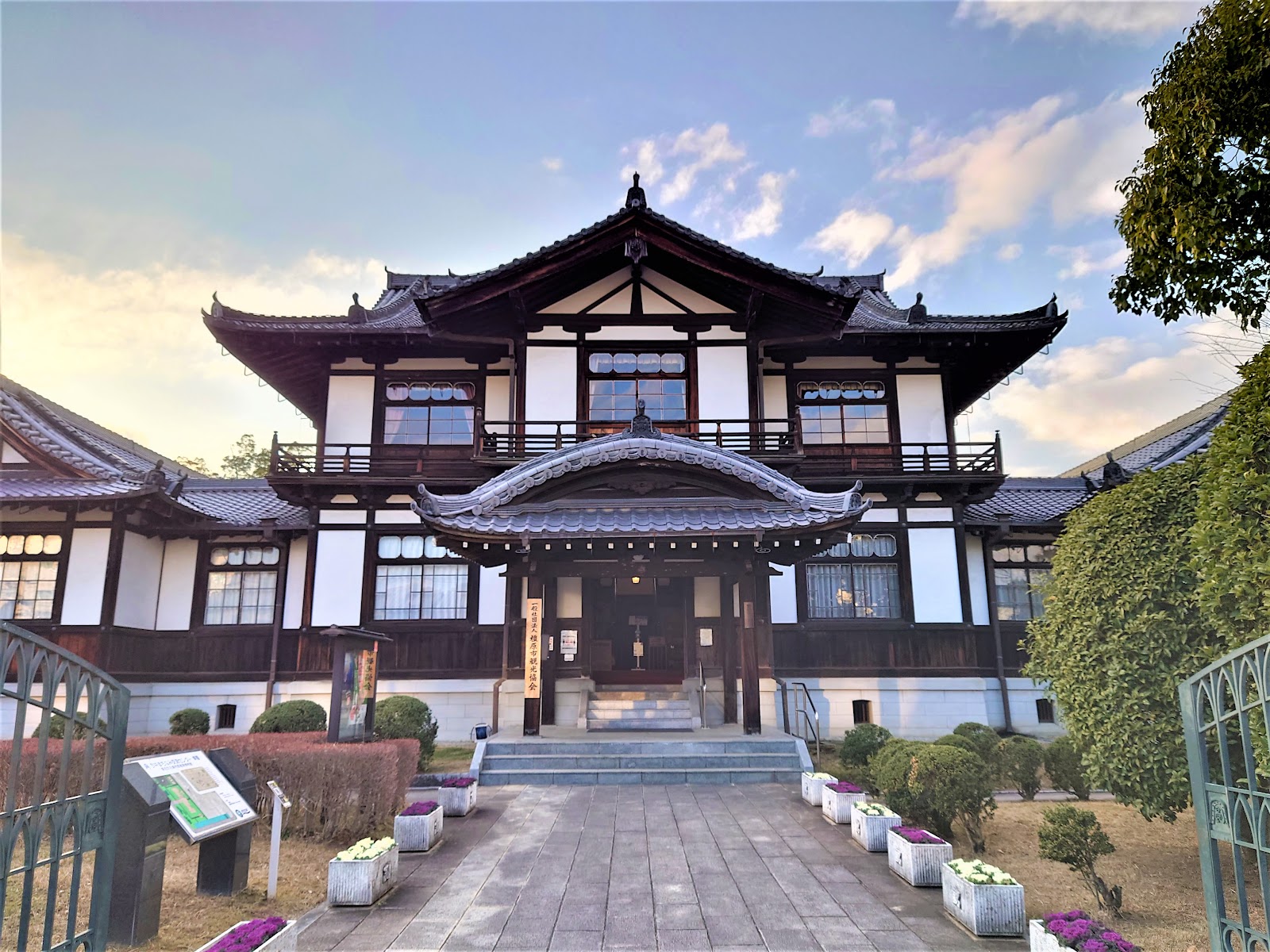
An astonishingly complete Edo-period merchant town in Kashihara, where some 500 traditional houses still line the streets.
Few places in Japan preserve the Edo era as completely as Imai-cho, a compact former merchant town in the city of Kashihara in central Nara Prefecture. Where most historic districts survive as a single photogenic street, Imai-cho keeps an entire townscape: some 500 traditional wooden houses stand within its old moated boundaries, around a tenth of them formally designated as Important Cultural Properties. Walking its lanes feels less like visiting a preserved street than stepping wholesale into the seventeenth century, and the district is protected as a national Important Preservation District for Groups of Traditional Buildings.
Imai-cho grew up in the sixteenth century around the fortified temple of Shonen-ji as a self-governing religious and commercial town, ringed by moats and earthworks for defence. In the peace of the Edo period it flourished as a centre of trade and finance, so wealthy that a saying arose that 'the money of Imai could buy up half of Japan.' That prosperity paid for the substantial merchant houses that still line the streets, with their whitewashed walls, wooden lattices, tiled roofs and imposing storehouses, and the town's careful management of its own affairs helped it avoid the fires and redevelopment that erased older townscapes elsewhere.
Today the town remains a living community rather than a museum, its houses still lived in, which gives the streets an authentic, unpolished atmosphere. Several of the finest residences are open to the public, among them the grand Imanishi Residence, a fortress-like house of 1650 that served as the town's administrative seat, and other merchant homes where you can see the deep interiors, earthen-floored workspaces, sooty kitchens and hidden gardens of a prosperous Edo household. The Imai Machiya-kan, a restored townhouse run as a free information centre, is the best place to begin, offering maps and guidance on which private homes are open on a given day.
What makes Imai-cho so rewarding is the absence of crowds and commercialism. There are no ticket gates at the entrance to the district, no tour-bus throngs and only a scattering of cafés and craft shops among the historic homes. You are free simply to wander the grid of narrow streets, admire the varied facades, and appreciate the rare experience of a complete pre-modern town going quietly about its life. Photographers and history enthusiasts in particular find it extraordinary.
The town lies a little off the usual tourist trail, which is part of its charm, but it is easy to reach as a half-day trip. It sits about fifteen minutes' walk from Yamato-Yagi Station, a major Kintetsu junction well connected to both Nara and Osaka, or slightly closer to the smaller Yagi-Nishiguchi Station, and an IC card covers the ride. Entry to the district and its streets is free, with only modest fees at some of the house museums.
Combine it with the nearby Kashihara Shrine or the ancient burial mounds of the Asuka region for a full day exploring the deep history of the Yamato heartland. For anyone who wants to see how an entire Japanese town looked and lived four centuries ago, Imai-cho has no real equal.
A local's tip
Start at the Imai Machiya-kan information house to pick up a map and find which private residences are open that day.
Best time to visit
Daytime, when a few historic houses are open to visitors
Getting there
About 15 minutes on foot from Yamato-Yagi Station, or a shorter walk from Yagi-Nishiguchi Station, in the city of Kashihara.
Good to know
- Cafes
- Restrooms
- Information Center
Plan the whole trip offline
Imai-cho Historic District is one of many places in the Real Japan app — with turn-by-turn directions, nearby spots and full offline maps you can use with no signal.