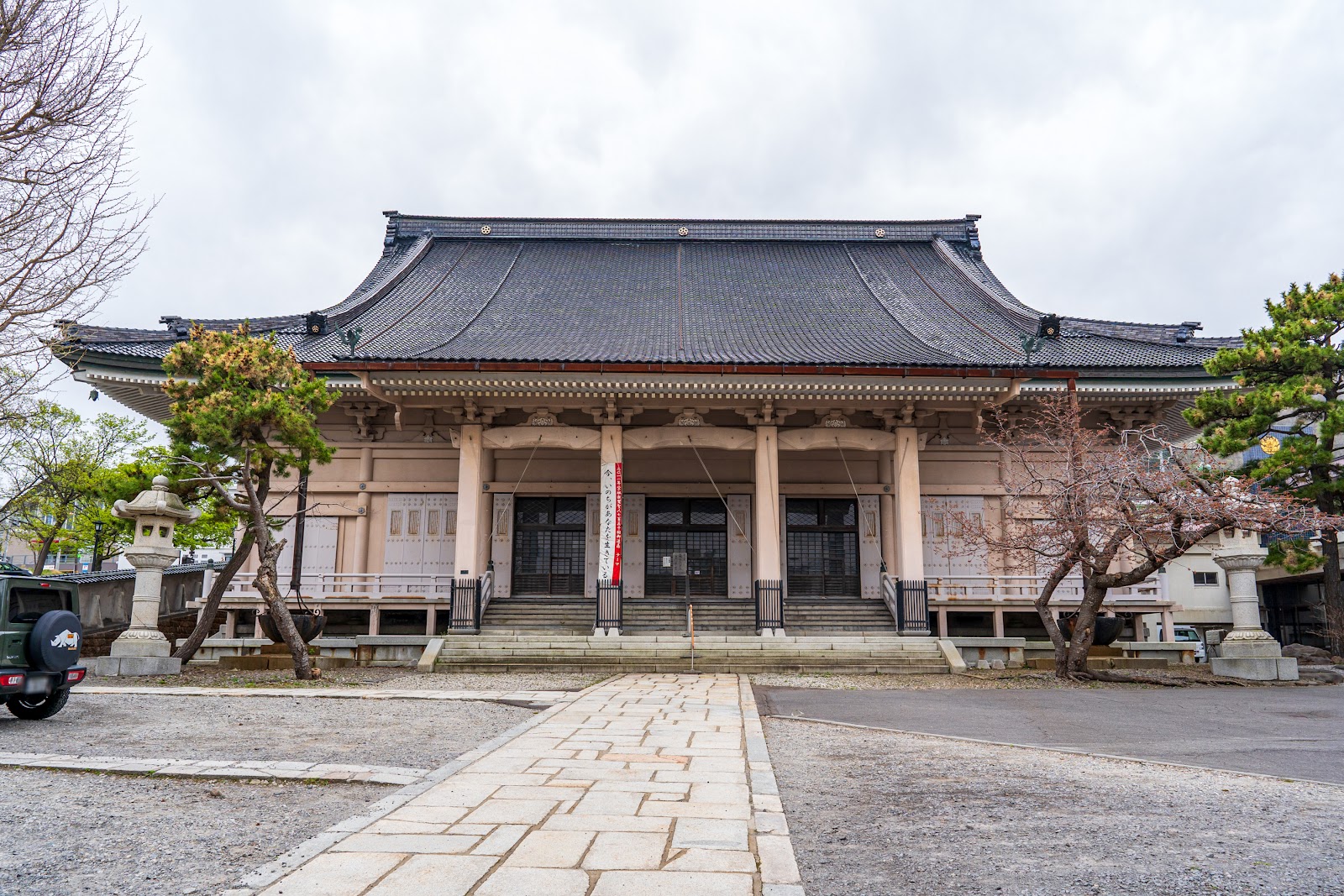
Japan's first reinforced-concrete temple, a 1915 landmark on the Motomachi slopes with a vast black-tiled roof.
The Higashi Honganji Hakodate Betsuin, the Hakodate branch of the great Higashi Honganji temple of Kyoto, holds a remarkable place in Japanese architectural history: completed in 1915, it is the oldest reinforced-concrete temple in Japan. Its massive, gleaming black-tiled roof rises above the Motomachi slopes and is visible from blocks away, an unmistakable landmark on the walk up from the bay.
The reason for its unusual construction is written into Hakodate's history. The port city was repeatedly devastated by fire — the great fires of the Meiji and Taisho eras destroyed whole neighborhoods, and wooden temples burned again and again. When the branch temple was rebuilt in the early twentieth century, its planners made the bold decision to use reinforced concrete, then a cutting-edge material, to create a building that could finally resist the flames. The result was a national first, and the temple has since been designated an Important Cultural Property of Japan in recognition of its pioneering engineering.
What makes the building so striking is that the concrete was cast and detailed to imitate traditional wooden temple architecture. The bracketing under the eaves, the sweeping roofline, the proportions of the main hall — all follow the conventions of classic Buddhist temple design, yet the entire structure is a single monolithic material. Standing before it, visitors often do a double take, unable to reconcile the ancient silhouette with the modern substance. The huge roof, sheathed in dark tiles, is the most photographed feature and looks especially dramatic against snow or a bright winter sky.
Inside, the main hall serves an active congregation of the Jodo Shinshu (True Pure Land) tradition, and the atmosphere is one of quiet devotion rather than tourism. Visitors are welcome to step in respectfully to see the golden altar and the calm, high-ceilinged worship space. Because it remains a working temple, there is no admission charge and no ticket booth — simply a place of faith that happens to be a monument.
The temple sits perfectly within a walking tour of Motomachi, Hakodate's historic hillside quarter of churches, consulates and slopes. From the Suehiro-cho tram stop it is a short uphill walk, and it pairs naturally with the nearby Orthodox and Catholic churches, the old public hall, and the sloping streets that frame views of the harbor. Allow around half an hour to walk the grounds and admire the exterior detailing. Photographers should try the approach from below, where the roof looms over the street, and again from the side, where the imitation-timber concrete brackets reveal the ambition of the 1915 builders.
A local's tip
Look closely at the walls and roof — the whole thing is reinforced concrete cast to look like traditional timber temple joinery, a pioneering feat for 1915.
Best time to visit
Daytime; combine with a Motomachi walk
Getting there
From Suehiro-cho tram stop walk uphill into the Motomachi slopes; the temple's huge dark roof is visible from several blocks away.
Good to know
- Parking
- Restrooms
Plan the whole trip offline
Higashi Honganji Hakodate Betsuin is one of many places in the Real Japan app — with turn-by-turn directions, nearby spots and full offline maps you can use with no signal.