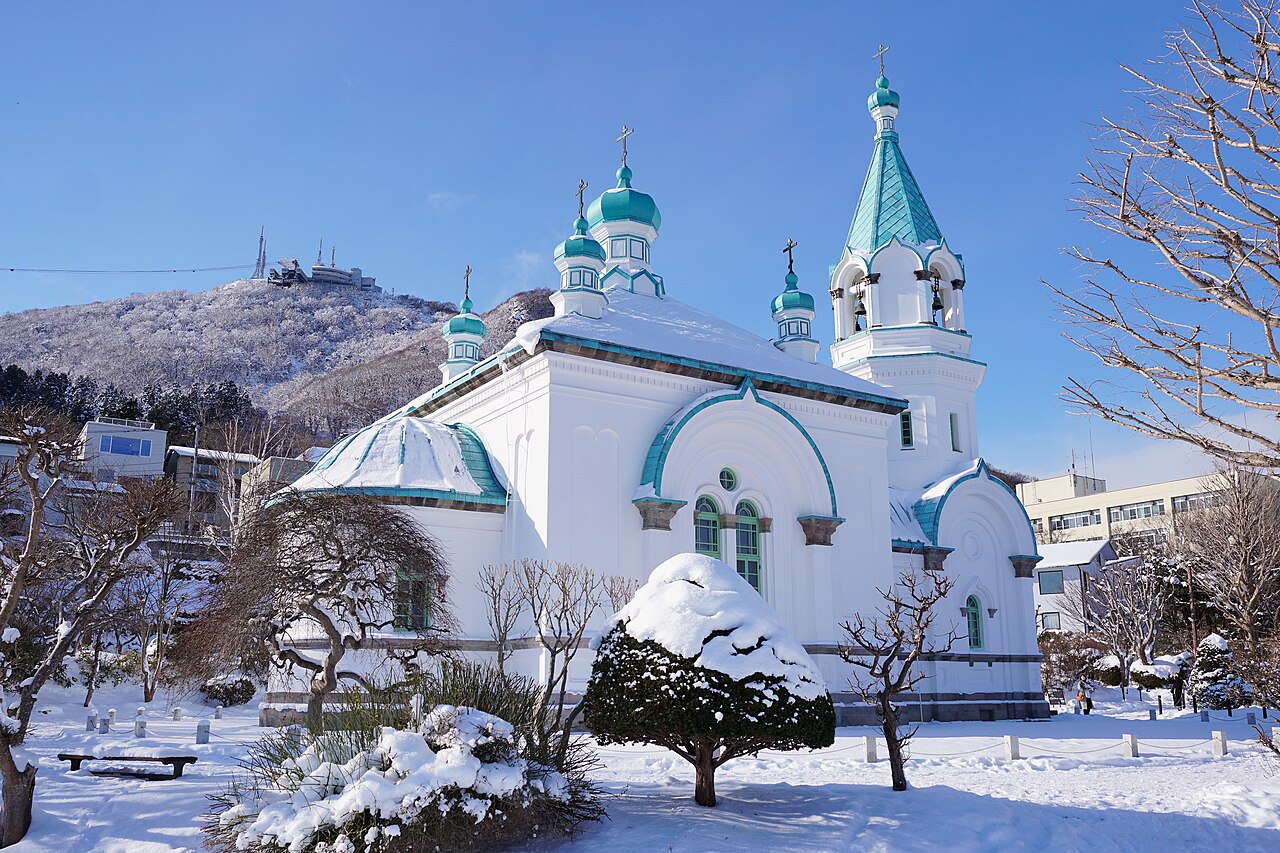
Japan's first Russian Orthodox church, a white-walled, green-domed landmark nicknamed for its chiming bells.
The Hakodate Orthodox Church, formally the Church of the Resurrection of Christ, is a graceful white-walled, copper-green-domed sanctuary in the Motomachi district and one of Hakodate's most beloved landmarks. It holds the distinction of being the birthplace of the Russian Orthodox faith in Japan, its origins tied directly to the opening of Hakodate as a treaty port and the arrival of a Russian consulate on the hill above the harbour.
The church's history is inseparable from a single remarkable figure: Saint Nikolai of Japan, who arrived in Hakodate in 1861 as chaplain to the Russian consulate. From this modest hillside base he learned Japanese, translated scripture and liturgy, and went on to found the Japanese Orthodox Church, eventually building the great cathedral in Tokyo. The original Hakodate church he served was lost, and the present building dates from 1916, erected after an earlier structure burned in one of the fires that repeatedly swept the city. Its Russo-Byzantine design, with rounded arches, a central dome and an octagonal bell tower, has been designated an Important Cultural Property of Japan.
What to see is above all the exterior. The stark white plastered walls, the verdigris copper roofs and the clustered onion domes make an unforgettable composition, especially set against the deep green of Mount Hakodate or a covering of winter snow. The building's silhouette anchors countless photographs of the old town. Inside, when open to visitors, the church reveals a quiet, incense-scented interior with icons and Orthodox liturgical furnishings; visitors are asked to be respectful, as this is an active place of worship.
A charming fact gives the church its local nickname. Its bells, cast in Russia, are considered among the finest church bells in Japan, and their gentle, resonant chiming across the Motomachi slopes earned the church the affectionate name Gangan-dera, roughly the "clang-clang temple." The sound drifting over the hillside on a Sunday is part of the district's character.
The visiting experience is brief but rewarding, usually taking twenty to thirty minutes. A small admission fee is requested to help with the building's upkeep, and photography inside is generally restricted. Because the church sits partway up the steep Motomachi hill near the top of Daisan-zaka, reaching it involves a short uphill walk, and the slopes can be icy in winter, so sensible footwear helps. Opening hours are limited and the church closes for services, so it is worth checking times before visiting. Just a short stroll away stand the Gothic Catholic Motomachi Church and the Episcopal church, letting visitors take in three very different foreign faiths within a few blocks.
The church is beautiful in every season: fresh and bright in summer, softened by autumn light, and at its most atmospheric under snow in winter, when the white walls and green domes seem to dissolve into the falling flakes. Spring offers mild, uncrowded visiting.
Getting there follows the usual Motomachi route. From JR Hakodate Station take the historic city tram and alight at Jujigai, then climb about ten minutes up through the sloping streets, following signs toward the churches. IC cards are accepted on the tram. As the church sits on the same hillside as the Old Public Hall, the other churches and the ropeway base, it fits naturally into a walking tour of the old quarter that can culminate in the Mount Hakodate night view.
A local's tip
Photograph the green domes from the slope just below rather than head-on, so the copper roofs and octagonal bell tower stack up against Mount Hakodate behind.
Best time to visit
Morning for soft light on the white walls
Getting there
Take the tram to Jujigai and walk about 10 minutes uphill into Motomachi; the church stands near the top of Daisan-zaka slope.
Good to know
- Gift Shop
- Restrooms
Plan the whole trip offline
Hakodate Orthodox Church is one of many places in the Real Japan app — with turn-by-turn directions, nearby spots and full offline maps you can use with no signal.