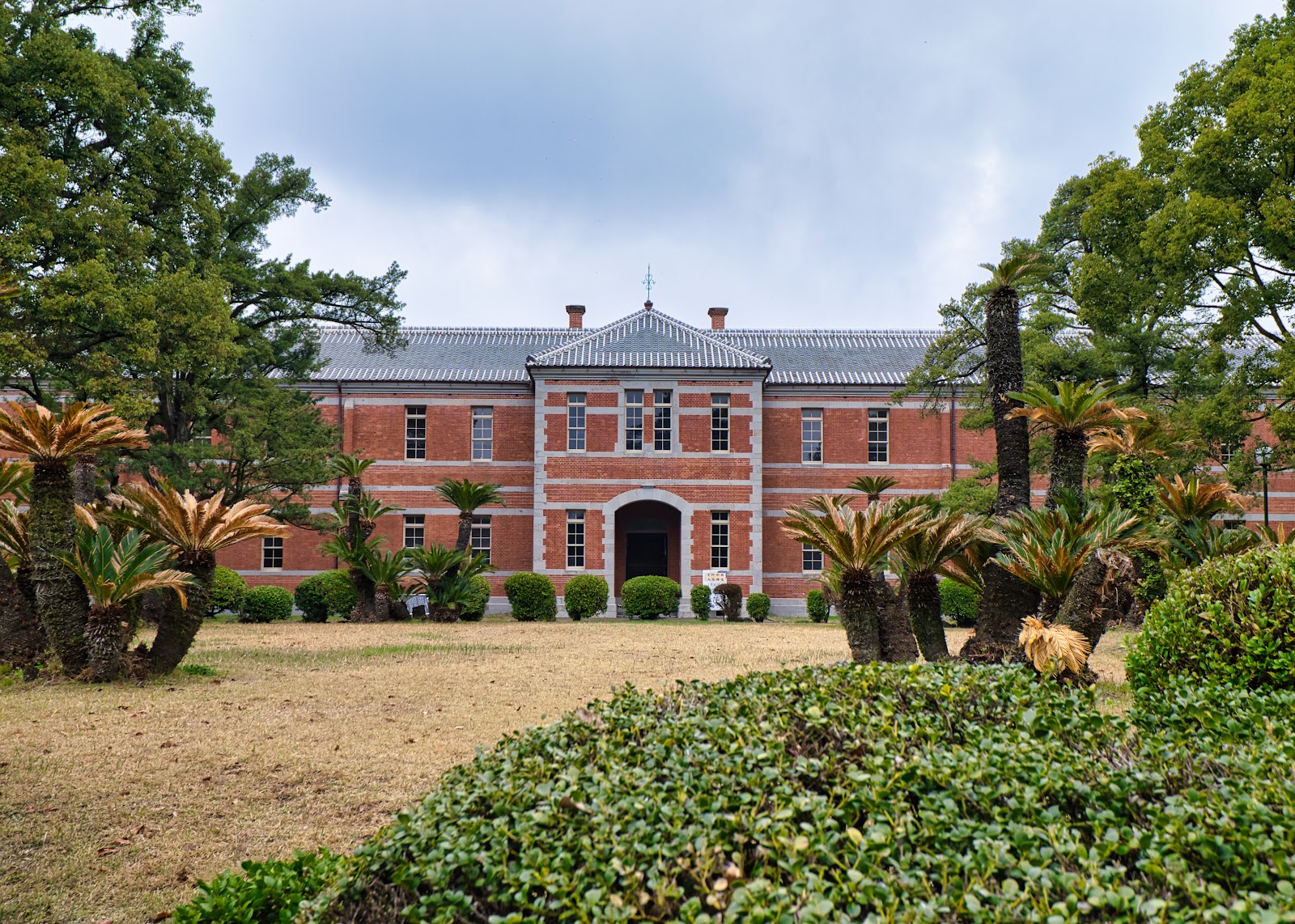
A handsome Meiji-era red-brick academic hall, an Important Cultural Property from the dawn of modern Japanese education.
The Former Fifth High School Main Building is one of Kumamoto's finest pieces of Meiji-era architecture and a designated Important Cultural Property, standing on what is now the Kurokami campus of Kumamoto University. It dates to 1889, a time when the young Meiji government was racing to build a modern education system, and the 'Fifth Higher School' was one of a small number of elite national institutions established to train the country's future leaders. The building embodies that era of confident modernisation, when Japan looked to the West for architectural models while forging its own path.
Built of warm red brick with white stone accents in a restrained neo-Renaissance style, the symmetrical facade, arched windows and central entrance give it a dignified, almost European air, a striking contrast to the wooden castle town that surrounded it when new. It was the work of foreign-influenced Japanese architects and remains remarkably intact, a rare survivor of the wave of brick institutional buildings from Japan's rapid industrialisation. The interior retains period classrooms and halls, and portions serve as an exhibition space tracing the history of the school and of higher education in the region.
What gives the building particular resonance is its association with two towering figures of modern Japanese culture. The novelist Natsume Soseki, whose face once graced the 1,000-yen note and whose works such as 'Kokoro' and 'Botchan' are pillars of Japanese literature, taught English here in the mid-1890s before travelling to London. His years in Kumamoto influenced his writing, and the city preserves several sites connected to him. The scientist and educator Lafcadio Hearn, the Greek-Irish writer who became Koizumi Yakumo and did so much to introduce Japanese folklore and culture to Western readers, also taught in Kumamoto around the same period. Walking the grounds where they worked adds a literary dimension to the visit.
The surrounding campus is pleasant to stroll, with cherry trees that bloom in spring and mature trees that colour in autumn, and the building photographs beautifully against the greenery. Because it is an active university, visitors should be respectful of students and staff, but the exterior and grounds are freely accessible during daytime, and exhibition rooms open on weekdays with hours that vary.
The site lies northeast of the city centre and is easily reached by bus toward Kumamoto University, about 20 minutes from the station or downtown. Allow around 40 minutes for the building and grounds. For travellers interested in how Meiji Japan reinvented itself, or in the literary heritage of Soseki and Hearn, this elegant red-brick hall is a rewarding and uncrowded stop that rounds out a picture of Kumamoto beyond its famous castle.
A local's tip
The novelist Natsume Soseki taught here in the 1890s — look for references to him around campus, as his time in Kumamoto shaped several of his early works.
Best time to visit
Any season; pleasant campus grounds
Getting there
On the Kurokami campus of Kumamoto University, northeast of the city centre; take a bus toward Kumamoto University from the station or downtown, about 20 minutes.
Good to know
- Restrooms
Plan the whole trip offline
Former Fifth High School Main Building (Goken-Kodo) is one of many places in the Real Japan app — with turn-by-turn directions, nearby spots and full offline maps you can use with no signal.