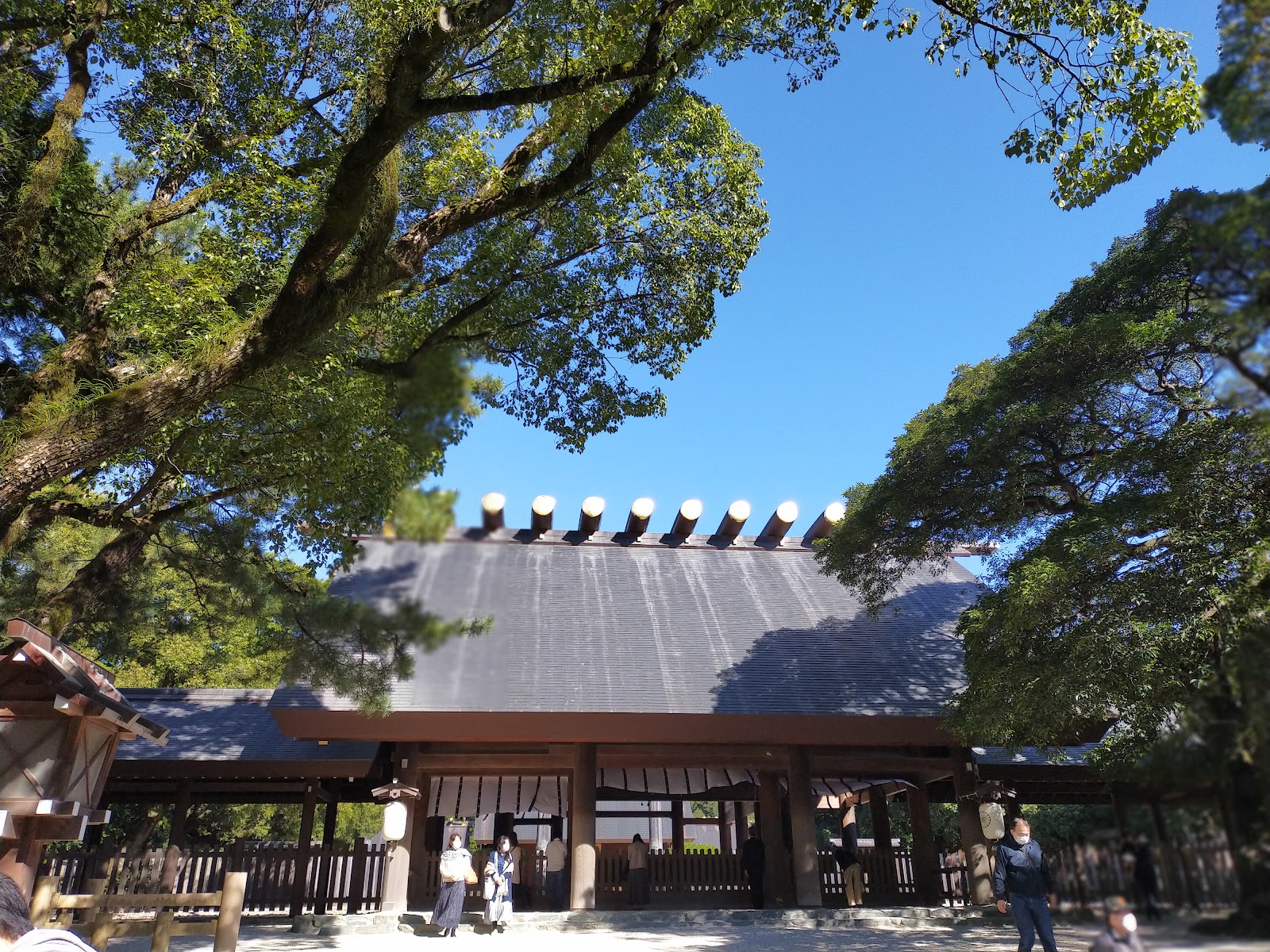
One of Shinto's holiest shrines, guardian of the sacred Kusanagi sword and set in an ancient forest in southern Nagoya.
Atsuta Jingu is, after Ise, the most venerable Shinto shrine in Japan, and for many pilgrims it is the spiritual heart of the Nagoya region. Founded around 1,900 years ago, it enshrines the Kusanagi-no-Tsurugi, one of the three sacred Imperial Regalia of Japan. The sword is never displayed, but its unseen presence gives the shrine an atmosphere of quiet gravity that sets it apart from the city just beyond the trees.
The grounds cover roughly 190,000 square metres of dense evergreen forest in the middle of urban Atsuta ward, so that stepping through the great torii gate feels like leaving Nagoya entirely. Towering camphor and cypress trees, some many centuries old, shade the gravel approach. The most famous is the Oo-kusu, a camphor tree more than a thousand years old and traditionally credited to the monk Kobo Daishi; visitors pause beneath its vast canopy to feel the shrine's age.
The main worship hall, or honden, is built in the austere shinmei-zukuri style shared with Ise Grand Shrine: unpainted cypress, thatched roofing and crossed finials rising against the sky. Around it stand more than forty subordinate shrines, each with its own deity and history. The Kusanagikan treasure hall displays swords, masks, bugaku dance costumes and ancient documents donated over the centuries, a reminder that Atsuta has long been a repository of martial and courtly culture.
A notable story ties the shrine to Japan's warring-states drama: in 1560 the young warlord Oda Nobunaga is said to have prayed here before the Battle of Okehazama, in which his outnumbered forces destroyed a far larger army. After his victory he donated the Nobunaga-bei, a roofed mud-and-tile wall that still stands on the grounds and is counted among Japan's three great walls.
The visiting experience rewards an unhurried pace. Purify your hands at the temizuya, walk the shaded paths, and watch local families arrive for blessings; the shrine remains a living place of worship rather than a museum. Wide gravel avenues and mostly level ground make it comfortable for wheelchairs and strollers, and English signage marks the main points of interest. Do not leave without trying a bowl of Miyakishimen, the flat Nagoya-style udon served at a rustic stall inside the precinct, a tradition among worshippers for generations.
Atsuta is beautiful year-round, but especially atmospheric in early morning mist and during its packed calendar of festivals. The Atsuta Matsuri each June brings lantern-lit displays and martial-arts demonstrations, while New Year draws over two million visitors for hatsumode. Because the grounds never truly close, an early or late visit lets you experience the forest in near solitude.
Getting there is simple. Meitetsu's Jingu-mae Station sits beside the eastern entrance, JR Atsuta Station is a short walk from the western side, and the Meijo subway line stops at Jingu-nishi. From central Nagoya the journey takes under fifteen minutes, making Atsuta Jingu one of the easiest and most rewarding half-day escapes in the city.
A local's tip
Slip away from the main hall to the Kokoro-no-Komichi forest path and the giant camphor tree said to have been planted by Kobo Daishi over a thousand years ago; it is far quieter than the crowded worship hall.
Best time to visit
Early morning or during a festival
Getting there
From Nagoya Station take the Meitetsu Nagoya Main Line three stops south to Jingu-mae; the main approach is a two-minute walk. Alternatively use Jingu-nishi Station on the Meijo subway line, or JR Atsuta Station on the Tokaido Main Line.
Good to know
- Food
- Wi-Fi
- Gift shop
- Restrooms
Plan the whole trip offline
Atsuta Jingu is one of many places in the Real Japan app — with turn-by-turn directions, nearby spots and full offline maps you can use with no signal.