One of Japan's most revered temples, home to a hidden Buddha and a famous dark tunnel to enlightenment.
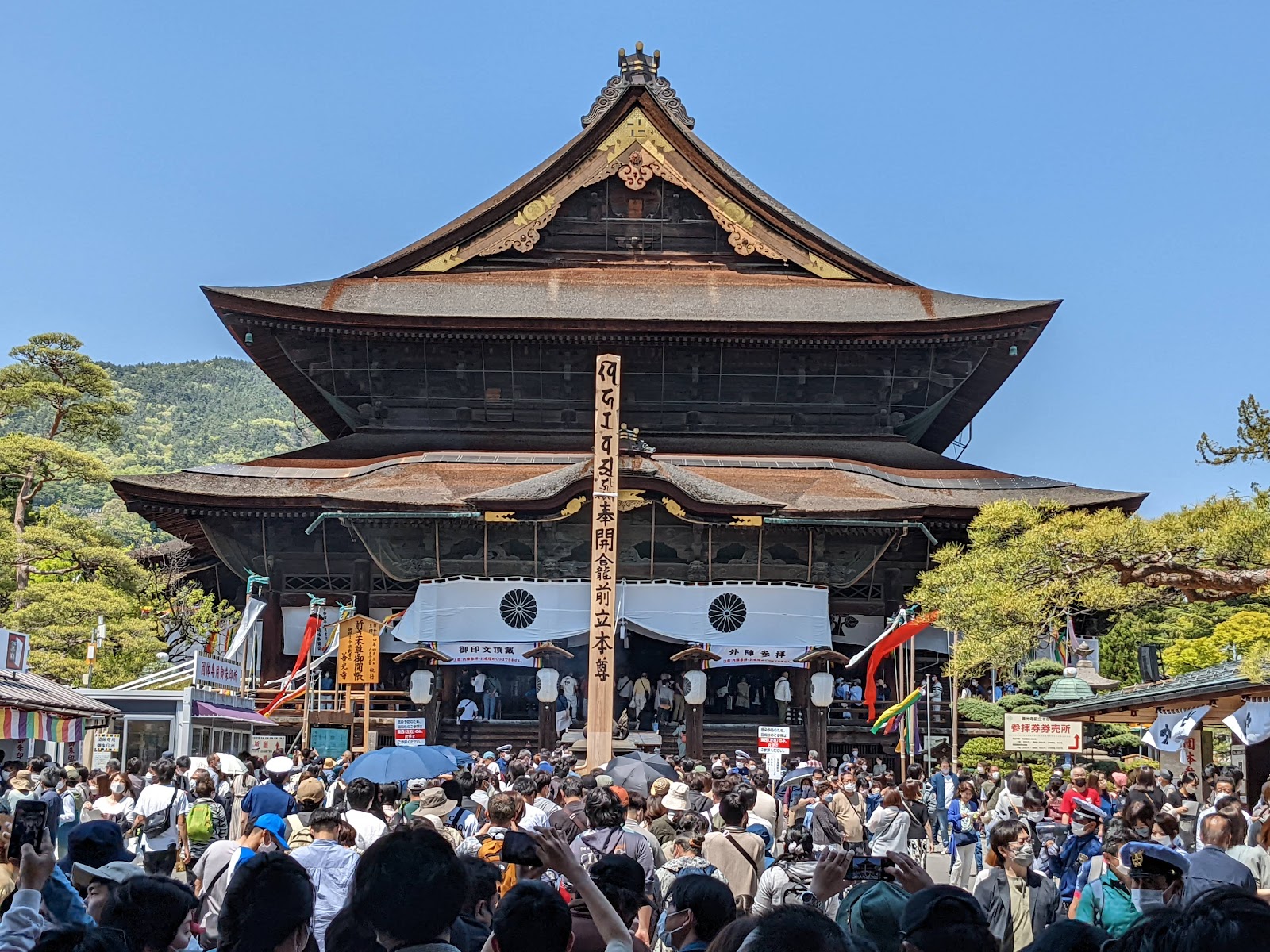
Zenko-ji is one of the oldest and most important Buddhist temples in Japan, a great pilgrimage center that has welcomed worshippers of every school and background for some fourteen centuries. Rising at the head of Nagano's long approach street, its immense wooden main hall is a designated National Treasure and one of the largest wooden buildings in the country, an unforgettable sight beneath the mountains of northern Nagano.
The temple's fame rests above all on its principal image, the Ikko Sanzon Amida Nyorai, said to be the very first Buddhist statue ever brought to Japan in the sixth century. The original is a hibutsu, an absolute secret Buddha, hidden from all human eyes, including those of the head priest. It has never been publicly displayed in living memory. Every six years the temple holds the Gokaicho festival, when a copy of the image is unveiled and a pillar connected to it by a sacred cord is erected before the hall, allowing pilgrims to touch the cord and forge a bond with the Buddha.
Zenko-ji occupies a special place in Japanese religious history because it was founded before Buddhism split into competing sects and has always remained non-sectarian, open to men and women alike at a time when many sacred mountains barred female pilgrims. This inclusiveness made it a beloved destination, and the saying that everyone should visit Zenko-ji once in a lifetime drew travelers from across the land along the old highways.
The temple's most famous ritual experience is the Okaidan Meguri, a passage through a completely dark corridor beneath the main altar. In total blackness, pilgrims feel their way along the wall until their hand meets a metal Key to Paradise, positioned directly below the hidden Buddha. Touching it is believed to grant enlightenment and a promise of salvation, and emerging back into the light is a genuinely moving experience. Just as memorable is the pre-dawn Oasaji morning service, when the head priest and priestess process to the hall along the stone approach and bless kneeling worshippers by gently tapping their heads with prayer beads in the Ojuzu-choudai ceremony.
The long approach to the temple, lined with pilgrim lodgings, incense shops, souvenir stores and eateries serving oyaki dumplings and soba, is an attraction in itself, retaining the feel of an old temple town. The great Niomon and Sanmon gates, the six Jizo statues and a smoking cauldron of incense before the hall all invite pause. Cherry blossoms in spring and blazing maples in autumn frame the grand tiled roof of the main hall.
Zenko-ji lies a straightforward thirty-minute walk or short bus ride straight up from Nagano Station, itself a stop on the Hokuriku Shinkansen, making it easy to reach even on a day trip. Allow at least ninety minutes to walk the approach, explore the grounds and complete the tunnel of darkness. Coming at dawn for the morning service rewards early risers with the temple at its most solemn and beautiful.
A local's tip
Join the pre-dawn Oasaji morning service, then descend into the pitch-black tunnel beneath the main hall to grope for the Key to Paradise on the wall — touching it is said to guarantee salvation.
Best time to visit
Early morning for the dawn service
Getting there
From Nagano Station take a bus bound for Zenkoji-daimon (about 10 minutes) and walk up the shopping street, or walk the whole way in around 30 minutes straight up Chuo-dori from the station.
Good to know
- Wi-Fi
- Parking
- Restrooms
Plan the whole trip offline
Zenko-ji Temple (Nagano) is one of many places in the Real Japan app — with turn-by-turn directions, nearby spots and full offline maps you can use with no signal.