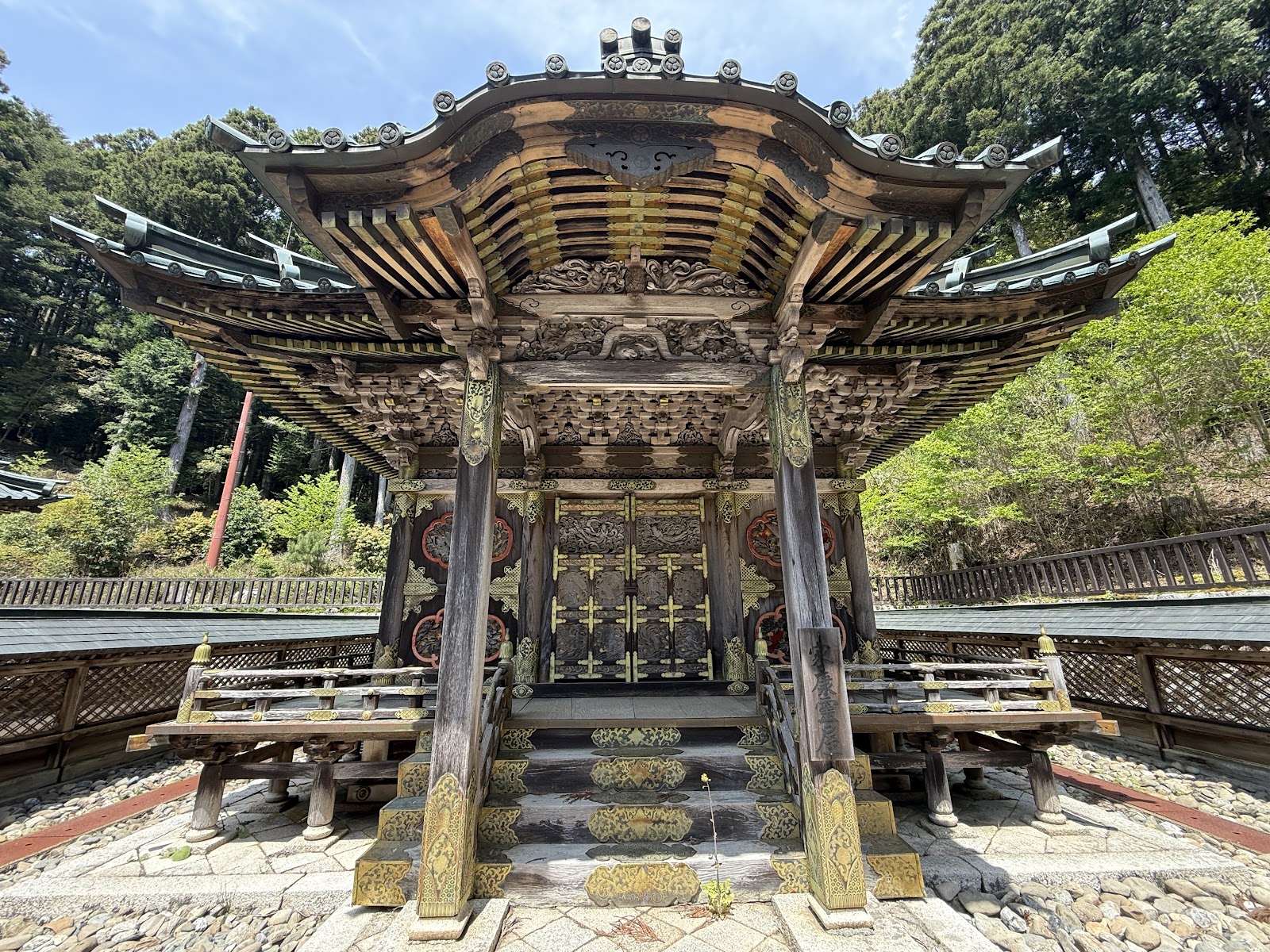
A pair of ornate mausolea enshrining the first two Tokugawa shoguns, richly carved and gilded in Edo-period style.
The Tokugawa Mausoleum, or Tokugawa-ke Reidai, is a small but exquisite complex enshrining the spirits of the first two shoguns of the Tokugawa dynasty, the family that ruled Japan for more than 250 years during the Edo period. It offers a very different experience from Koyasan's austere monastic halls: here the mood is one of concentrated decorative splendour, a demonstration of the wealth and prestige the shogunate lavished even on a remote Buddhist mountain.
The two structures were completed in 1643 on the orders of Tokugawa Iemitsu, the third shogun, to honour his grandfather Ieyasu, founder of the dynasty, and his father Hidetada, the second shogun. The mausoleum on the right, viewed from the front, is dedicated to Ieyasu; the one on the left to Hidetada. Between them stands a smaller building for offerings. Though modest in footprint, the two mausolea are masterpieces of Edo craftsmanship, their eaves and doorways covered in intricate carvings, lacquer and gold leaf in the same ornate style later perfected at the far grander Toshogu shrine in Nikko.
That Koyasan should host the tombs of the Tokugawa is itself telling. For centuries powerful families across Japan sought to place a memorial on the mountain, believing that proximity to Kobo Daishi's mausoleum in Okunoin would benefit the souls of their ancestors. The Tokugawa, as supreme rulers, secured a prominent and richly funded site of their own, and its survival gives visitors a vivid sense of how political power and religious devotion intertwined in early modern Japan.
The mausolea are enclosed within a walled precinct and viewed from outside a protective railing, which preserves the delicate decoration while still allowing a close look at the carved beams, gilded fittings and family crests. Interpretive signage explains the history, and because the site is compact it takes only around half an hour to appreciate. Cherry trees and maples nearby add colour in spring and autumn respectively.
Set in the central-eastern part of Koyasan town, the Tokugawa Mausoleum is easily combined with a walk toward Okunoin or the central temple district, and its small entrance fee makes it an inexpensive addition to a day on the mountain. It rewards visitors interested in Japanese history rather than religion alone, illuminating the dynasty that shaped the country from 1603 to 1868. In a place devoted overwhelmingly to Buddhist practice, this jewel-box of shogunal grandeur is a fascinating reminder that Koyasan drew the mighty as well as the pious to its cedar-shaded slopes.
A local's tip
Look closely at the lavish carvings and gold fittings, a rare display of Tokugawa-era decorative extravagance that contrasts with Koyasan's usual austerity.
Best time to visit
Morning
Getting there
From Koyasan Station take the Nankai Rinkan bus to Namikiri-fudomae or Senjuinbashi (about 10 minutes), then a short walk. It lies in the central-eastern part of town.
Good to know
- Restrooms
Plan the whole trip offline
Tokugawa Mausoleum is one of many places in the Real Japan app — with turn-by-turn directions, nearby spots and full offline maps you can use with no signal.