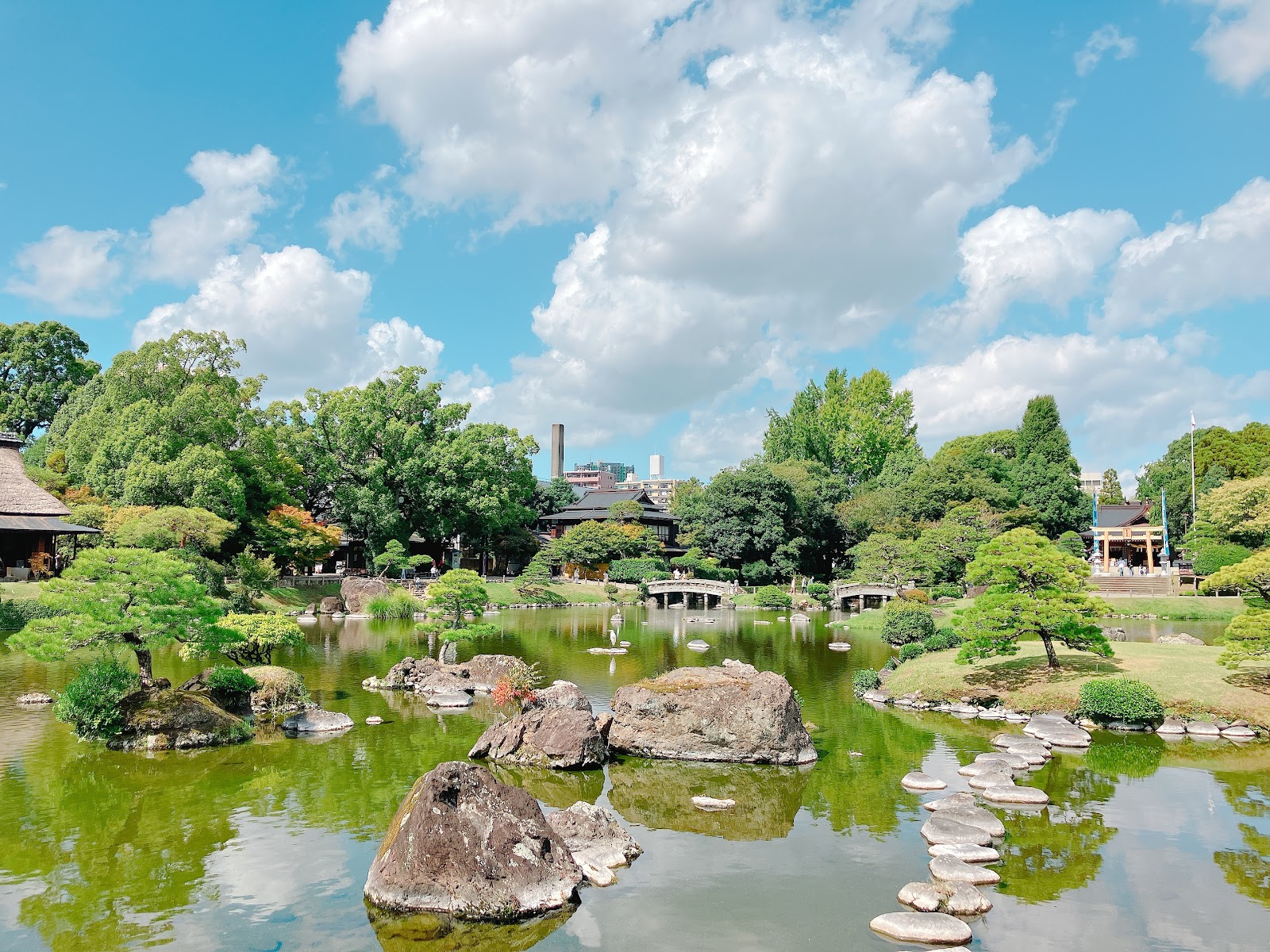
A serene strolling garden whose grassy hills recreate the 53 post stations of the old Tokaido road, including a miniature Mount Fuji.
Suizen-ji Jojuen is Kumamoto's most beloved traditional garden and one of the finest 'kaiyu-shiki', or circuit-style strolling gardens, in all of Kyushu. It was begun in 1636 by the Hosokawa lords, the ruling family of the Higo domain, who chose the spot for its abundant, exceptionally pure spring water welling up from the volcanic ground of nearby Mount Aso. That crystalline water still feeds the garden's central pond, and its clarity is part of what gives the scenery its luminous, painterly quality.
The garden's celebrated conceit is that its landscape represents, in miniature, the fifty-three post stations of the old Tokaido highway that linked Edo and Kyoto. As you follow the winding path, the manicured grassy mounds, ponds and stones are said to evoke stages of that famous journey, and the most recognisable feature is a small, perfectly formed grass-covered hill that stands in for Mount Fuji, its symmetrical cone reflected in the water. Whether or not you trace every station, the effect is a compressed, idealised vision of the Japanese landscape that unfolds gradually as you walk, exactly as its designers intended.
Within the grounds stands the Kokindenju-no-ma, a modest thatched teahouse of considerable pedigree; it was relocated here from the Kyoto Imperial Palace and dates back some four centuries. Sitting on its tatami with a bowl of matcha and a seasonal sweet, looking out over the pond and the miniature Fuji, is the quintessential Suizen-ji experience and well worth the modest extra cost. Also on the grounds is Izumi Shrine, dedicated to the Hosokawa lords, its vermilion structures adding colour among the greenery, along with sacred spring outlets where visitors collect the famed water.
The pond teems with colourful carp, and pause points, stone lanterns and carefully placed pines reward slow, contemplative walking. Each season transforms the garden: cherry and plum blossom in spring, deep green and cool shade in summer, fiery maples in autumn, and a spare, sculptural beauty in winter. Because the circuit is compact and entirely flat, it suits all ages and abilities, and a full loop takes only about an hour, making it easy to combine with the castle.
Suizen-ji lies a short tram ride east of the centre; take the B-line to the Suizenji-koen stop and walk about four minutes to the entrance. The garden opens from early morning, and coming near opening time rewards you with soft light and few people, ideal for photographing the reflected Fuji. Between the historic teahouse, the shrine, the sacred springs and one of Japan's most elegant designed landscapes, Suizen-ji Jojuen offers a serene and quintessentially Japanese counterpoint to Kumamoto's mighty castle.
A local's tip
Sit at the traditional Kokindenju-no-ma teahouse with a bowl of matcha — this 400-year-old building was moved here from Kyoto's Imperial Palace and frames the garden's most famous view.
Best time to visit
Early morning or late afternoon for soft light on the miniature Mount Fuji
Getting there
Take the B-line tram from central Kumamoto to Suizenji-koen (about 20 min from Kumamoto Castle area), then walk 4 minutes to the garden gate.
Good to know
- Gift shop
- Restrooms
- Tea house
Plan the whole trip offline
Suizen-ji Jojuen Garden is one of many places in the Real Japan app — with turn-by-turn directions, nearby spots and full offline maps you can use with no signal.