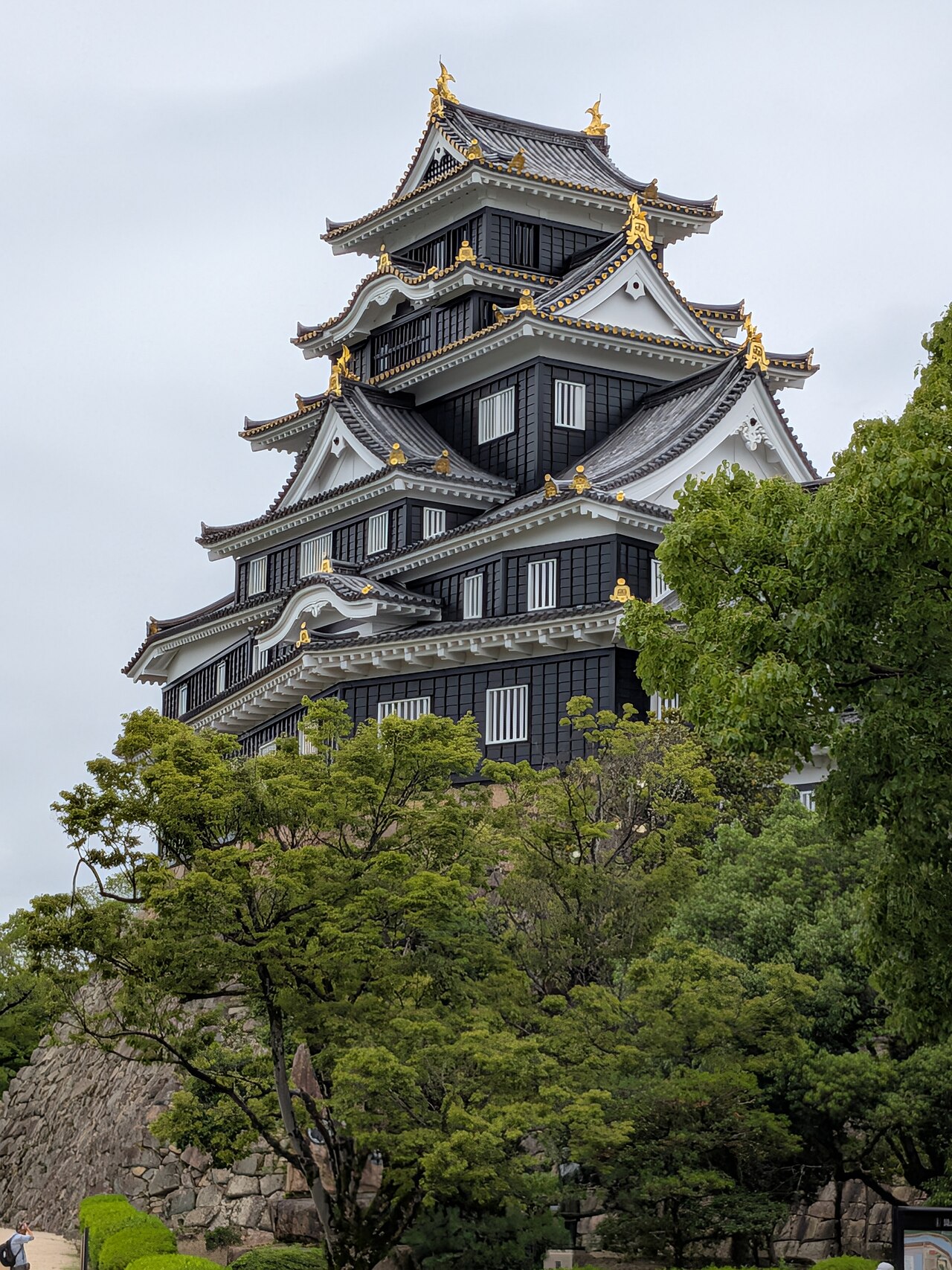
The black-lacquered 'Crow Castle', paired with Korakuen garden across the Asahi River.
Okayama Castle, nicknamed Ujo or 'Crow Castle' for its striking black-lacquered walls, is the historic centrepiece of the city and forms an inseparable pair with the great Korakuen garden on the opposite bank of the Asahi River. Its dark timber facades - a deliberate contrast to the white 'egret' castles like nearby Himeji - give it a bold, brooding elegance, set off by gilded roof ornaments that glint in the sun.
The castle was completed in 1597 under the daimyo Ukita Hideie, a foster son of the great warlord Toyotomi Hideyoshi, and its distinctive black keep and irregular pentagonal design reflect the turbulent Sengoku era in which it rose. Later the Ikeda clan ruled Okayama from here through the peaceful Edo period, developing the castle town that became the modern city. Tragically, the original keep was destroyed in a wartime air raid in 1945; the present main tower is a faithful concrete reconstruction completed in 1966, though one original turret, the Tsukimi Yagura, survives from the Edo period.
Inside, the keep functions as a modern museum spread over several floors, with displays on the castle's history, the ruling clans, samurai life and the Okayama castle town. Interactive exhibits and, in season, opportunities to try on kimono or armour make it engaging for families, while the top floor offers views over the river, the city and Korakuen. A lift serves the upper levels, making the reconstructed keep unusually accessible for a Japanese castle.
What elevates a visit is the relationship between castle and garden. Korakuen, one of Japan's three great landscape gardens, was laid out by the Ikeda lords in the late 17th century partly to be admired from the castle, and the black keep in turn provides borrowed scenery for the garden. Crossing the Tsukimi Bridge between the two, with the dark tower reflected in the Asahi River, is one of the classic experiences of the San'yo region, especially when framed by cherry blossom in spring or fiery maples in autumn.
The castle grounds are pleasant to wander, with the black keep offering superb photographs from many angles - the riverside and the garden side are both rewarding, and golden-hour light on the dark walls is particularly striking. Allow around 90 minutes for the keep and grounds, more if you combine it with Korakuen next door, which the discounted joint ticket encourages.
Spring blossom and autumn colour are the standout seasons, but the castle photographs well year-round and is floodlit on some evenings. To reach it, take the tram from Okayama Station to the Shiroshita stop and walk about ten minutes, or approach on foot through Korakuen and over the bridge. As the symbol of the city and half of one of Japan's finest castle-and-garden pairings, Okayama Castle is an essential first stop in the region.
A local's tip
Buy the combined ticket with Korakuen garden - the castle and garden sit on opposite banks of the Asahi River and are meant to be seen together.
Best time to visit
Golden hour, when the black keep catches the light
Getting there
From Okayama Station take the tram to Shiroshita stop (about 5 minutes), then walk 10 minutes; or walk through Korakuen garden and cross the Tsukimi Bridge.
Good to know
- Cafe
- Wi-Fi
- Elevator
- Restrooms
Plan the whole trip offline
Okayama Castle is one of many places in the Real Japan app — with turn-by-turn directions, nearby spots and full offline maps you can use with no signal.