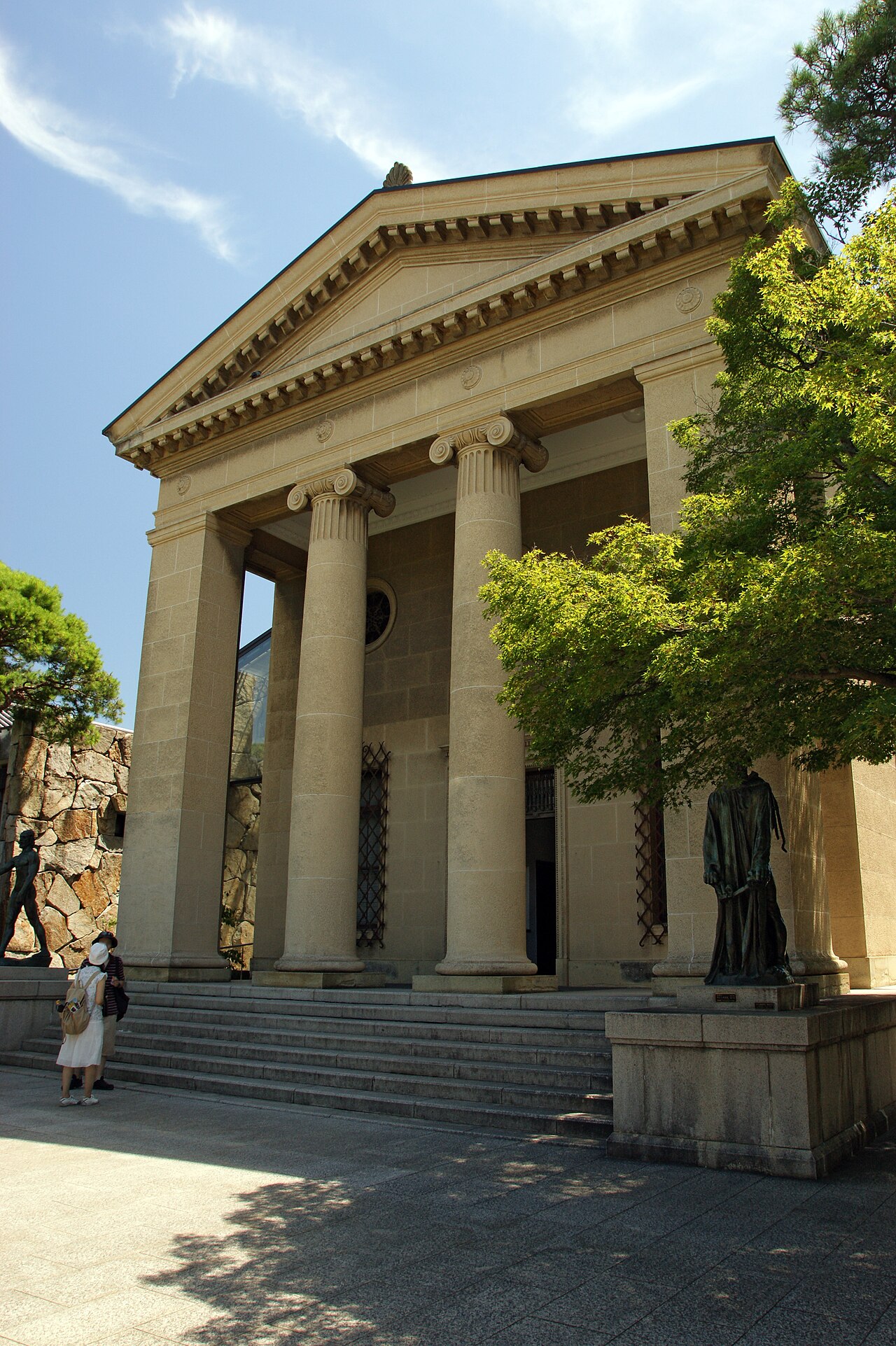
Japan's first museum of Western art, with El Greco, Monet, Gauguin and more in a Greek-temple building.
The Ohara Museum of Art is the cultural jewel of Kurashiki and a landmark in the history of Japanese museums: opened in 1930, it was the first institution in Japan to permanently exhibit Western art, and it remains one of the country's most important private collections. Its neoclassical facade, modelled on a Greek temple with a portico of columns, stands with quiet grandeur at the northern end of the Bikan quarter's canal, an unmistakable symbol of the town.
The museum was founded by textile magnate Ohara Magosaburo in memory of his friend, the Western-style painter Kojima Torajiro. Ohara financed Kojima's collecting trips to Europe in the 1910s and 1920s, and it was Kojima who acquired many of the masterpieces that form the core of the collection, buying directly from artists and dealers at a time when almost no Japanese institution was doing so. The result is a collection of remarkable depth for its size and setting.
The holdings read like a survey of European art. The signature work is El Greco's luminous 'Annunciation', a genuine museum treasure, but the galleries also hold paintings by Monet - including a water-lilies canvas - Gauguin, Renoir, Matisse, Pissarro, El Greco's contemporaries and El Greco himself, alongside sculpture by Rodin. Beyond the Western galleries, the museum's annexes present modern and contemporary art, and craft rooms celebrate the Japanese folk-craft (mingei) movement with works by Bernard Leach, Hamada Shoji, Tomimoto Kenkichi and the potter-designer relationships that Ohara supported.
Visiting is a pleasure precisely because of the scale. Unlike vast national museums, the Ohara is intimate enough to see properly in a single visit, yet rich enough to surprise. Moving from an El Greco to a Monet to a room of Japanese folk pottery, all within one elegant complex, gives a satisfying sense of the collector's cosmopolitan eye - and of Ohara's conviction that a provincial industrial town deserved world-class art.
The main building and its annexes are largely accessible, with the principal galleries on convenient levels, though the historic architecture means some steps; staff can advise on the smoothest route. There is a cafe and a well-stocked shop, and photography rules vary by gallery. Allow around two hours to do the collection justice, more if you linger. The museum is closed on Mondays (open the following day when Monday is a holiday) and during exhibition changeovers, so check before planning your day around it.
The galleries are climate-controlled and rewarding in any season, making the museum an ideal wet-weather or midsummer refuge. To reach it, walk about 12 minutes from Kurashiki Station into the Bikan quarter, where the temple-fronted building faces the canal. As the anchor of Kurashiki's extraordinary concentration of art, the Ohara Museum is, for many visitors, the single most compelling reason to make the trip.
A local's tip
Head straight to El Greco's 'Annunciation' first thing - it is the collection's crown jewel and the galleries are quietest right after opening.
Best time to visit
Morning; closed Mondays
Getting there
Walk about 12 minutes south from Kurashiki Station into the Bikan quarter; the Greek-temple facade stands at the northern end of the canal.
Good to know
- Cafe
- Shop
- Wi-Fi
- Restrooms
Plan the whole trip offline
Ohara Museum of Art is one of many places in the Real Japan app — with turn-by-turn directions, nearby spots and full offline maps you can use with no signal.