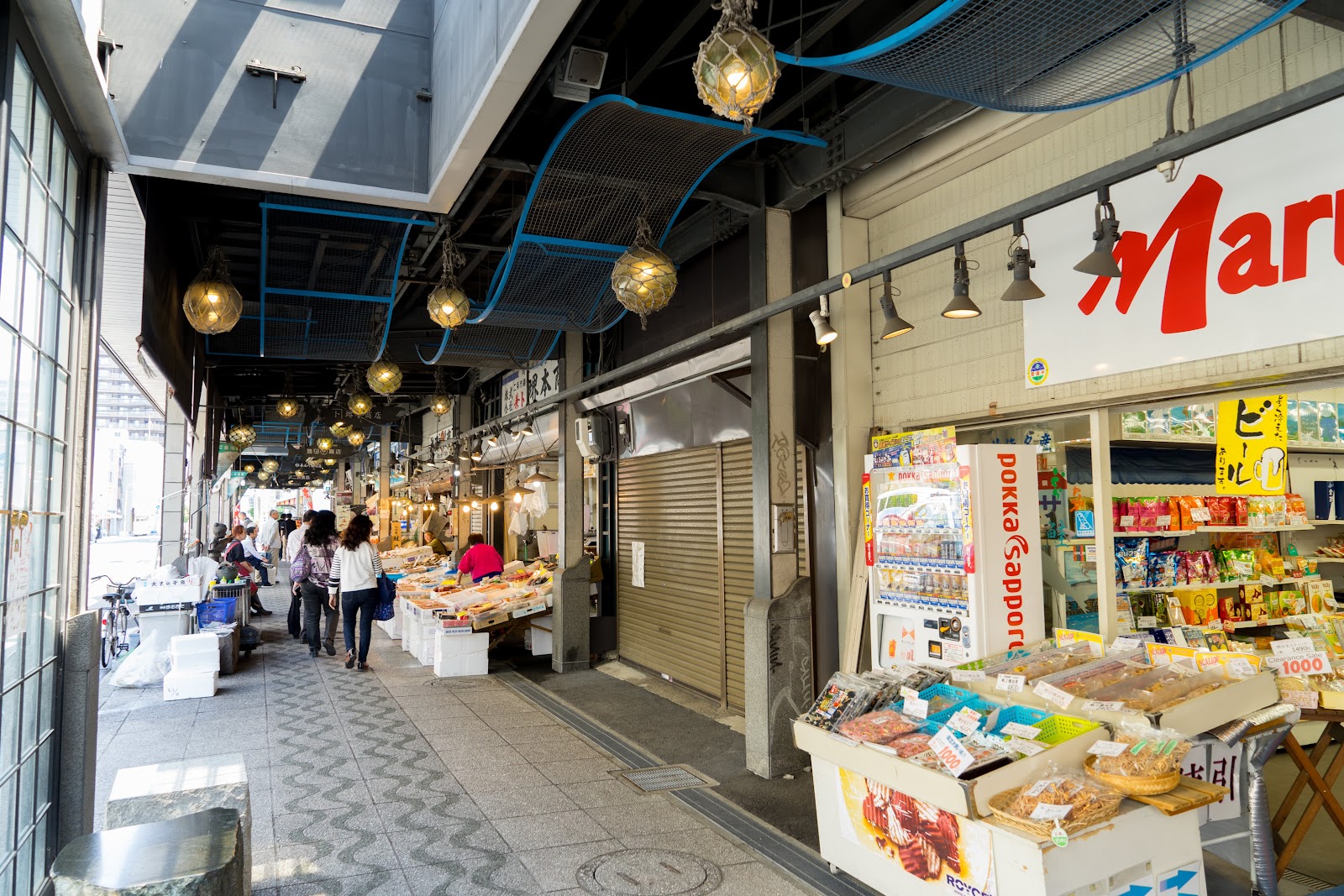
A century-old downtown seafood market where you can eat crab, sea urchin and salmon roe rice bowls straight from the source.
Nijo Market has fed central Sapporo for well over a hundred years, and it remains the most convenient place in the city to taste Hokkaido's legendary seafood without leaving the downtown grid. Occupying a compact block just southeast of Odori Park, the market grew up in the early twentieth century when fishmongers from the coast began selling their catch to the growing city. Today its narrow lanes are lined with stalls piled high with the cold-water bounty for which Hokkaido is famous: hairy crab and snow crab, plump scallops, salmon and salmon roe, sea urchin, squid, and glistening fillets of every kind.
The market is small enough to explore in half an hour, but the real reason to come is to eat. Several stalls and tiny restaurants serve kaisendon, rice bowls crowned with a colourful mosaic of raw seafood chosen from the display cases. A classic order pairs orange sea urchin with ruby salmon roe and slices of crab, a combination that shows off Hokkaido's produce at its best and costs far less here than in a formal sushi restaurant. Vendors will also grill scallops or crab legs on the spot, and in colder months you can warm up with a bowl of miso soup rich with crab.
Beyond the seafood, the market sells Hokkaido melons, corn, potatoes and dairy, along with pickles, dried goods and souvenirs. Vendors are used to visitors and many display prices and simple English, though a friendly haggle over a whole crab is part of the fun. Bringing cash is wise, as some smaller stalls do not take cards. The atmosphere is brisk and cheerful, especially in the morning when restaurant buyers and locals shop for the day.
The experience is easy and casual, and the ground-level lanes are broadly accessible, though they can be tight and slippery near the fish counters. Most travellers pair a visit with the nearby Clock Tower, Odori Park or the shopping arcades, making Nijo a natural stop on a downtown walking route. Attached to the market is Noren Yokocho, a small alley of izakaya-style eateries that come alive in the evening, so the block serves as both a morning food destination and a nighttime one.
A notable point is that Nijo's location sets it apart from Sapporo's larger wholesale market on the city's edge. Where the outer market caters to bulk buyers and early-rising food tourists, Nijo is squarely a downtown market, prized for being walkable from the main hotels and sights. That convenience has made it a little touristy in places, but the quality of the seafood remains genuinely high, and locals still shop here.
The best time to visit is the morning, when the counters open and the catch is freshest, though the market stays busy through the afternoon. Aim for Odori subway station and walk about seven minutes southeast. Whether you sit down for a full seafood bowl or simply graze on a grilled scallop as you wander, Nijo Market is the tastiest and most immediate introduction to why food-lovers travel to Hokkaido.
A local's tip
For breakfast, order a kaisendon at one of the market's small stand-up counters and ask for the day's uni or ikura, which is far cheaper here than in a sit-down restaurant.
Best time to visit
Morning, when the seafood is freshest and the donburi counters open
Getting there
About seven minutes on foot southeast from Odori subway station; also walkable from Bus Center-mae station.
Good to know
- Restrooms
- Food stalls
- Cash preferred
Plan the whole trip offline
Nijo Market is one of many places in the Real Japan app — with turn-by-turn directions, nearby spots and full offline maps you can use with no signal.