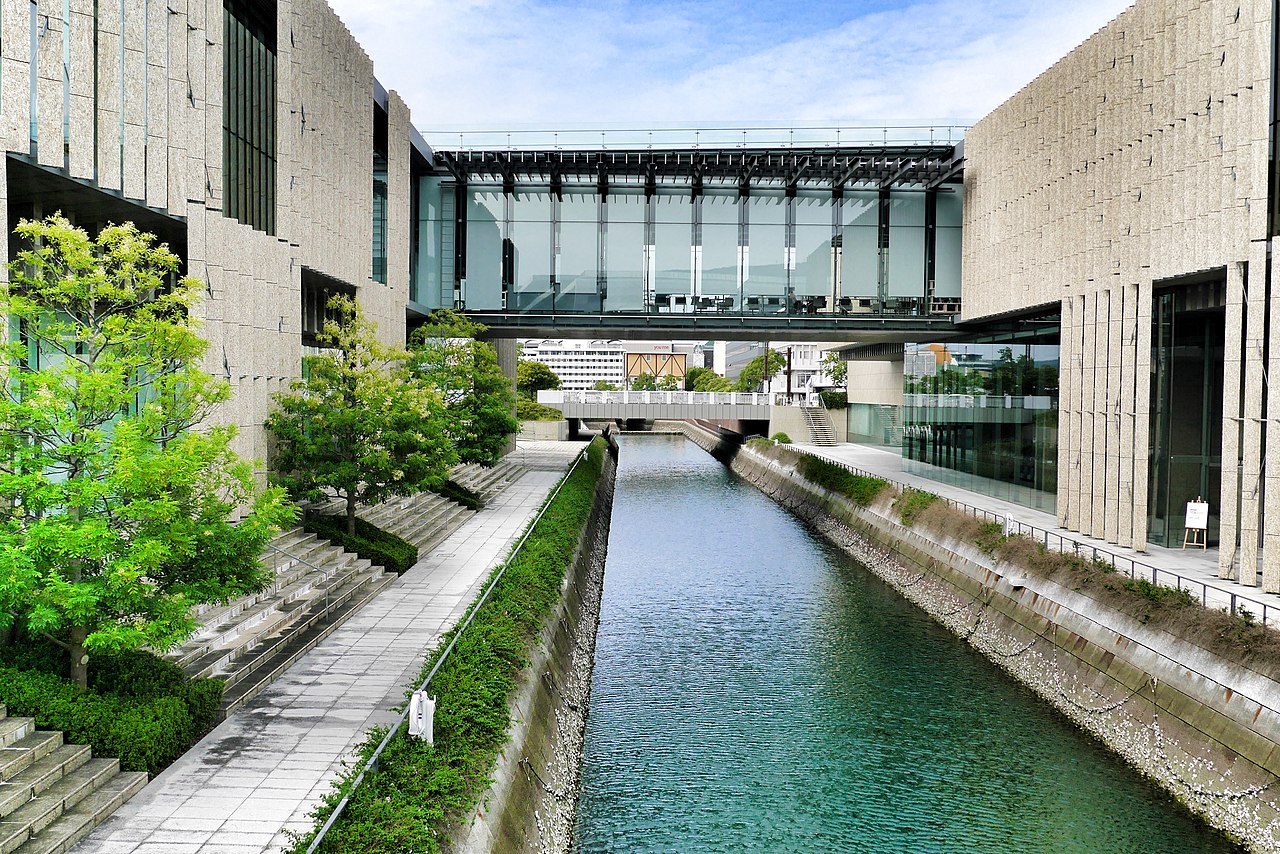
Kengo Kuma's waterfront art museum spanning a canal—Spanish and modern Japanese art in a striking glass-and-timber building.
The Nagasaki Prefectural Art Museum is one of the city's finest pieces of modern architecture, a low, elegant building of glass, timber and stone that straddles a canal on the reclaimed waterfront beside the old Dejima trading post. Designed by the celebrated architect Kengo Kuma—known worldwide for his sensitive, timber-lattice modernism—and opened in 2005, it replaced two older prefectural museums and gathers their collections into a single, light-filled space that is as much a pleasure to inhabit as it is to browse.
Kuma's design responds directly to the site and to Nagasaki's history as a port. The museum is built in two wings linked by a glass-walled bridge-gallery spanning a canal, so that water runs literally through the building; broad windows and a screen of vertical louvres draw in daylight and harbour views, and a planted rooftop garden opens to the public with sweeping vistas over the port and the surrounding hills. The architecture consciously evokes the meeting of Japan and the wider world that has always defined Nagasaki, and the building has become a landmark of the redeveloped Dejima waterfront in its own right.
The collection has two distinctive strengths. The first is a notable holding of Spanish art—one of the most significant in Japan—built around works donated by a Nagasaki-connected diplomat and collector, and including paintings, prints and drawings that reflect Spain's own long maritime and Catholic history, a fitting resonance in a city shaped by Iberian missionaries and traders. The second strength is art connected to Nagasaki and its region: works by local and Japanese artists, and pieces that document the city's unique cross-cultural heritage. Alongside the permanent collection, the museum runs an ambitious programme of special exhibitions, which range from Japanese and Asian art to touring international shows.
Even for visitors who are not devoted gallery-goers, the museum is worth seeking out for the building and its public spaces. The rooftop garden and the canal-bridge cafe are open to all, free of the gallery admission, and make a serene spot to pause with a coffee and watch the light change over the water—especially fine toward sunset. The clean modern galleries are a restful counterpoint to the emotional weight of Nagasaki's atomic-bomb sites, and the whole complex is designed to be lingered in rather than rushed.
The museum's location makes it easy to fold into a waterfront afternoon. It sits directly beside the reconstructed Dejima island—the fan-shaped Dutch trading post that was Japan's sole window on Europe for two centuries—and next to Dejima Wharf, a strip of harbourside restaurants and bars. A natural itinerary combines the historic Dejima site, lunch or coffee at the wharf, and an hour in the art museum, tying together the old and the new faces of the port.
Getting there is simple: the Dejima and Meditchi tram stops on Nagasaki's charming streetcar network are a few minutes' walk away, and the flat waterfront setting is fully accessible. Open late into the evening and closed only on the second and fourth Mondays, the Prefectural Art Museum is both a serious cultural institution and one of the most agreeable pieces of contemporary architecture in southern Japan.
A local's tip
Go up to the free rooftop garden for harbour views, and have coffee on the canal-bridge cafe—both are open even if you don't buy a gallery ticket.
Best time to visit
Any time; the rooftop and cafe are lovely at sunset
Getting there
A short walk from the Dejima or Meditchi tram stops, on the waterfront canal beside the Dejima Wharf. The building straddles a canal, linked by a glass bridge.
Good to know
- Cafe
- Wi-Fi
- Restrooms
Plan the whole trip offline
Nagasaki Prefectural Art Museum is one of many places in the Real Japan app — with turn-by-turn directions, nearby spots and full offline maps you can use with no signal.