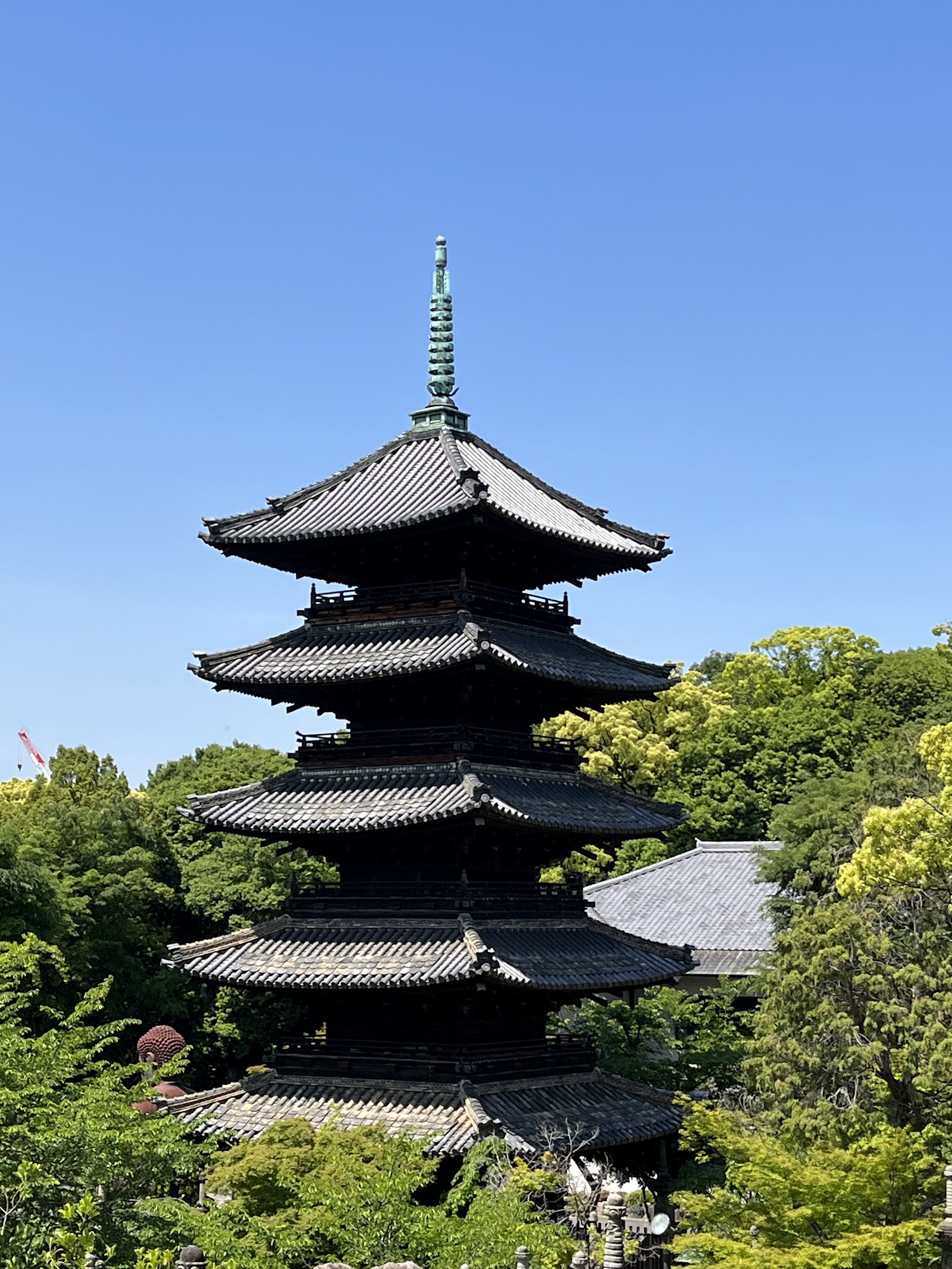
A serene hilltop Shingon temple crowned by a graceful wooden five-storey pagoda, glorious under autumn maples.
Koshoji, often known by its location as Yagoto Koshoji, is one of the most atmospheric temples in Nagoya and a favourite retreat for city dwellers seeking a few minutes of calm. Belonging to the Shingon school of esoteric Buddhism, it was founded in 1688 by the priest Tenzui on a wooded rise in the eastern part of the city, and it has kept much of its serene, forested character ever since.
The temple's signature feature is its five-storey wooden pagoda, completed in 1808 and one of only a handful of authentic tall pagodas in the entire Chubu region. Standing roughly thirty metres high and designated an Important Cultural Property, it rises above the surrounding maples with elegant, tapering eaves. Unlike many famous pagodas that can only be admired from a distance, this one can be reached along the temple paths, allowing visitors to stand almost beneath it and appreciate the joinery of its bracketing.
Koshoji spreads across a hillside of cedar and maple, connected by stone stairways, moss-edged paths and a series of halls and gates. The main hall enshrines a Dainichi Nyorai image, and scattered around the grounds are smaller shrines, a bell tower, stone lanterns and statues worn smooth by centuries of weather. The layered arrangement up the slope means that new views open at every turn, and the dense greenery muffles the sound of the city entirely.
Historically the temple was patronised by the Owari branch of the Tokugawa clan, the lords of Nagoya Castle, and it grew into an important centre of learning and worship for the domain. That heritage lends the grounds a dignity beyond their modest size, and the surviving Edo-period structures give a genuine sense of continuity with the castle town's founding era.
The visiting experience is at its most magical in autumn. From mid to late November the maples surrounding the pagoda turn brilliant scarlet and gold, and photographers gather to capture the wooden tower framed by fiery leaves; it is widely considered one of the finest koyo spots in the city. Spring brings cherry and plum blossom, and even in summer the shaded slopes stay cool. On the 5th, 13th and 21st of each month a small market brings vendors and a gentle bustle to the approach.
Because it draws far fewer visitors than the big shrines, Koshoji rewards a slow, meditative wander. Climb the stone steps, pause at the pagoda, listen for birdsong in the cedars, and you will understand why locals treasure it. The hillside layout does involve stairs, so it is less suited to wheelchairs than the flatter city temples, but sturdy footwear is all most visitors need.
Getting there could hardly be easier. Yagoto Station, served by both the Meijo and Tsurumai subway lines, is only a few minutes' walk from the temple gate, and the surrounding Yagoto district near Nanzan University offers cafes and restaurants for afterwards. For travellers who want a quiet, authentically old corner of Nagoya away from the crowds, Koshoji and its wooden pagoda are a small revelation.
A local's tip
The wooden five-storey pagoda is one of very few in Japan you can approach closely on foot; visit in mid-to-late November when the maples around it blaze red, or during the monthly market on the 5th, 13th and 21st.
Best time to visit
Autumn for the maple colours
Getting there
Take the Meijo or Tsurumai subway line to Yagoto Station; the temple's outer gate is a four-minute walk from exit 3, next to the Nanzan University area.
Good to know
- Restrooms
Plan the whole trip offline
Koshoji Temple is one of many places in the Real Japan app — with turn-by-turn directions, nearby spots and full offline maps you can use with no signal.