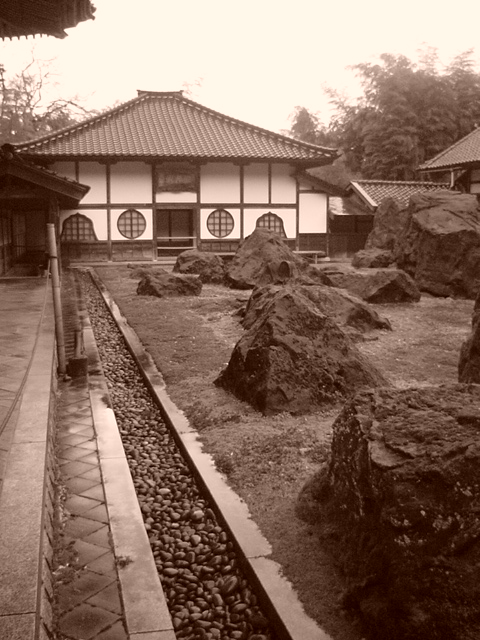
A 1300-founded Rinzai Zen head temple in a forested valley below Mt. Futagami near Takaoka.
Kokutai-ji, the 'Temple of National Peace', is a Rinzai Zen temple set in a quiet, forested valley at the foot of Mt. Futagami on the edge of Takaoka. Founded in 1300 by the monk Jiun Myoi, it holds a distinguished place in Japanese Zen as the head temple of one of the fourteen autonomous branches of the Rinzai school, and centuries of history give its wooded precinct a deep, contemplative atmosphere that rewards visitors willing to seek it out.\n\nThe temple's origins reach back to the late Kamakura period, when Jiun Myoi established a hermitage here that grew into a significant monastery. In 1327 the Emperor Go-Daigo granted it the name Kokutai-ji and honoured its founder with the title Seisen Zenji, marking imperial recognition of the temple's standing. Over the following centuries Kokutai-ji weathered the turbulence of Japan's warring-states era, including the disruptions of the campaigns fought across the Hokuriku region, and was rebuilt and sustained through the patronage of later powers, including the Maeda lords who ruled the Kaga domain that encompassed this area.\n\nKokutai-ji also carries an unusual cultural association: it was historically a temple of the Fuke sect, the order connected with the komuso, the wandering Zen mendicants who played the shakuhachi bamboo flute while begging, their faces hidden beneath distinctive basket-like hats. This link to shakuhachi tradition is still commemorated, and the temple is known among practitioners of the instrument, lending it a resonance beyond its role as a Zen monastery.\n\nArchitecturally and atmospherically, the appeal of Kokutai-ji lies in its setting and its restraint. The temple buildings, including its zendo (meditation hall), sit among tall trees at the base of Mt. Futagami, reached by an approach that feels removed from the modern town. There is little of the crowd or commercialism found at Japan's most famous temples; instead the visitor finds moss, timber, the sound of wind in the trees, and the ordered calm of a place still used for Zen training. Autumn, when the surrounding foliage turns, is an especially beautiful time to visit, though the grounds have a subdued charm in every season.\n\nFor travellers exploring Takaoka, a city better known for its Great Buddha and its history of bronze casting, Kokutai-ji offers a complementary experience: a step into the living tradition of Zen in a natural, unhurried setting. It pairs well with a wider exploration of the Futagami area and the Manyo-associated landscapes around Takaoka.\n\nPractical details are simple. The temple grounds are generally open during daylight hours, and the wooded precinct is free to walk, though visitors should behave respectfully, as this is an active place of religious training rather than a tourist attraction. Access is easiest by car or taxi from Takaoka Station, as the temple lies a little outside the city centre at the mountain's foot; there is parking on site. Comfortable shoes are useful for the approach and grounds, and a quiet, early visit best captures the meditative spirit that has defined Kokutai-ji for more than seven centuries.
A local's tip
Come on a quiet weekday morning to feel the working-monastery atmosphere. The temple hosts a major memorial for the wandering komuso flute monks with whom it is historically linked.
Best time to visit
Autumn for foliage; any season for zen tranquillity
Getting there
From Takaoka Station take a bus or taxi toward the Futagami area at the foot of Mt. Futagami; the temple sits in wooded grounds about 15-20 minutes by car from the station.
Good to know
- Parking
- Restrooms
Plan the whole trip offline
Kokutai-ji Temple is one of many places in the Real Japan app — with turn-by-turn directions, nearby spots and full offline maps you can use with no signal.