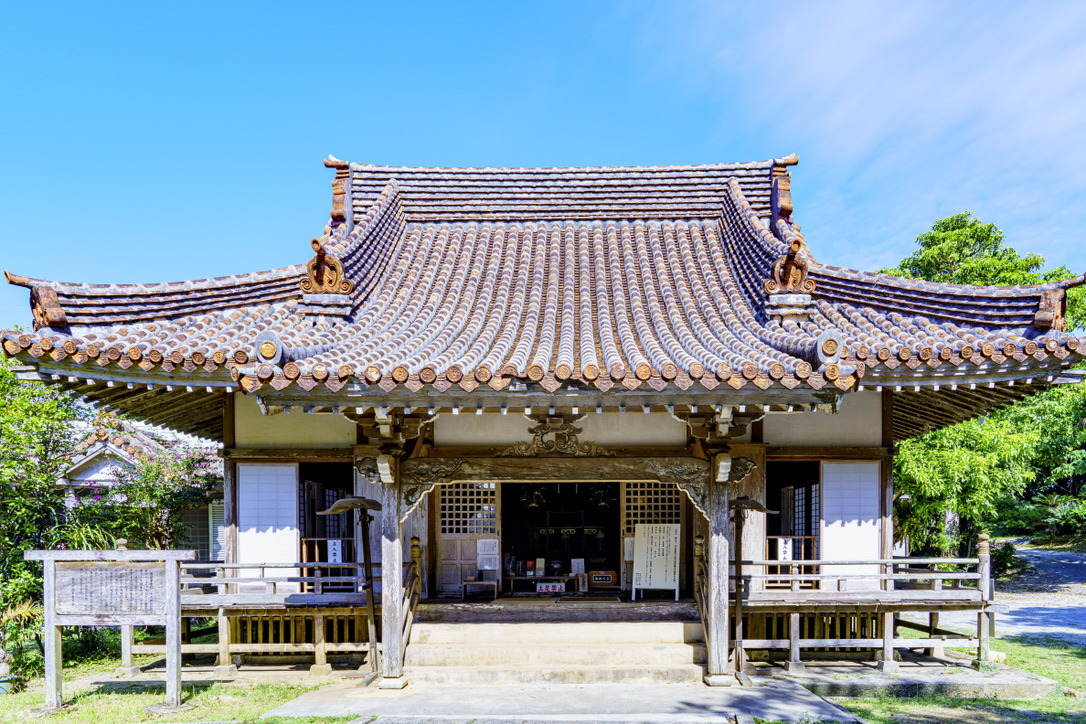
A 16th-century cave temple in Kin town where a sacred limestone cavern doubles as a cellar for aging awamori liquor.
Kin Kannon-ji, in the town of Kin in northern-central Okinawa, is a Buddhist temple whose history reaches back to the 16th century and which is tied to the Ryukyu Eight Shrines through the Kin-gu enshrined on its grounds. Uniquely among the Eight, Kin-gu has no conventional shrine building; its sacred space is a limestone cave beneath the temple, making it the only one of the official Ryukyu shrines defined entirely by a natural cavern rather than a hall.
The temple's founding story is vivid. In 1552 a Buddhist priest named Nisshu, traveling from China back toward mainland Japan, was washed ashore near Kin during a typhoon. Sheltered and cared for by the villagers, he repaid their kindness with prayer, and local tradition credits him with ridding the nearby cave of the large, venomous habu snakes that had preyed on the villagers' animals. A temple grew from this episode, and the cave, now known as Kin Kannon-do or the Nisshu cave, became a place of worship bound up with the priest's legend.
What makes the site unforgettable is what the cave does today. The natural limestone cavern, cool and humid year-round, serves a double life: it remains a sacred place of Buddhist worship and it functions as a cellar where Kin's celebrated awamori, the island's distilled rice spirit, is aged in the constant dark. Rows of maturing bottles of the local Tatsu, or Dragon, brand rest in the same passages that hold the shrine, a distinctly Okinawan marriage of the sacred and the everyday that exists nowhere else on the island.
The visiting experience combines temple, cave, and craft. Above ground stands the historic Kannon-ji with its worship hall and grounds; below, visitors can descend into the cool cave to see both the sacred inner space and the aging awamori. The temperature drop on entering the cavern is a welcome relief from the subtropical heat, and the sight of liquor maturing beside an altar is a memorable one. Plan on around forty-five minutes to take in both levels.
Highlights include the Nisshu cave with its snake-slaying legend, the awamori aging in the sacred dark, and the venerable temple hall above. The grounds and cave access are relatively easy, though the cave floor can be uneven, so wear stable shoes; the site is free to enter, with restrooms and free parking. Because it lies well north of Naha, this temple rewards those already exploring central or northern Okinawa by car or on a longer day trip.
Getting there takes commitment, as Kin lies far beyond the Yui Monorail, which serves only Naha. The practical options are a highway bus north from Naha toward Kin, alighting at the Kin stop for a short walk to the temple, or a rental car, which reaches the town in roughly 60 to 75 minutes from central Naha. Okinawa has no JR line and no Shinkansen, so a JR Pass is of no use; IC cards can be used on local buses. Kin Kannon-ji pairs naturally with a driving itinerary through central Okinawa, and its liquor-aging sacred cave makes it one of the most singular temple visits in the whole prefecture.
A local's tip
Descend into the Kin Kannon-do cave beneath the temple, where local Tatsu (Dragon) awamori liquor is aged in the cool dark alongside the sacred hall.
Best time to visit
Daytime, when the cave is open for visits
Getting there
In Kin town, northern-central Okinawa, with no monorail. From Naha take a highway bus or drive about 60-75 minutes north; alight at the Kin stop and walk about 5 minutes. Free parking is available. No JR exists on Okinawa.
Good to know
- Parking
- Restrooms
Plan the whole trip offline
Kin Kannon-ji Temple (Kin-gu) is one of many places in the Real Japan app — with turn-by-turn directions, nearby spots and full offline maps you can use with no signal.