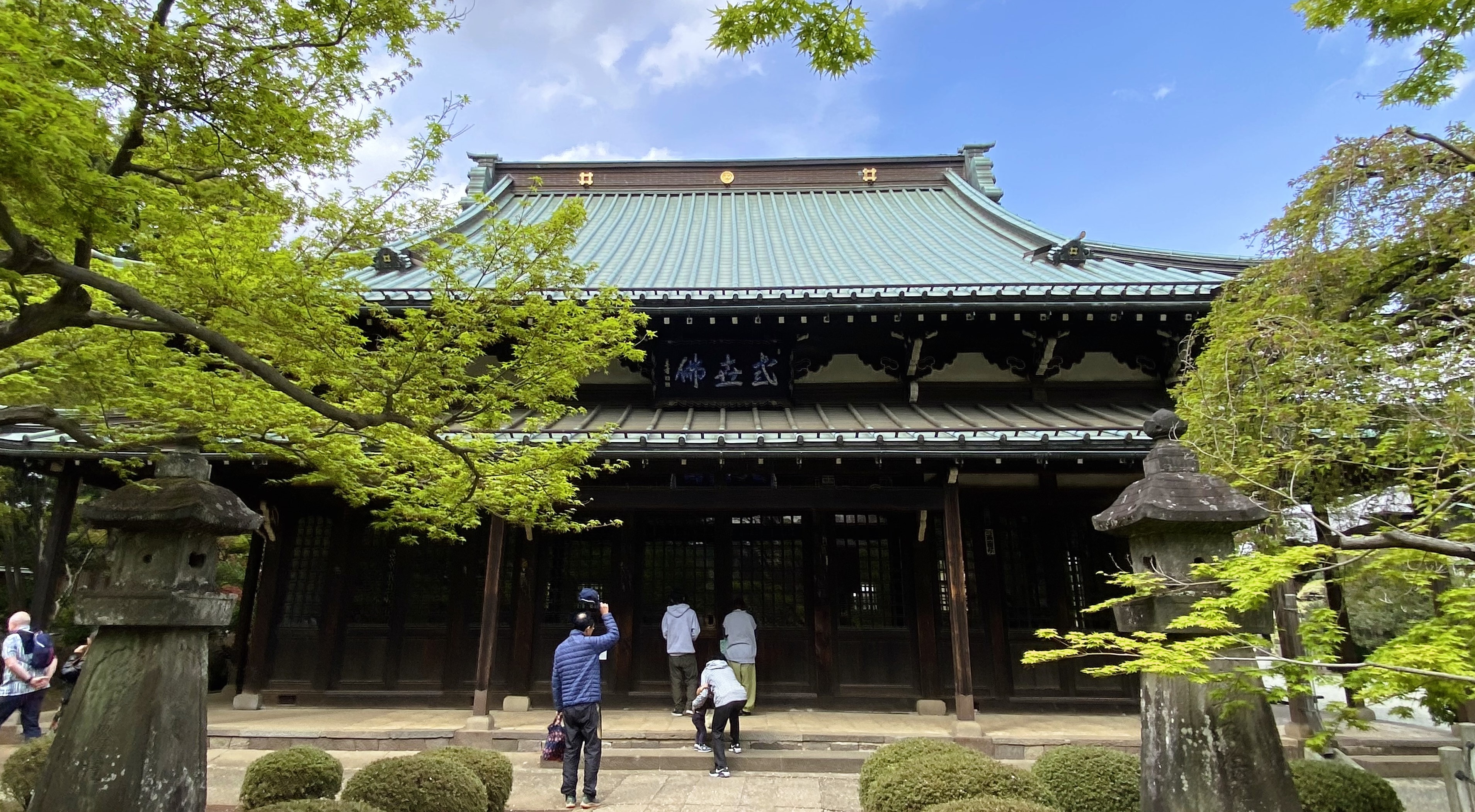
The tranquil 'lucky cat' temple in Setagaya where hundreds of white maneki-neko sit stacked in prayer.
Gōtoku-ji is the temple that, by local tradition, gave the world the maneki-neko — the beckoning cat whose raised paw waves fortune into shops and homes across Japan and far beyond. A Sōtō Zen temple in the leafy Setagaya ward, it draws a steady stream of visitors who come to see hundreds, sometimes thousands, of small white cat figurines arrayed on tiered shelves beside its elegant three-story pagoda.
The legend explains everything. In the early Edo period the temple was a poor, run-down monastery. Ii Naotaka, lord of the Hikone Domain, was passing on horseback during a storm when he saw the temple's cat raising its paw as if beckoning him inside. He followed it under the gate just as a lightning bolt struck the spot where he had been standing. Grateful for his life, Naotaka made the humble temple the family temple (bodaiji) of the powerful Ii clan, endowing it richly. When the fortune-bringing cat later died it was enshrined, and worshippers began leaving maneki-neko in thanks — a practice that continues today, which is why the shelves are perpetually restocked with new white cats left by hopeful visitors.
Beyond the famous felines, Gōtoku-ji is a genuinely beautiful and historic complex. The main butsuden (Buddha hall) dates to 1677, and the graceful three-story pagoda, completed in 2006, carries carved zodiac animals — and, if you look closely, hidden cats — around its base. The temple is also the resting place of the Ii lords, including Ii Naosuke, the powerful chief minister assassinated at Sakuradamon in 1860; his grave and those of his clan lie in a quiet cemetery of towering cedars behind the halls.
The visiting experience is meditative rather than touristy. Unlike the commercial cat-cafés of Tokyo, Gōtoku-ji charges nothing to enter, sells no tickets, and asks only that visitors treat it as the working Zen temple it is. You can buy a maneki-neko (in several sizes) from the temple office and place it yourself, an oddly satisfying act. The grounds are spacious, gravelled and largely flat, easy for most visitors, with maple trees that turn fiery in November and a general hush broken only by birdsong.
A notable point of trivia: Gōtoku-ji is widely believed to be one of the inspirations for Tokyo's Setagaya cat imagery and is sometimes linked in popular lore to the origins of Hello Kitty's cultural cousins, though the temple itself keeps to its Zen roots.
Getting there takes you off the tourist trail into residential west Tokyo. From Shinjuku, ride the Odakyu Line to Gotokuji Station (about 15 minutes) and walk ten minutes, or take the charming little Setagaya Line tram to Miyanosaka. The surrounding streets, dotted with cat motifs and small cafés, make the short walk a pleasure in itself.
A local's tip
Buy a small maneki-neko from the temple office and add it to the shelves yourself — then photograph the hundreds of white cats stacked beside the three-story pagoda, best in soft morning light.
Best time to visit
Clear mornings; autumn for foliage
Getting there
Take the Odakyu Line to Gotokuji Station or the Tokyu Setagaya Line tram to Miyanosaka, then walk about 10 minutes through a quiet residential neighbourhood.
Good to know
- Restrooms
- Temple office
Plan the whole trip offline
Gōtoku-ji is one of many places in the Real Japan app — with turn-by-turn directions, nearby spots and full offline maps you can use with no signal.