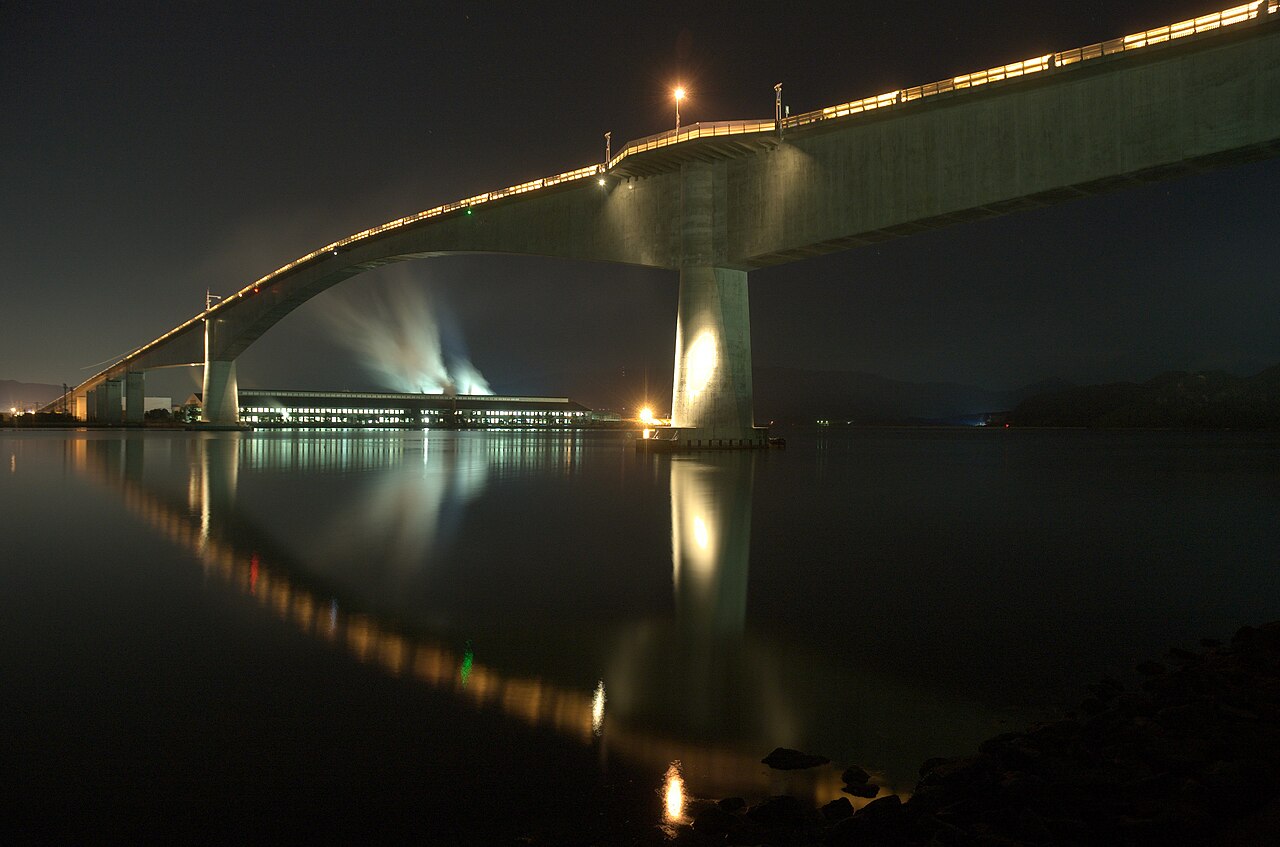
The 'rollercoaster' concrete bridge over Lake Nakaumi that appears impossibly steep from the right angle.
The Eshima Ohashi Bridge is a striking rigid-frame concrete road bridge that leaps across Lake Nakaumi, connecting the Eshima district of Yatsuka in Matsue, Shimane, with the city of Sakaiminato in Tottori. At about 1.7 kilometres long it is the largest bridge of its type in Japan and the third largest in the world, and its purpose is entirely practical: it rises steeply so that ships can pass beneath without an opening span. That functional steepness is exactly what turned it into a viral scenic landmark.
Seen head-on from the Tottori side, the bridge appears to climb almost vertically into the sky, earning it the affectionate nickname 'Betabumi-zaka,' roughly the 'pedal-to-the-metal slope.' In reality the gradient is a manageable 6.1 percent on the Shimane approach and about 5.1 percent on the Tottori side, and the deck reaches around 44 metres above the water at its highest point to give clearance for shipping in the channel below. The dramatic wall-like look is an optical illusion created by telephoto compression, but it is a genuinely photogenic one that has drawn photographers and car enthusiasts from all over Japan since a 2013 television commercial made it a sensation.
The bridge replaced an older drawbridge that frequently halted traffic while it lifted for boats, limiting crossings to lighter vehicles and a few thousand cars a day. Completed in 2004, the new structure freed up movement across the lake and, almost by accident, gave the region an unlikely tourist icon. Today visitors come not to cross it in a hurry but to admire it, photograph it and feel the small thrill of driving up and over its crest.
Experiencing the bridge is simple and free. Many people drive across for the gentle rollercoaster sensation and the wide views of Lake Nakaumi opening out on either side, with the Shimane Peninsula, distant Mount Daisen and the lake's islands all in view from the summit. Photographers, however, get the money shot from ground level: standing back at the Tottori foot of the bridge in Sakaiminato and using a long lens to flatten the perspective into that famous near-vertical wall of road. Late afternoon light rakes across the deck and deepens the effect.
Access depends on which side you approach from. On the Tottori side the bridge is a short taxi ride or a roughly 25-minute walk from central Sakaiminato, which is the terminus of the JR Sakai Line, itself an enjoyable ride decorated with Gegege no Kitaro manga characters. From the Matsue side, buses running toward Sakaiminato cross the lake's islands and pass close to the Eshima approach, and drivers can fold the bridge into a loop that also takes in Daikonshima and its peony gardens.
There is no admission and no set schedule, so the bridge can be visited at any time of day and in any season. Sunny days give the crispest photographs, while sunset adds warm colour to the concrete and the surrounding water. Bring a zoom lens, watch for traffic if you are shooting from the roadside, and allow time to enjoy the lake views that the crossing itself reveals.
A local's tip
Stand well back at the Tottori (Sakaiminato) base and use a long zoom lens; compression makes the gentle 6 percent slope look like a near-vertical wall, exactly the illusion that made the bridge internet-famous.
Best time to visit
Late afternoon for the steepest-looking light
Getting there
The bridge spans Lake Nakaumi between Yatsuka in Matsue and Sakaiminato in Tottori. From Matsue Station take a bus toward Sakaiminato via the lake islands; from the Tottori side it is a short taxi or walk from central Sakaiminato. The famous 'wall' view is shot with a telephoto lens from the Tottori foot of the bridge.
Good to know
- Parking
- Restrooms
Plan the whole trip offline
Eshima Ohashi Bridge is one of many places in the Real Japan app — with turn-by-turn directions, nearby spots and full offline maps you can use with no signal.