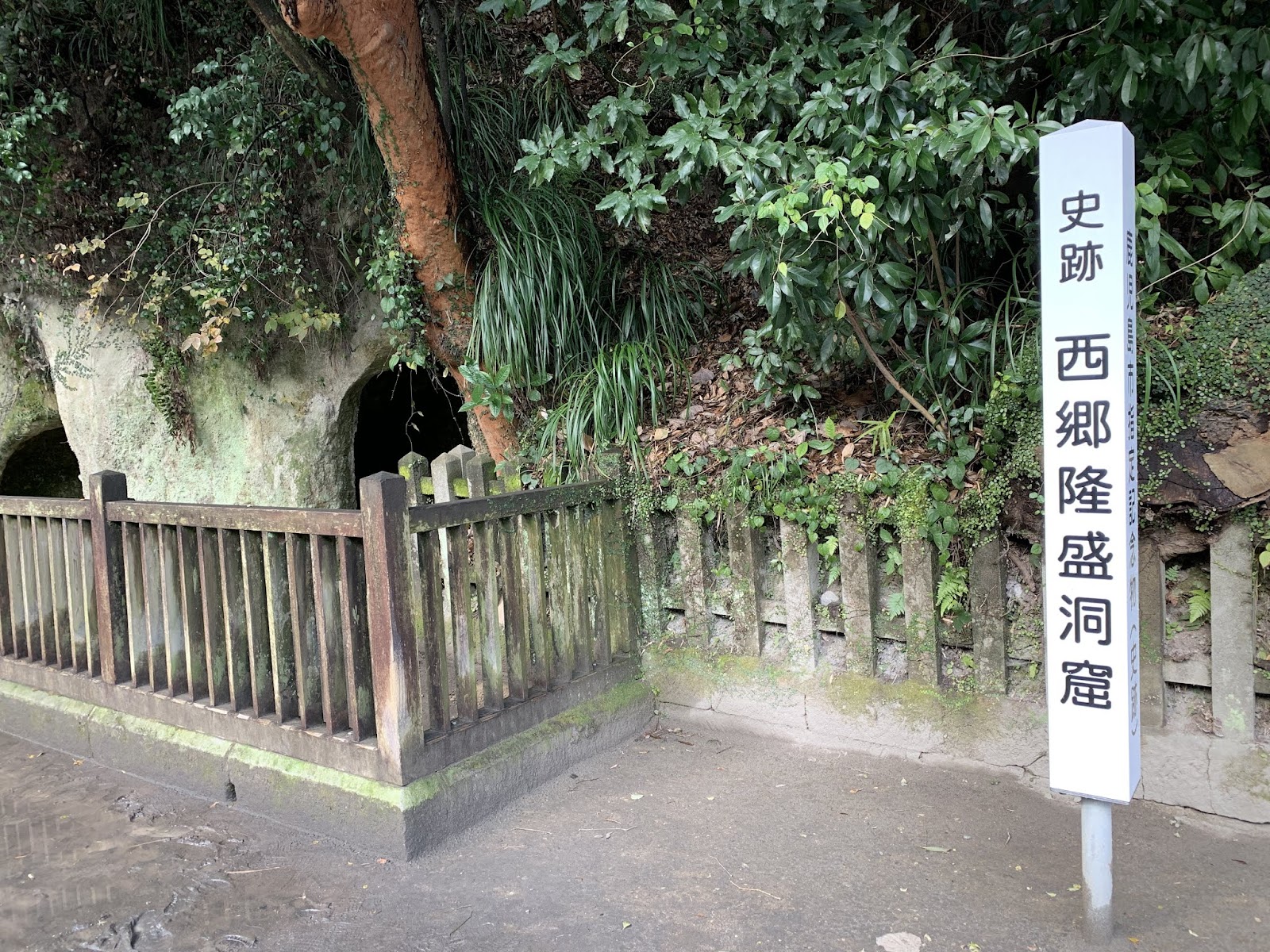
The cave where the 'last samurai' Saigo Takamori spent his final five days before his death.
Tucked into the base of Shiroyama hill, this small, unassuming cave holds one of the most poignant chapters in Japanese history. It was here, in late September 1877, that Saigo Takamori — the towering figure remembered as the "last samurai" — sheltered during the final days of the Satsuma Rebellion. For roughly five days he and his last loyal followers hid in and around this hillside while government forces closed in from every side.
To understand why this modest opening in the rock matters, you have to know Saigo. He was one of the principal architects of the 1868 Meiji Restoration that overthrew the shogunate and restored imperial rule, a leader admired across Japan for his integrity and force of character. But he grew disillusioned with the new government he had helped create, especially its dismantling of the samurai class to which he belonged body and soul. In 1877 he reluctantly led the disaffected samurai of Satsuma in a doomed rebellion against the very modern state he had built.
The uprising was crushed over months of hard fighting. By the end, Saigo's army had been reduced from tens of thousands to a few hundred, driven back to their home city of Kagoshima and finally to Shiroyama itself. From this cave he made his last stand. On the morning of September 24, 1877, Saigo and his remaining men charged down the hill into overwhelming fire. Wounded, Saigo is said to have committed seppuku with the help of a comrade, choosing death with honor over capture. He was 49.
The rebellion's failure marked the definitive end of the samurai era, yet Saigo was not condemned as a traitor. Within little more than a decade he was posthumously pardoned and embraced as a national hero, the embodiment of loyalty, sincerity, and self-sacrifice. His famous statue stands elsewhere in the city, and he inspired countless stories, including loose echoes in Western pop culture.
The cave today is exactly what it was: a plain hollow in the hillside, marked by a simple sign and often visited quietly by Japanese travelers who come to pay respects. There is little to "do" here, and that is the point. Standing before it, you sense the compression of a huge historical drama into one small, still spot. It takes only a few minutes to see, costs nothing, and sits within easy walking distance of the castle ruins and the Nanshu Cemetery where Saigo and his men are buried — visit all three in sequence and the story of Satsuma's tragic finale unfolds in order. The City View sightseeing bus passes nearby, making it an easy addition to a day of exploring Kagoshima's rich history.
A local's tip
Pair this with the bullet-scarred walls at the castle and Nanshu Cemetery to trace Saigo's final days in order.
Best time to visit
Anytime
Getting there
At the foot of Shiroyama hill; walk from the Shiroyama or Shiyakusho-mae area, or take the City View bus and continue a short way on foot.
Good to know
- Restrooms
- Information Board
Plan the whole trip offline
Cave of Saigo Takamori is one of many places in the Real Japan app — with turn-by-turn directions, nearby spots and full offline maps you can use with no signal.